


A Calima – pronounced ‚Kalima‘ – is a type of sandstorm. Fine desert sand is carried by the wind from the Sahara for hundreds of kilometres towards the Canary Islands and Cape Verde. The world-famous desert lies only about 300 kilometres to the east, exactly level with the Canary Islands.
What is a Calima?
During a Calima, a high-pressure system causes temperatures over the Sahara to rise. The fine desert sand is then drawn into the atmosphere by rising air and can thus be carried hundreds of kilometres towards the Canary Islands on the south-easterly flow.
This results in brownish-yellow patches on satellite images. Up close, a Calima often manifests itself in poor visibility and rising temperatures. At the same time, humidity usually drops rapidly. Precipitation is rather rare due to the very dry air. However, thunderstorms may form towards the end of a Calima.
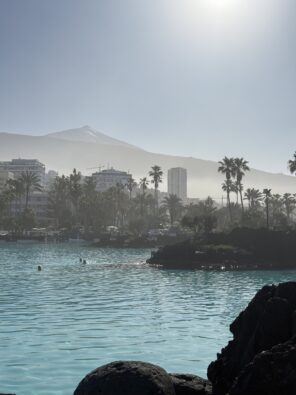
If a Calima occurs with strong winds, it can cause damage to the natural environment. During the winter months, it often occurs with high wind speeds. The sky then becomes hazy at first. In severe weather conditions of this kind, visibility gradually decreases. In extreme cases, it may be as little as a few hundred metres.
In summer, Calima can contribute to forest fires in the Canary Islands. Extreme drought and heat literally parch the natural environment. If forest fires and Calima occur at the same time, this makes fire-fighting efforts considerably more difficult. The wind flares up the flames and the dry conditions provide more fuel.
Is a Canary Islands Calima dangerous?
Calimas can occur suddenly and, in some cases, be very intense. It has been observed on Tenerife that storms can break out suddenly, causing a sudden exchange of air masses. Sudden drops in temperature at night, accompanied by a rapid fall in humidity, are also common.
This weather phenomenon should not be underestimated, particularly by older and unwell people. Researchers, in collaboration with the University of La Laguna (ULL) in Tenerife, have found that the risk of a heart attack rises by up to two per cent during a Calima weather event. People who are sensitive to changes in the weather should avoid leaving the house, at least during the midday hours. It is also recommended that they drink plenty of water.
How does a Calima manifest itself in nature?
Usually, as a result of a Calima, entire streets, cars and other objects left outdoors are completely covered in fine sand. When cleaning sensitive surfaces, such as painted surfaces, only running water should be used. Cloths and other objects that create friction can leave scratch marks due to the fine sand.
Are flights cancelled during a Calima?
In particularly severe cases, air traffic may even have to be suspended. The fine sand can significantly impair visibility. Furthermore, when present in high concentrations, the fine sand can clog aircraft turbines.
Calima warning for the Canary Islands
Due to the geographical conditions mentioned, a Calima usually sweeps in from Africa and first hits the eastern Canary Islands of Lanzarote and Fuerteventura. From there, the weather phenomenon then moves on to the western Canary Islands of Gran Canaria and Tenerife. Sometimes they even reach La Gomera, El Hierro and La Palma. In extreme cases, Calima weather conditions can last for up to several weeks. Calimas sometimes even reach as far as the Cape Verde Islands.
All the latest Calima news
The national weather service, Aemet, issues warnings in good time before such weather conditions are expected over the Canary Islands. You will then find the relevant reports here.



No comments on this article yet.