

More than 350 days of sunshine a year, a spring-like climate and temperatures of up to 35 degrees Celsius: with these idyllic conditions, Tenerife has always attracted tourists from all over Europe. The ‚Island of Eternal Spring‘ owes its mild year-round climate to its location – and its mountains.
The mountains on Tenerife mean that two completely different climates prevail on the island. The guaranteed sunshine in the south contrasts with a significantly milder climate in the north. Anyone travelling round the island will feel, after just a few kilometres, as though they have entered a completely different world.
Tenerife’s climate – two worlds
Anyone planning a holiday on Tenerife should familiarise themselves with the weather conditions beforehand. In the south, around the popular tourist hotspot Costa Adeje, the weather is perfect for a day at the beach all year round. Not even the slightest cloud usually gets in the way of sunbathing. However, the landscape offers little of interest. The intense sunshine is a challenge even for the most resilient plants.
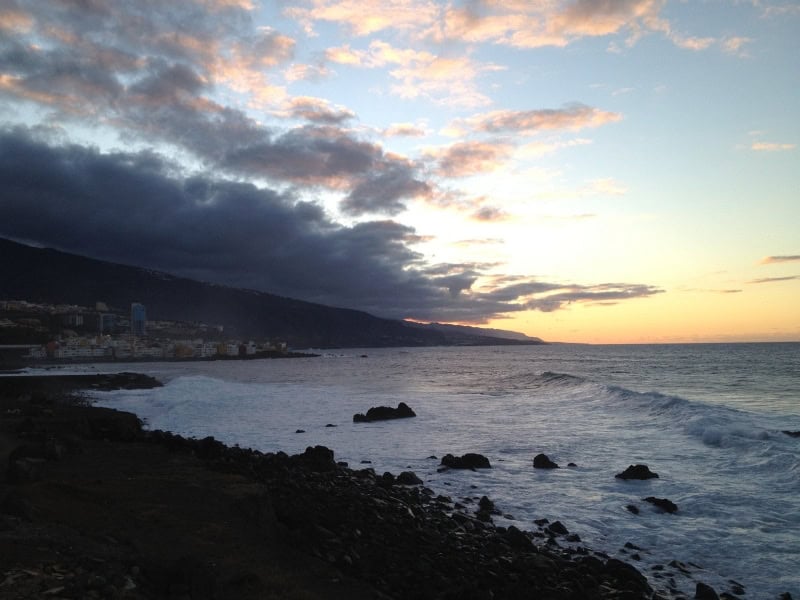
In the north, where Puerto de la Cruz and the lush Orotava Valley are the main tourist centres, the weather is generally only two to three degrees cooler in summer and a maximum of four to five degrees cooler in winter than in the south. Nature and people are protected from direct sunlight by a thin veil of cloud. As a result, there are significantly more rainy days – particularly between November and March. The landscape benefits from this and, thanks to the interplay of sun, clouds and rain, is so rich that even tropical plants thrive here.
Click here for the latest weather forecast for TenerifeClick here
for the latest sea temperature off Tenerife
The promise of numerous sunny days certainly does not mean that Tenerife is immune to heavy rain. However, whilst in Northern Europe the skies usually ‚close in‘ for several days at a time, the weather on Tenerife can change very quickly, and a heavy downpour can be followed by perfect beach weather again after just a few hours.
Canary Islands: Tropical downdrafts and clouds 500 metres thick
As on all 13 of the Canary Islands, tropical downdrafts also occur on Tenerife. The trade winds then give rise to the ‚Azores High‘, which is often mentioned in European weather forecasts. During the day, air saturated with sea water rises up the Teide massif. In summer, a cloud cover around 300 metres thick then forms over the volcanic rocks at an altitude of between 600 and 1,300 metres, creating the famous climate in the north of the island. In winter, this cloud layer can even reach a thickness of up to 500 metres. At this time of year, it settles at an altitude of between 900 and 1,700 metres.
Tenerife: Up to eleven hours of sunshine a day
When the clouds finally come into contact with the laurel trees and pine forests growing there, they condense into a fine drizzle. Thanks to this rainfall from the clouds, nature thrives, particularly in the north of the island.
The combination of rainfall and, at times, even extreme temperatures means that flora and fauna find extremely favourable climatic conditions on Tenerife. Agriculture on the island therefore benefits greatly from these climatic conditions in these regions, despite the otherwise extremely dry summer months.
In December, there are five to seven hours of sunshine a day. This figure almost doubles in June to eight to eleven hours of sunshine. Statistically, the daytime air temperature in January and February ranges from 19 to 20 degrees Celsius in the north and from 21 to 22 degrees in the south. The statistical daily maximum temperature on Tenerife between July and September ranges from 24 to 26 degrees in the north and from 28 to 30 degrees in the south.
A very unusual weather phenomenon in the Canary Islands is the Calima. You can find all the information about this particularly hot sandstorm here. Below you will also find the climate chart for both parts of Tenerife:
Climate table for Tenerife North
| Month | Max. temperature | Average temperature | Min. temperature | Days of rain |
| January | 16 °C | 13 °C | 10 °C | 12 |
| February | 17 °C | 14 °C | 10 °C | 10 |
| March | 18 °C | 15 °C | 11 °C | 11 |
| April | 18 °C | 15 °C | 11 °C | 11 |
| May | 20 °C | 16 °C | 12 °C | 9 |
| June | 22 °C | 18 °C | 14 °C | 7 |
| July | 24 °C | 20 °C | 16 °C | 6 |
| August | 26 °C | 21 °C | 17 °C | 4 |
| September | 25 °C | 20 °C | 16 °C | 7 |
| October | 22 °C | 19 °C | 15 °C | 12 |
| November | 20 °C | 16 °C | 13 °C | 13 |
| December | 17 °C | 14 °C | 12 °C | 15 |
Climate table for Tenerife South
| Month | Max. temperature | Average temperature | Min. temperature | Days of rain |
| January | 22 °C | 19 °C | 15 °C | 5 |
| February | 22 °C | 19 °C | 15 °C | 4 |
| March | 23 °C | 20 °C | 16 °C | 4 |
| April | 23 °C | 20 °C | 16 °C | 4 |
| May | 24 °C | 21 °C | 17 °C | 1 |
| June | 26 °C | 22 °C | 19 °C | 1 |
| July | 28 °C | 24 °C | 20 °C | 0 |
| August | 29 °C | 25 °C | 21 °C | 1 |
| September | 28 °C | 24 °C | 21 °C | 2 |
| October | 27 °C | 23 °C | 20 °C | 5 |
| November | 25 °C | 22 °C | 18 °C | 4 |
| December | 23 °C | 20 °C | 16 °C | 6 |
Further information on the weather in Tenerife can be found here.