

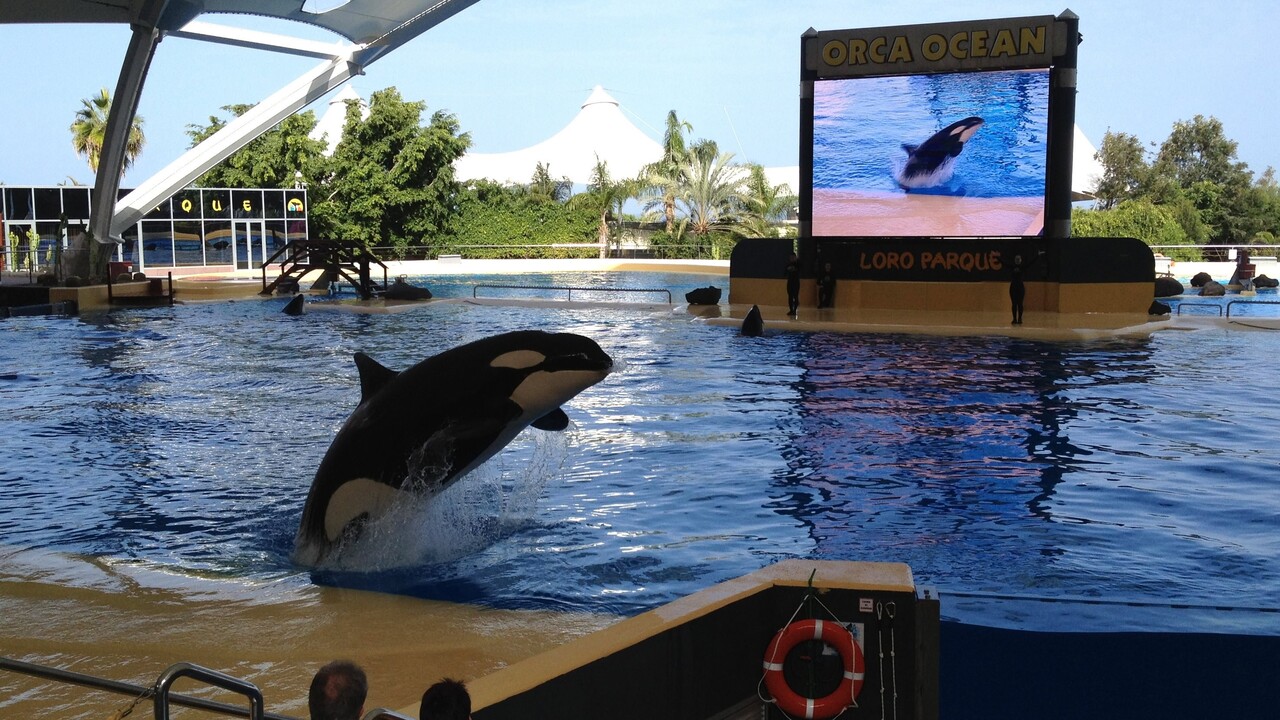
The study does not deserve this name, and its findings can be interpreted in two diametrically opposed ways. It comes as little surprise to see where Loro Parque stands on this issue.
A protected marine area has been established in Ireland for two beluga whales. The two marine mammals were transferred from a zoo in China and are now able to live more freely in Ireland than they did previously in their cramped tank.
According to a scientific article cited by Loro Parque, the whales make very little use of it. For the zoo in Tenerife, which is regularly criticised for keeping orcas, this is reason enough to question the validity of such facilities. To outsiders, this comes across as a poorly thought-out marketing ploy.
Loro Parque and the keeping of orcas
The park’s own statement on the matter claims that this is the only example of partial reintroduction into the wild anywhere in the world. Furthermore, it states that the animals are ill. Consequently, the validity of this claim is open to doubt.
Of course, it is understandable that a zoo which makes money from keeping animals in captivity would seize every opportunity to dispel criticism of such a business model. However, its latest attempt seems rather flimsy.
Advertising for the zoo on Tenerife has changed. Whereas the orcas used to be the main focus, other animals are now increasingly featured on the billboards. Loro Parque is presumably responding to the current climate, which condemns the keeping of whales in cramped pools.
Given the public impact, it is therefore hard to understand why the zoo – which is otherwise very keen to cause as little of a stir as possible regarding the care of its orcas – has now published such a statement.
Trained whales return to tanks – is that really surprising?
The statement in the latest press release states that, although the animals now have much more space than before, they still spend 92.6 per cent of their time in a traditional, covered pool. «Only 3.4 per cent of operating hours were spent in the sanctuary’s bay, which is often touted as a ’natural solution‘ for their wellbeing,» writes Loro Parque.
The zoo’s conclusion is therefore: «These findings call into question the assumption that simply moving whales to a marine environment guarantees a better quality of life.»
Conversely, the validity of this observation may be called into question. This is because, in the report itself, Loro Parque states: «Among the reasons» for the limited time that «Little Grey» and «Little White» spend enjoying their supposed freedom «are health problems such as stomach ulcers and loss of appetite, as well as the need to protect the belugas from adverse weather conditions.»
It should come as little surprise that sick animals behave differently from their healthy counterparts. Nor is it surprising that, as a result, the pool is repeatedly used as a safe haven, accustoming the animals to returning there. Throughout their lives, they have been conditioned to exchange favours for food. It is therefore not surprising that they now tend to find returning to the pools worthwhile.
New orcas for Loro Parque on Tenerife?
To be fair, it should be noted that the Loro Parque report points out that key data is missing and that the authors conclude that the current husbandry model needs to be revised. «The case of Little Grey and Little White shows that natural conditions alone do not guarantee better welfare for whales and dolphins,» it states.
Nevertheless, it must be criticised that, with such a statement, the park is once again attempting to portray the situation of the orcas living in captivity as having no alternative, despite emphasising that the statement is not representative.
Objective readers are likely to find Loro Parque’s statement flimsy. Whether the press release was simply issued in good faith or is intended to smooth the way in advance for the arrival of potential new orcas in Tenerife remains to be seen. For it is possible that two new orcas will soon arrive in the Canary Islands to replace the four that have recently died:
«Loro Parque questions the point of releasing its orcas into the wild»
No comments on this article yet.