

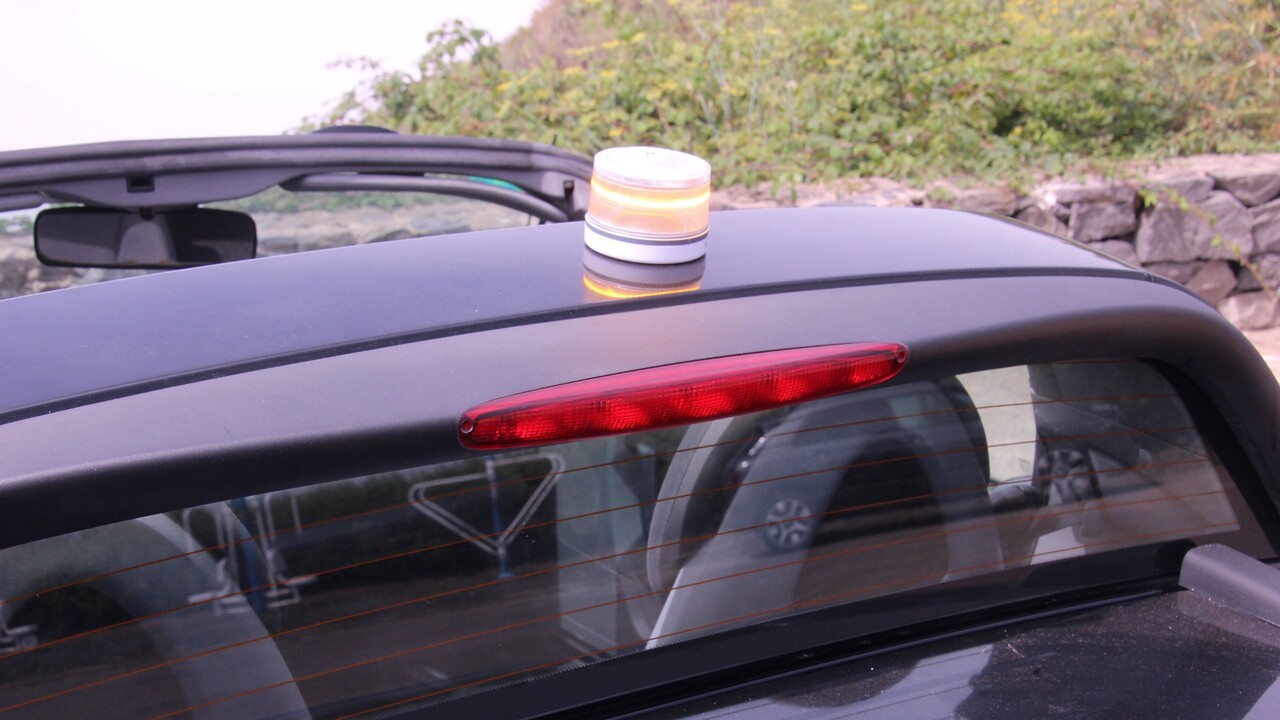
At the start of 2026, new warning lights will be required throughout Spain – and therefore also in the Canary Islands. The devices are on sale everywhere – be it in discount stores, Spanish post offices or car dealerships.
From the start of the new year, the V16 warning light will be compulsory. It must be certified and must be carried in the vehicle at all times and used in the event of a breakdown. Warning triangles are no longer permitted, or are only permitted on minor roads or within town centres.
However, the warning light is also permitted there for safety purposes. That said, this new development isn’t nearly as bad as some might initially think. Here’s why:
This is the new V16 warning light in the Canary Islands
The warning light emits a yellow flashing light with 360-degree coverage. At the same time, it transmits a radio signal which is sent to the traffic control centre and also alerts other motorists via their sat-nav systems to the presence of a broken-down vehicle.
Important to note: This radio signal is merely a warning. It does not automatically alert the emergency services. This would, in any case, be technically impossible, as the signal does not specify whether the vehicle simply requires a breakdown recovery vehicle due to a technical fault, whether an accident has occurred and the police are required, or, in the worst-case scenario, whether there are injuries and an ambulance is needed.
Some suppliers offer warning lights for very little money. They often come with additional features, such as a torch. Whilst this sounds handy, there’s a catch: these devices are not permitted. By law, a certified V16 warning light must not have any additional features.
Despite V16 warning lights in the Canary Islands – safety comes first!
Our author, who works as a volunteer paramedic, has one more important piece of advice: some publications praise the „V 16“ warning light, partly because it can be activated without even leaving the car. That may be true in theory, but anyone who stops on the hard shoulder of the motorway should definitely get out of the car.
The rule of thumb is: switch on your hazard warning lights and warning lights, put on your high-visibility vest and immediately move to safety behind the crash barrier. Anyone who stays in their car risks being involved in a serious accident.
By the way: if you ever need an ambulance and don’t speak Spanish, you can dial 112 and say „Alemán“ or „Deutsch“. You’ll be put through to a German-speaking member of staff at the emergency services control centre in no time at all.






No comments on this article yet.