

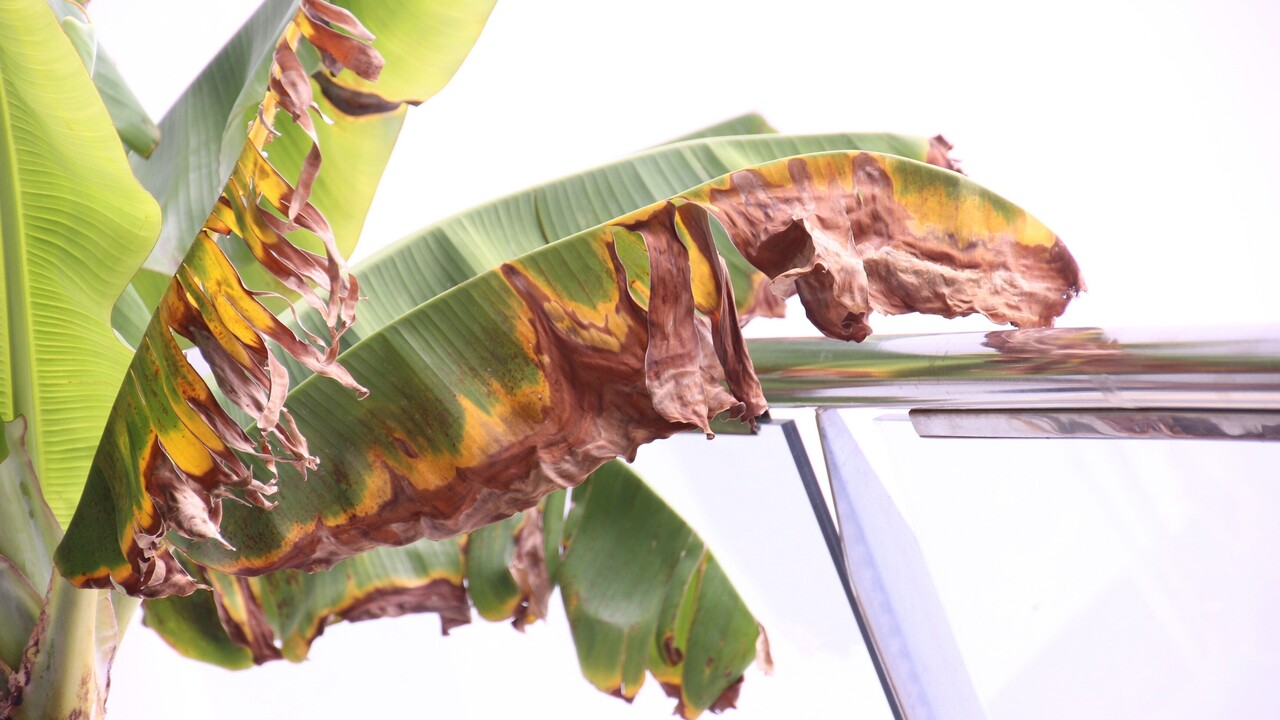
Neither a fungal infection nor a lack of nutrients is to blame for the poor general condition of many plants in the Canary Islands. The reason lies elsewhere entirely: it is the water.
For a long time, through a lack of knowledge, I used tap water in conjunction with an upstream activated carbon filter. Whilst the filter removes the smell of chlorine, too much chlorine remains in the water.
Plants react differently to chlorinated water. The banana plants are developing increasingly visible areas of necrosis. My little lemon tree is producing new leaves, but loses them again almost straight away. The chillies and various kitchen herbs show no symptoms, but are growing at a snail’s pace, even in this otherwise ideal climate.
How to water plants properly in the Canary Islands
So what can you do? There are several options: boiling the water and letting it bubble for several minutes is a solution for extremely sensitive plants such as orchids. For patio plants with considerably higher water requirements, this is of course completely impractical.
Ascorbic acid, better known as vitamin C, binds chlorine. It is sometimes used in swimming pools with a volume of several tens of thousands of litres to regulate the chlorine level. However, when used in watering plants, the vitamin C would need to be dosed in the microgram range. It therefore does not work in this context either.
Rainwater would, of course, be ideal, but hardly anyone has their own cistern.
Why do many plants in the Canary Islands have brown patches?
The solution: chlorine evaporates over time. So the only practical option is to meet your daily watering needs by filling existing five- or eight-litre drinking water containers with tap water. Multiplying this by three ensures you have a supply of sufficiently settled water for the corresponding number of days. You should always use the oldest water first.
Of course, the containers should not be filled to the brim, but only up to the point where they start to taper. This ensures the largest possible water surface area, allowing the chlorine to evaporate. Needless to say, they should not be covered with a lid.
By the way: UV light also breaks down chlorine – but only UV-C. As soon as glazed patio railings, such as those shown in the picture above, are used, this method no longer works. This is because window glass completely filters out UV-C. The simplest solution, therefore, is to keep a large supply of pre-filled watering cans with as wide an opening as possible.




«How to water pot and tub plants correctly in the Canary Islands»
No comments on this article yet.