

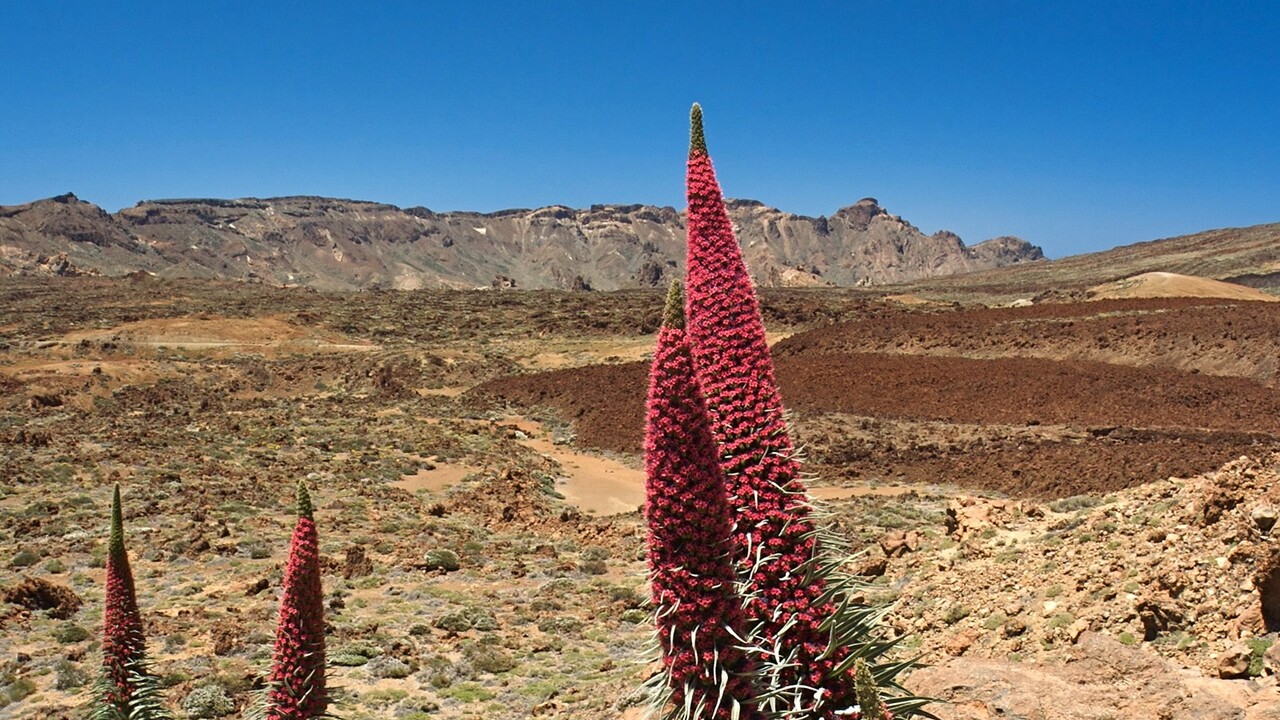
May traditionally offers a special natural spectacle in the Canary Islands: In the higher elevations of Tenerife, La Palma and in a few other places across the islands, the viper’s-bite, known as ‚tajinaste‘ in the Canary Islands, is in full bloom.
The Tajinaste Rosado is in full bloom for about a month, covering vast areas around the peaks of the islands. It grows in a conical shape and was long considered to be at risk of extinction. In the 1980s, there were still around 200 specimens, which survived in the hard-to-reach rocky regions of the Caldera de Taburiente.
It was only through targeted reintroduction programmes that the species could be saved and spread across the islands. Its life cycle is unique: the plants take three to five years to reach the size required to flower, and die immediately afterwards. During the flowering season, thousands of individual flowers grow on each rosette, appearing from a distance as a compact cluster. Where best to admire the Tajinaste:
When does the Tajinaste flower in the Canary Islands?
This rare plant, endemic to La Palma and Tenerife, can be found scattered across the Cañadas – the national park surrounding the Mount Teide crater – on the largest of the Canary Islands. On La Palma, it can be admired in particular along the LP-4.
Large stands can be found there at kilometre 27 in the Barranco Vizcaíno. El Reventón near Puntagorda and La Tabladita in Tijarafe are also considered sure-fire spots for spotting the plants.
Targeted planting schemes for tajinastes on La Palma
Many of the populations now to be admired on La Palma are the result of targeted planting campaigns. Between 2003 and 2009, tajinastes were painstakingly sown by hand and, in hard-to-reach places, dropped from helicopters. The conservation programme has been running since 1990. These new sites are intended to ensure the species‘ survival and promote its natural distribution.
The plants grow up to three metres tall. Although they die off after their first flowering, nature has ensured their survival: Tajinastas produce thousands of seeds. In this way, new populations spring up near previous locations. The flowering season runs from mid-May to mid-June. The plants are a protected species in the Canary Islands and must therefore not be touched, let alone picked.




No comments on this article yet.