

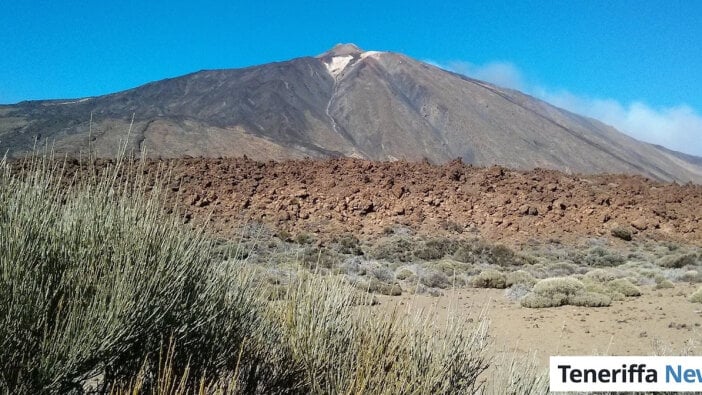
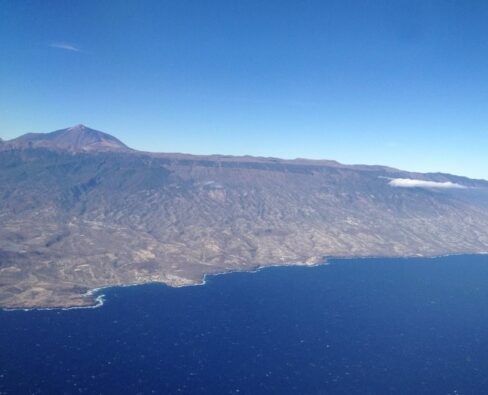
Mount Teide is Spain’s highest mountain. However, according to researchers, the peak of Mount Teide is three metres lower than is generally stated. Rather than 3,718 metres, the mountain is said to be only 3,715 metres high. Official sources have also confirmed this.
The world’s largest search engine is certain: well over 100,000 references lead Google to believe that Mount Teide is 3,718 metres high. This figure is also given in the online encyclopaedia Wikipedia. And on Tenerife, almost every tourist quotes this height for the mighty volcano in the centre of the island. But it is incorrect.
This is reported by Juan Tous Meliá. The former professor of topography cites official sources, amongst other things, and explains the confusion in his book *La Medida del Mount Teide* (The Surveying of Mount Teide).
Meliá explains that Spain’s National Geographic Institute (IGN) shares some of the blame for the misunderstanding. According to him, the error is thought to have crept into one of the IGN’s many publications. It then took on a life of its own. And indeed: in all current official IGN documents, Mount Teide is listed as 3,715 metres high, for example here or here on page 60.
Measurements show: Mount Teide is ‚only‘ 3,715 metres high, not 3,718 metres
In April 1983, the Instituto Geográfico Nacional surveyed Mount Teide using a precise elevation angle measurement technique. For this undertaking, a pillar was erected at the highest point, the so-called geodetic summit of Mount Teide. Using this pillar and the angle measurement technique, an elevation of 3,715 metres was calculated.
Although, according to the IGN, the height varies by a few centimetres from decade to decade, it was stated that the figure given in metres is correct. However, continuous measurements are important in order to collect accurate data over the long term. Shortly after the first measurement, however, the necessary pillar was destroyed. Consequently, the angle calculation has not been carried out since then.
Requests for interim measurements made by Meliá to the IGN were rejected due to the considerable effort involved. Consequently, on 2 December 2011, independent researchers from ‚Grafcan‘ – a public limited company under the authority of the Canary Islands Government and responsible for the islands‘ cartography – carried out a GPS measurement. This once again confirmed the height of 3,715 metres.
Mount Teide smaller than thought – a misunderstanding is said to be to blame
Both official bodies have therefore been stating for years that Mount Teide is 3,715 metres high. But where, then, did the incorrect figure of 3,718 metres come from? According to Meliá, a misunderstanding at the IGN dating back to 1994 is to blame. The Institute vehemently denies this, although, according to Meliá, there is a document in which this incorrect height was stated. The topography specialist concludes that the incorrect altitude figure became established unintentionally and by chance. However, as both institutes officially list Mount Teide as being 3,715 metres high, it is only a matter of time before the correct height is officially recognised.
A definitive conclusion is to be reached in the future. Whilst the IGN points out the difficulty of such measurements and the fact that the result depends largely on the people carrying them out, a new measurement is intended to dispel all doubts once and for all – not least to generate sufficient public awareness for what will then very likely be a new, universally accepted elevation figure. In the meantime, the figure of 3,715 metres, as measured by both institutions, remains valid.
What does the corrected height mean for Mount Teide?
And what does the correction now mean for Mount Teide? Even at 3,715 metres, Pico del Teide remains Spain’s highest mountain. And it may continue to hold the title of the world’s third-highest island volcano. A ‚reduction‘ of three metres therefore merely entails a major effort to correct the figures. Whilst this should be sorted out swiftly on Wikipedia, it may take several years for the information boards and leaflets produced by public authorities on Tenerife to be updated. And as for how long Google will continue to return incorrect results in the six-figure range, that is now written in the stars – which are officially three metres further away…
You can now find more news and all the information about Mount Teide here.

No comments on this article yet.