

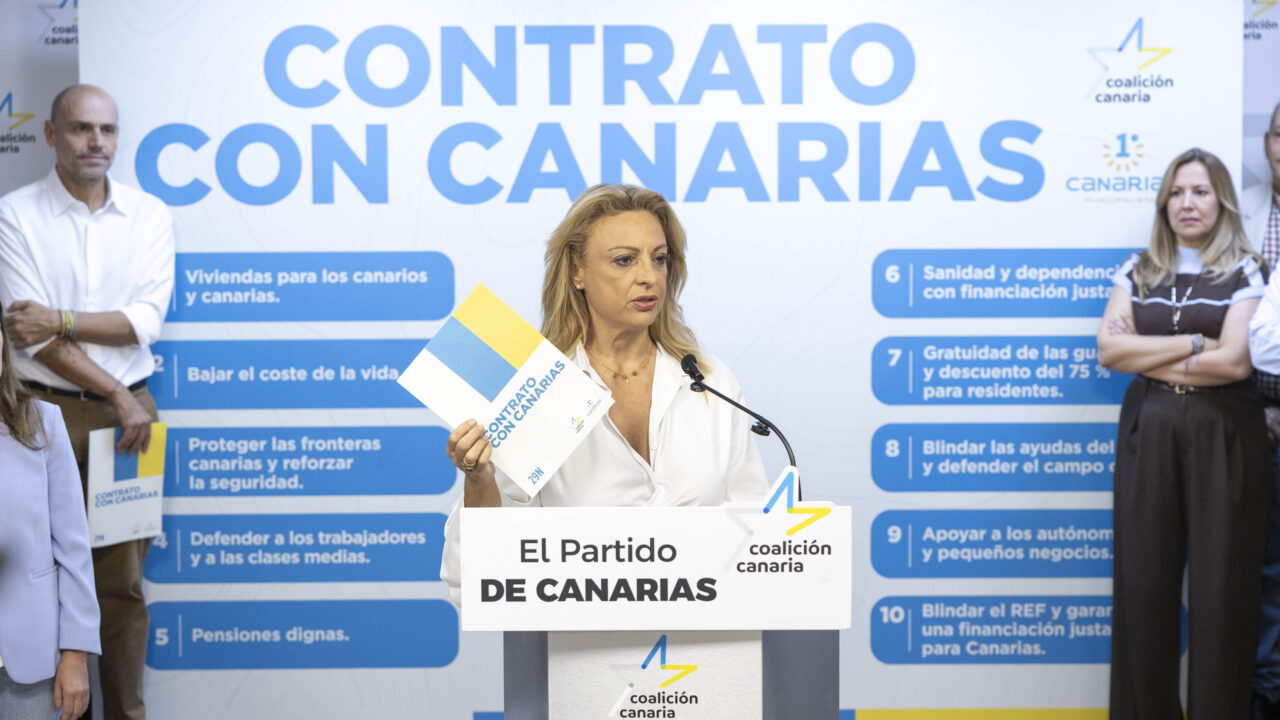
The CC-Primero Canarias alliance announced on Tuesday that any support it might give to the investiture of the candidate seeking to lead the government after Sunday’s elections is conditional on ten commitments involving 2.084 billion euros of investment in the islands.
At two separate public events, the two lead candidates of Coalición Canaria-Primero Canarias, Cristina Valido, for Santa Cruz de Tenerife, and Teodoro Sosa, for Las Palmas, signed the same document of ten commitments, a «contract with the Canary Islands» that they are challenging the other candidates to sign.
Flanked by fellow candidates and by CC leaders in Tenerife, Valido went through the points of this ten-point plan, which range from a legal reform banning the purchase of housing in the Canary Islands by anyone who cannot show twelve years of registered residence in the islands, to «the protection of the borders» and the safeguarding of the Economic and Fiscal Regime, the 75 % transport discount for residents and free bus travel.
Canary Islands: CC-Primero Canarias demands ten-point agreement
It also includes an increase in non-contributory pensions, better pay and a reduction in the tax burden on middle incomes, guaranteeing that POSEI funds are paid directly to the Canary Islands, and compensating small businesses and the self-employed for the extra costs caused by the islands‘ insularity and remoteness.
Cristina Valido urged the Canarian candidates of the other parties to «take on this contract» and to commit to voting in favour in Congress of every initiative CC puts forward relating to this ten-point plan.
The CC-Primero Canarias candidate invited Canarians to reflect on which representatives of the Canary Islands they want in Congress, whether those who will defend the interests of the islands or those who will «follow the strategies of their bosses on the mainland».
«I ask the people of the Canary Islands to think of their land, of their sons and daughters, of their future, of our needs and of our right to be heard and to take part in all the decisions that affect us», Valido declared, adding: «If you think of the Canary Islands, I have no doubt that on Sunday you will vote for CC-Primero Canarias».
Valido: Canarians should elect representatives in the islands
Asked about the prospects the polls published up to Monday suggest for her party, Valido said they have «very good feelings» because the only surveys they pay attention to are «those on the street», not those with barely 30 interviews in the Canary Islands or those commissioned «by an interested party».
In Las Palmas de Gran Canaria, her electoral alliance partner Teodoro Sosa issued the same challenge to the other parties.
«Anyone who wants to govern Spain with the support of the Canarian nationalists must sign this ‚Contract with the Canaries'», the leader of Primero Canarias warned, arguing that the archipelago’s funding needs to be updated after a population increase of 500,000 in the past 25 years and in the face of successive extensions of the General State Budget.
Las Palmas: Sosa demands 1.337 billion euros a year
Most of the economic demands set out by Sosa relate to regional funding to bring the costs of healthcare, education, dependency care and double insularity into line with those of the mainland, valued at 1,337 million euros a year.
To this are added specific items to restore the bilateral agreements with the State, including 200 million euros a year for road plans and 140 million a year for water infrastructure, as well as 40 million every two years (for 2026 and 2027) earmarked for healthcare and double insularity.
On social protection and employment, the CC-Primero Canarias candidate called for funding for the Dependency Act to be raised from 80 million to 200 million a year, for anti-poverty support to be increased from 30 million to 80 million, and for 45 million a year to be allocated to youth employment schemes and 42 million to comprehensive employment plans.
Social protection: care law and poverty aid to be increased
Asked about a possible understanding between the PP and Vox to form a government after 29N, Sosa made any dialogue conditional on Santiago Abascal’s party signing up to the solidarity-based distribution of unaccompanied migrant minors among all the autonomous communities of mainland Spain.
On this issue, he also called for greater financial and logistical involvement from the State and the European Union in response to the migration crisis affecting the archipelago as Europe’s southern gateway.
The number 2 candidate for Las Palmas, María Fernández, stressed the need for the State to «count properly» the real population of the archipelago when calculating the resources allocated to essential services such as housing, healthcare and social care for dependent people, because every resident left out of the allocation means homes that go unbuilt, she warned.
Fernández criticised the other political parties for barely mentioning the islands in their election manifestos (between one and four times at most) and for resorting to «euphemisms» such as «extra-peninsular territories» to avoid recognising the distinctiveness of the Canaries as Spain’s only Outermost Region (OR).
A status which, she stressed, is indispensable for protecting the primary sector through the POSEI programme and for offsetting the extra costs arising from territorial fragmentation, since the provision of public services has to be multiplied «by seven or even eight» islands, which directly pushes up the cost of the weekly shop and the cost of living.






Comments (0)
No comments on this article yet.