

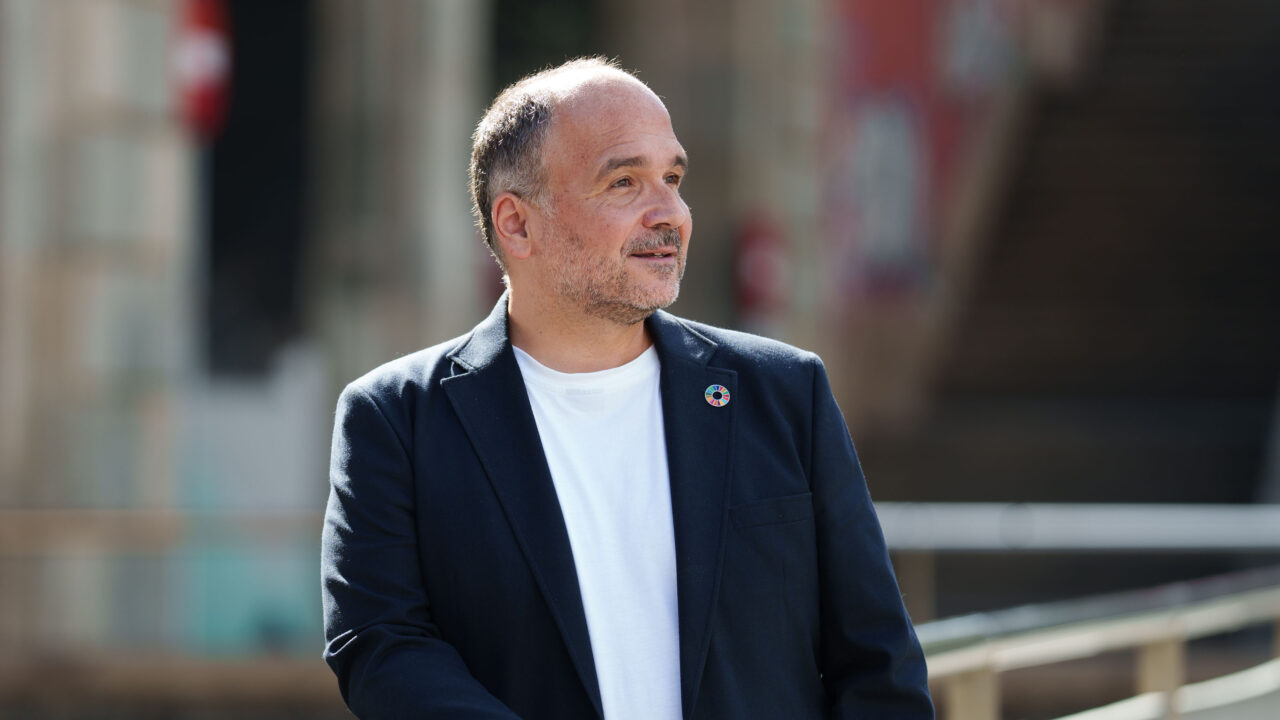
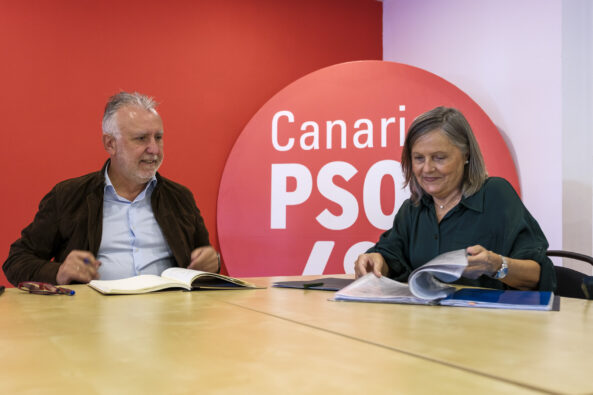
The PSOE’s lead candidate for the Congress of Deputies in the Santa Cruz de Tenerife constituency, José Antonio Valbuena, warns that the Canary Islands «would become the Lesbos of the Atlantic» if the migration policy which, in his view, is championed by the PP and Vox were to be implemented; he accuses them of wanting those who arrive irregularly in the archipelago to remain on the islands.
In an interview with EFE, Valbuena, who was a member of the previous Canary Islands Government, attributes part of the recent surge in arrivals to the temporary reduction in surveillance in departure areas in Senegal and believes that the strain this has placed on the reception network is also linked to the fact that temporary reception centres for foreign nationals in Tenerife were undergoing renovation work.
He has, however, defended the government’s response and pointed out that, of the approximately 7,000 people who arrived in the Canary Islands in November, fewer than a thousand currently remain on the islands, due to transfers between the islands and referrals to the mainland.
Canary Islands: Valbuena defends the relocation of migrants
The candidate states that since 2020, around 180,000 migrants have arrived in the Canary Islands, and that the vast majority are no longer in the archipelago.
«If it were up to the Partido Popular and Vox, those 180,000 people would still be in the Canary Islands. The Canary Islands would become the Lesbos of the Atlantic,» argues Valbuena, who distinguishes Coalición Canaria from those views.
According to Valbuena, Canary Islands President Clavijo is exploiting migration for political gain
However, when asked about the Canary Islands Government’s stance during the crises, the candidate believes that, particularly in this latest episode, the President of the Canary Islands, Fernando Clavijo, «is trying to be a Vivas», in reference to the President of Ceuta, Juan Jesús Vivas, of the PP.
According to Valbuena, Clavijo is attempting to «exploit the human tragedy» of migration for political and electoral gain, although he acknowledges that, despite their public differences, there has been cooperation between the central and regional governments and that both have reached agreements on how to deal with new arrivals at the most recent sectoral meeting on immigration convened for this purpose.
The socialist argues that action must be taken at source through cooperation policies, that the networks organising the departures must be tackled and, once people are at sea, that we must «save lives», bring them ashore and ensure they are treated with dignity.
On the subject of housing, he admits that the nearly 6,000 homes provided for in the Canary Islands Housing Plan, which was approved during Ángel Víctor Torres’s term of office between 2019 and 2023, «are not enough», although he emphasises that they represented a step forward after years without public housing construction.
In his view, the housing stock must grow «exponentially», through both public and private development at regulated prices, and he cites the lack of available public land and rising construction costs as some of the main obstacles.
Housing Bill aims to impose stricter limits on large landowners in the Canary Islands
Valbuena also advocates for the implementation of the Housing Act in the Canary Islands, including the designation of areas under pressure, and argues that it is necessary to bring vacant properties onto the market and take action against large property owners.
«The Canary Islands are the third region in Spain with the highest number of large property owners. 2,000 people alone own 60,000 homes, and four owners account for 600 of them,» he explains.
With regard to the Canary Islands‘ specific tax arrangements and the Economic and Fiscal Regime (REF), Valbuena points out that maintaining the 75 per cent discount on airfares is «non-negotiable», although he considers it necessary to tighten controls on the actual cost of tickets to prevent the discount from becoming a «windfall» for the airlines.
When asked whether they would consider capping prices, he pointed out that, in principle, in order to arrive at that average, a detailed study of the actual costs of the journeys would first be required.
On the subject of the REF, Valbuena asserts that the PSOE defends it «to the hilt» and that its funding is «untouchable», whilst also maintaining that ordinary state investment in the Canary Islands should be in line with the national average, without including in that figure the compensation payments arising from the archipelago’s unique characteristics.
A slowdown in the growth of renewable energy
On the subject of the energy transition, Valbuena, who was the regional minister responsible for this area, accuses the current Canary Islands Government of having «halted» progress on renewables, as between 2018 and 2023, installed renewable capacity increased by 47 per cent and the amount of energy fed into the grid by 82 per cent, compared with increases of 7 per cent and 11.7 per cent respectively since 2023.
«Fossil fuels have been favoured over renewables. Companies have realised that it is simply not profitable to develop a renewable energy portfolio in the Canary Islands because, as priority is given to new fossil fuel power stations, profitability comes at the expense of renewable energy sources not feeding power into the grid,» he summarises.
With regard to power cuts and security of supply, he points out that decisions on the generation model are primarily the responsibility of the regional government, and rejects the notion that the Spanish Government should bear primary responsibility for problems relating to security of supply.

Comments (0)
No comments on this article yet.