

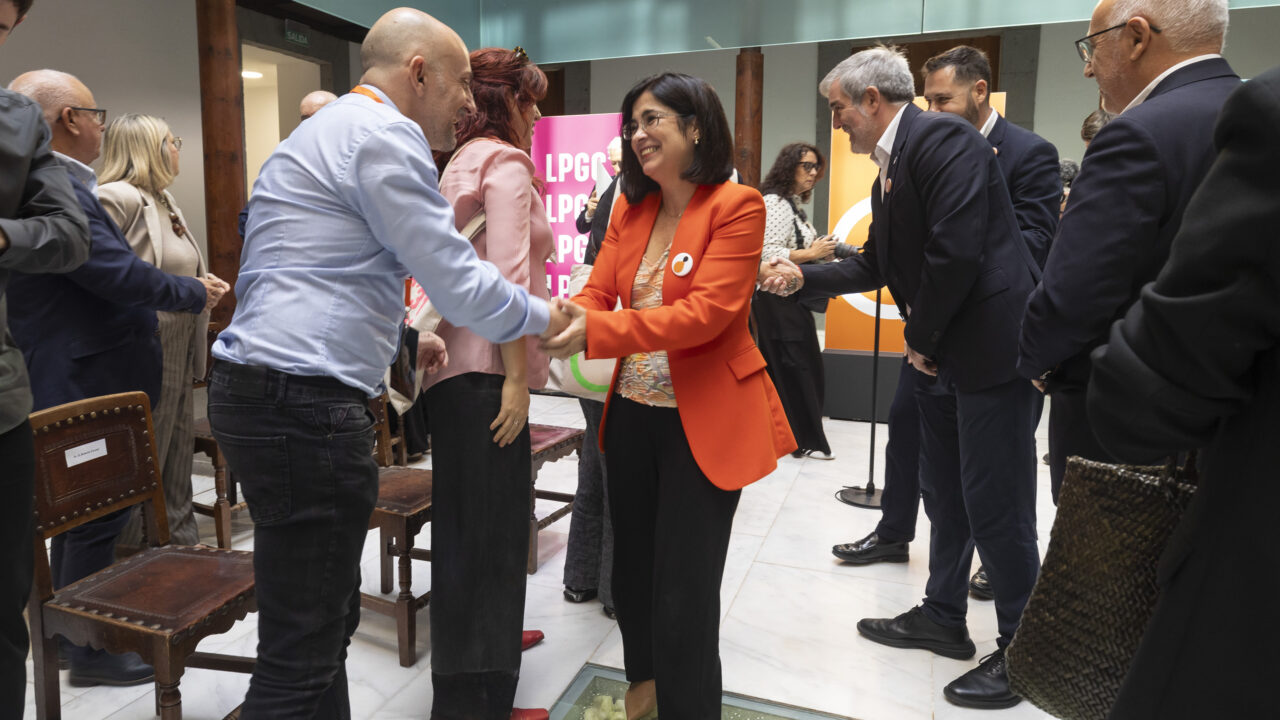
Three of the ten members of the jury that will decide the European Capital of Culture 2031 were received in Las Palmas de Gran Canaria on Thursday at an event at which the Canarian institutions defended a bid based on the role of the city and the archipelago as a cultural bridge between Europe, Africa and America.
The European delegation was received at the Casas Consistoriales by the mayor of Las Palmas de Gran Canaria, Carolina Darias; the president of the Government of the Canary Islands, Fernando Clavijo; and the president of the Cabildo of Gran Canaria, Antonio Morales, a week before the final verdict, scheduled for 3 December.
During the official event, Darias said the bid aims to turn culture into «a process of transformation that improves the lives of those of us who live in this city, socially and territorially» and not just «a programme of events».
Las Palmas: City wants to win more than a title through culture
The mayor argued that the archipelago’s geographical position is not a disadvantage but «a different way of looking at and understanding» Europe, and said the Canary Islands can offer the continent a vision linked to sustainability, coexistence and the management of limited resources.
«The islands know things that the continent sometimes forgets. We know that resources are finite, that water and soil and landscape are either cared for or lost, that a border is not just a line on a map but a place where people arrive with names and with histories. And the way the Canary Islands receive those people says a lot about who we are,» Darias said.
«Europe also begins here, in the middle of the Atlantic Ocean, and from here it reaches out to the whole world,» she said, stressing the institutional and public backing for a bid that she described as «the bid of a city, of an island, of an archipelago» and «of an entire people».
«I am convinced that you will not find here a city that wants a title; you will find a city that wants to be better and that has found in art and culture the path to achieve it,» Darias told the members of the jury.
Canary Islands: Island status highlighted as an advantage for Europe
The president of the Cabildo of Gran Canaria, Antonio Morales, maintained that the cultural capital title would mean «much more than recognition» for an outermost region, and highlighted the role of culture as a tool for tackling inequalities arising from insularity.
Designating Las Palmas de Gran Canaria as European Capital of Culture 2031 «would show that distance does not diminish our capacity to believe, to share, to contribute to the European project in which we firmly believe», he added.
Morales also championed the cultural tradition of Gran Canaria, with references to figures such as Benito Pérez Galdós, Alfredo Kraus, Josefina de la Torre, Martín Chirino and Manolo Millares, while also highlighting the generation of creators «who today write, perform, research and develop their talent».
Gran Canaria: Morales points to cultural heritage and creatives
He also backed a cultural scene that is «close to people, open and accessible, and a bulwark for democracy, peace, understanding and social justice».
Fernando Clavijo said that Las Palmas de Gran Canaria has «the merits, the track record and the necessary capacity» to become European Capital of Culture 2031, and argued that the bid represents «a project for the Canaries that commits us as a European territory and represents an opportunity for all eight of our islands».
The Canarian president also stressed that the Gran Canaria capital is not seeking the title «solely because of its legacy» but also «because of the vitality of its cultural fabric, the ability of its creators to innovate and its determination to respond, through culture, to the great challenges of our time».
Clavijo recalled that, under the slogan ‚Rebelión de la geografía‘ (‚Rebellion of Geography‘), the bid champions the «island and Atlantic» character of the archipelago «as a strength», and its strategic position as a place of encounter and cooperation between Europe, Africa and the Americas.
Las Palmas de Gran Canaria is competing for the title with Oviedo, Granada and Cáceres, the last two of which were already visited this week by members of the jury.

Comments (0)
No comments on this article yet.