

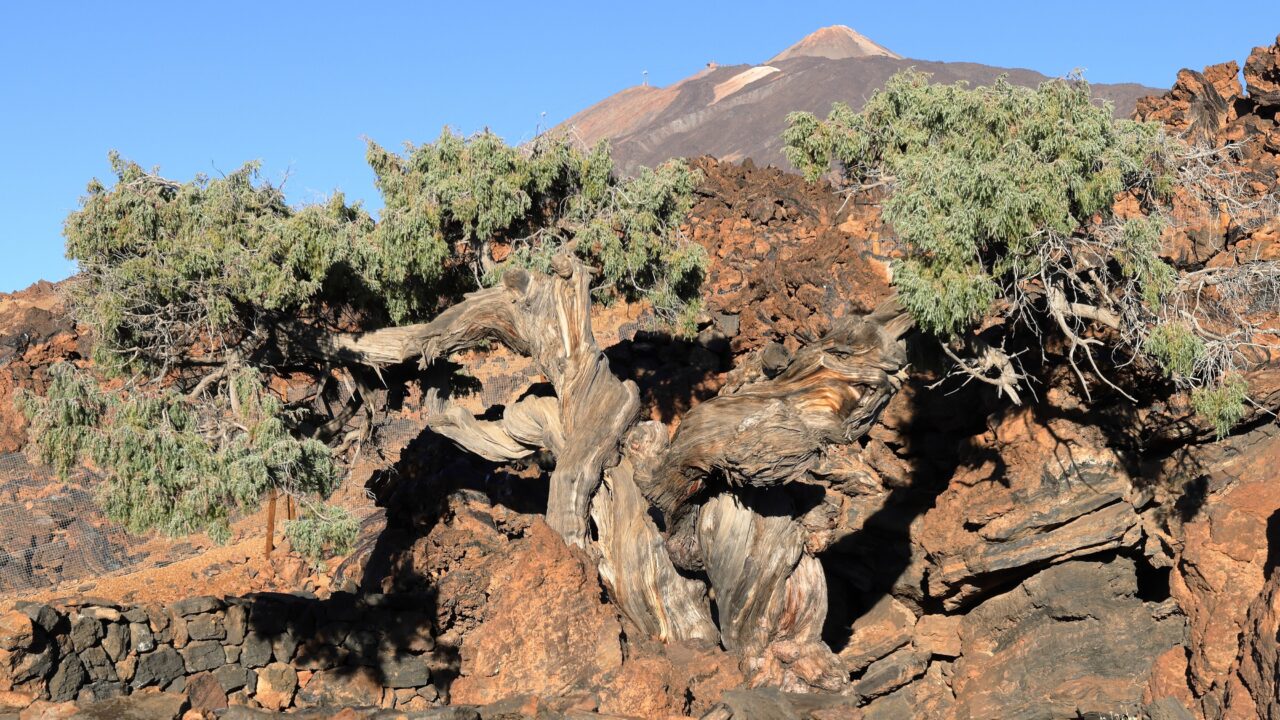
At just under 1,550 years old, it is the oldest living tree in Europe. The tree is located on Tenerife and, contrary to popular belief, it is not the Drago in Icod de los Vinos. Although Europe’s oldest tree is not too far away from it, the record-holder is situated at a much higher altitude.
The famous dragon tree is considerably larger. Yet despite its name, the Drago Milenario is only a few hundred years old. This makes the tree comparatively young.
For high up, near Mount Teide, stands a much older tree. The Canary Island cedar, known as the ‚Patriarch‘, seems out of place in what is actually a relatively hostile environment. Yet this master of survival turned a staggering 1,544 years old in 2025. Here it is:
‚Patriarch‘ is Europe’s oldest tree – it stands on Tenerife
A major project has been carried out on the Canary Islands focusing on the „millennial cedars“. In collaboration with the University of Valladolid (UVa) and the Endesa Foundation, the trees were not only counted but also identified in greater detail. As part of the categorisation process, „Patriarch“ was identified as the oldest tree in the EU. It thus replaces „Bárbol“, which is just 1,481 years old and was previously considered the oldest tree in Europe.
Since 2019, scientists have been studying ‚Juniperus cedrus‘ (cedar juniper) at the foot of Mount Teide in greater detail. This year saw a breakthrough: the age of organic material can be determined using carbon-14 dating, also known as the radiocarbon method.
The method was also applied to 25 cedar trees in the Canary Islands. The result: eight of them are more than 1,500 years old – and ‚Patriarch‘ is the oldest living tree in Europe.
Europe’s oldest tree on Tenerife is the subject of research
Researchers regard the tree as a true master of survival. They are also beginning to draw conclusions about the ecological past of the area around Mount Teide, its surrounding national park and Tenerife in general.
José Miguel Olano and Gabriel Sangüesa from the research group see the project as proof that „science and public-private partnerships can achieve tangible results in protecting our natural heritage.“ In this way, they say, „the biodiversity of the Canary Islands can be preserved through care, knowledge and commitment“.
The journal *Ecological Society of America* regards the cedar-juniper not only as a master of survival, „which has withstood human pressure and volcanic activity for a millennium“, but also, in its surroundings, as „a vast scientific laboratory in constant operation“.
Visitors can also see Europe’s oldest tree up close. ‚Patriarch‘ is situated in the Mount Teide National Park, just a few hundred metres from a large car park:
Meanwhile, researchers are investigating what the vegetation on Mount Teide might have looked like before the arrival of the first human settlers.






No comments on this article yet.