

Last year, I did some voluntary work in Tenerife. I lived on an animal sanctuary in the middle of the barren landscape of the south; working under the sun during the day, and heading down to the sea in the evenings to cool off. One of the most beautiful beaches I found was in Abades.
Sparkling white houses and clean streets divide the small coastal town into a symmetrical grid. Sunflowers and cacti line the gardens of the tiny bungalows. Abades is pretty. Abades is peaceful. However, a few houses standing a little apart seem out of place in this picturesque scene. They are a grubby brown and far too big. Above all, though, they are lifeless and deserted.
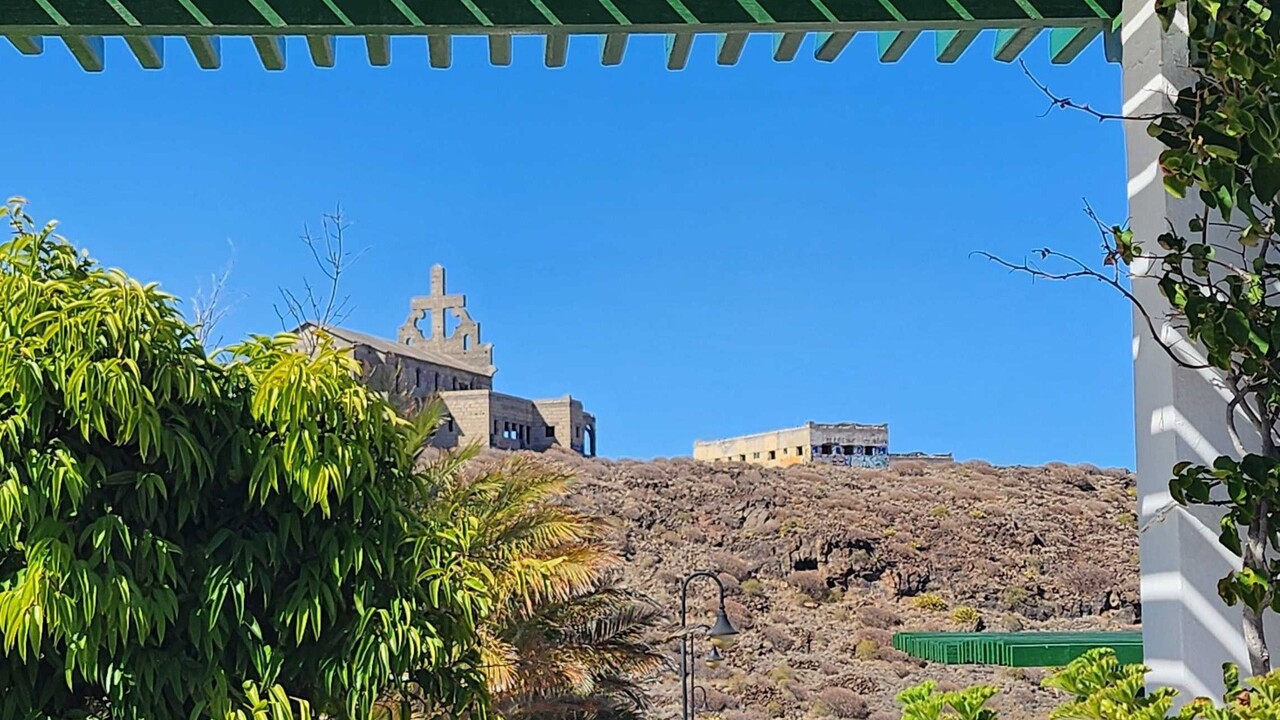
One of the entrances features a brick cross. It almost looks like a gateway. If you look up from Playa de Abriguitos below, you can clearly make out the silhouette of this towering Christian symbol – a collection of lost places: the Sanatorio de Abona.
The history of this ‚lost place‘ on Tenerife
When I saw the sanatorium for the first time, I was immediately told a story about it. In this building, so the story went, people suffering from leprosy were once housed – for treatment or perhaps even as the final stage of their lives. But that is only half the truth. For the ‚Leprosy Village‘ project was never actually put into operation.
Sending people suffering from leprosy to a house on the outskirts of an island to prevent the risk of infection and the spread of this serious skin disease – a chilling thought, albeit a bitter reality of the past. But the Sanatorio de Abona never housed a single leprosy patient. What became of the project in which the government of the time, under Francisco Franco, invested a great deal of money in 1944?
Planned as a leprosy village, now a photographic backdrop
1944 – a date that, when combined with the word ‚leprosy‘, raises eyebrows. After all, leprosy is one of the oldest known diseases, and the major epidemics had already been overcome by the Middle Ages. But on Tenerife, the bacterial infection was introduced relatively late – and recognised as a serious disease even later. Following the Spanish Civil War in the 1930s, there were several hundred people suffering from leprosy on the island – and still no cure.
Die Kranken mussten isoliert, ein abgelegener Ort dafür gewählt werden. Die Regierung beauftragte den Architekten José Enrique Regalado Marrero, mehrere Häuser für die teils schwer gezeichneten Erkrankten im südlichen Arico zu errichten. Neben der heute noch so auffälligen Kirche sollten Unterkünfte, Verwaltungsgebäude und sogar eine Schule entstehen.
What is not immediately apparent: at that time, there was no trace whatsoever of the little town of Abades. Abades did not exist. It was only with the construction of the leprosy village that wooden huts were erected in the surrounding area to accommodate holidaymakers from the mountains. The leprosy village: hollow and empty beside it. The medical measures were implemented more quickly. The project was never carried out.
The Sanatorio de Abona on Tenerife and its history
The new drug ‚Dapson‘ significantly reduced the number of new leprosy cases. It has anti-inflammatory and antibiotic properties. The purpose of the newly built sanatorium thus remained unfulfilled. The surrounding area, on the other hand, was discovered. Instead of patients, holidaymakers from the higher-altitude villages came to Los Abriguitos, as Abades was previously known.
People from the mountains wanted to enjoy being close to the sea down there. The wooden huts were adequate at first. However, as road construction on Tenerife progressed, the opportunity was seized to consolidate and modernise the village. In 1986, in what was almost a radical move, the huts were burnt down using a controlled fire to make way for stone houses. And that is how today’s Abades came into being – and has remained an insider’s tip amongst holidaymakers ever since.

Tenerife’s mystical spot and romantic TikTok trend
The Sanatorio de Abona is also an insider’s tip: a place to spray-paint, hang out, and occasionally even host a rave. Nobody really knows for sure when events take place, or which graffiti artworks will be adorning the walls in a few weeks‘ time.
The sanatorium has become a mysterious ‚lost place‘ – the sort of which there aren’t many on Tenerife. Young people are celebrating the place on TikTok, speculating about what it might be all about. Or they’re simply enjoying the seclusion and tranquillity of an unusual spot – and there have to be places like that, after all.






No comments on this article yet.