

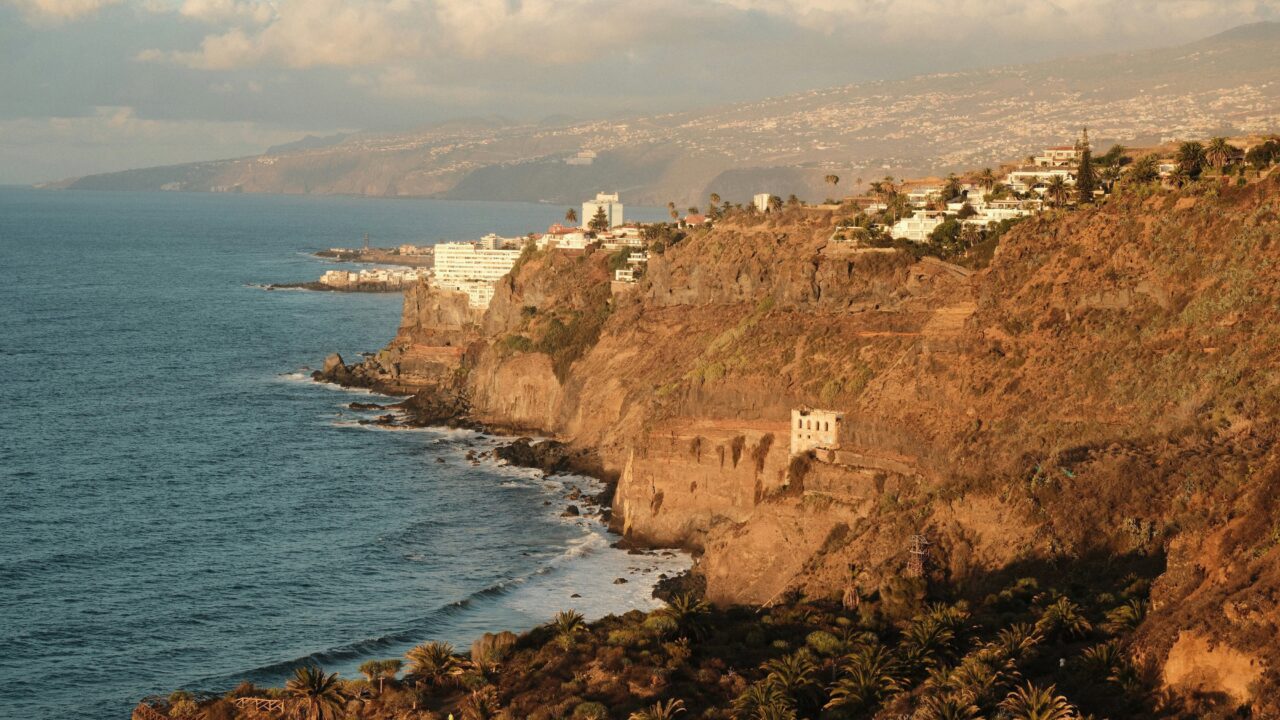
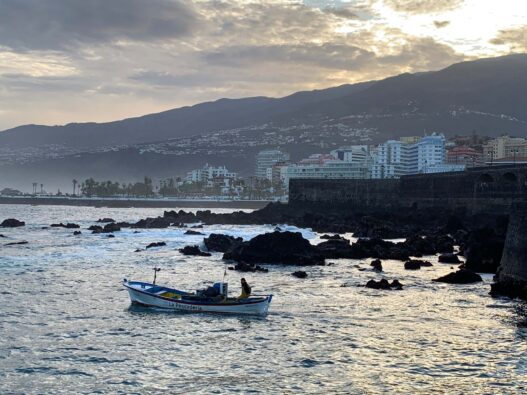
Most holidaymakers on Tenerife know Los Realejos only as a green strip to the left of the TF-5 motorway, on the way from Puerto de la Cruz to Icod de los Vinos. They don’t turn off. And as a result, they miss out on a truly fascinating town in the north of the Canary Islands. For Los Realejos has what many tourist resorts lack: genuine history, a semi-wild cliff coastline, a nature reserve of European significance and a festival culture that is second to none. Anyone who spends a day here will see a Tenerife that the coach tours tend to overlook.
Los Realejos Travel Guide
The town lies around 40 kilometres west of Santa Cruz, on the western flank of the fertile Orotava Valley. More than 37,500 people now live within its 57 square kilometres. The town centre is divided into three historically developed areas: Realejo Alto, the higher, older quarter around the old Church of St James; San Agustín, situated between them; and Realejo Bajo, closer to the coast. Well into the 20th century, Realejo Alto and Realejo Bajo remained two separate municipalities with their own administrations and a deep-seated rivalry. It was not until 1952, following the fire at the Monastery of San Agustín, that the two agreed to merge. The merger became official in the mid-1950s.
The name harks back to the final phase of the Spanish conquest: ‚Realejo‘ is derived from real, meaning ‚military camp‘. It was here, in 1496, that the troops of the conqueror Alonso Fernández de Lugo and the Guanche forces set up camp. A second interpretation identifies Realejo Alto as the Castilian camp and Realejo Bajo as the Guanches‘ camp. Be that as it may, it was here that the war for Tenerife came to an end. A single day – 25 July 1496 – continues to shape the local history to this day.
Here is an overview of the sights that are well worth a visit. Enjoy exploring:
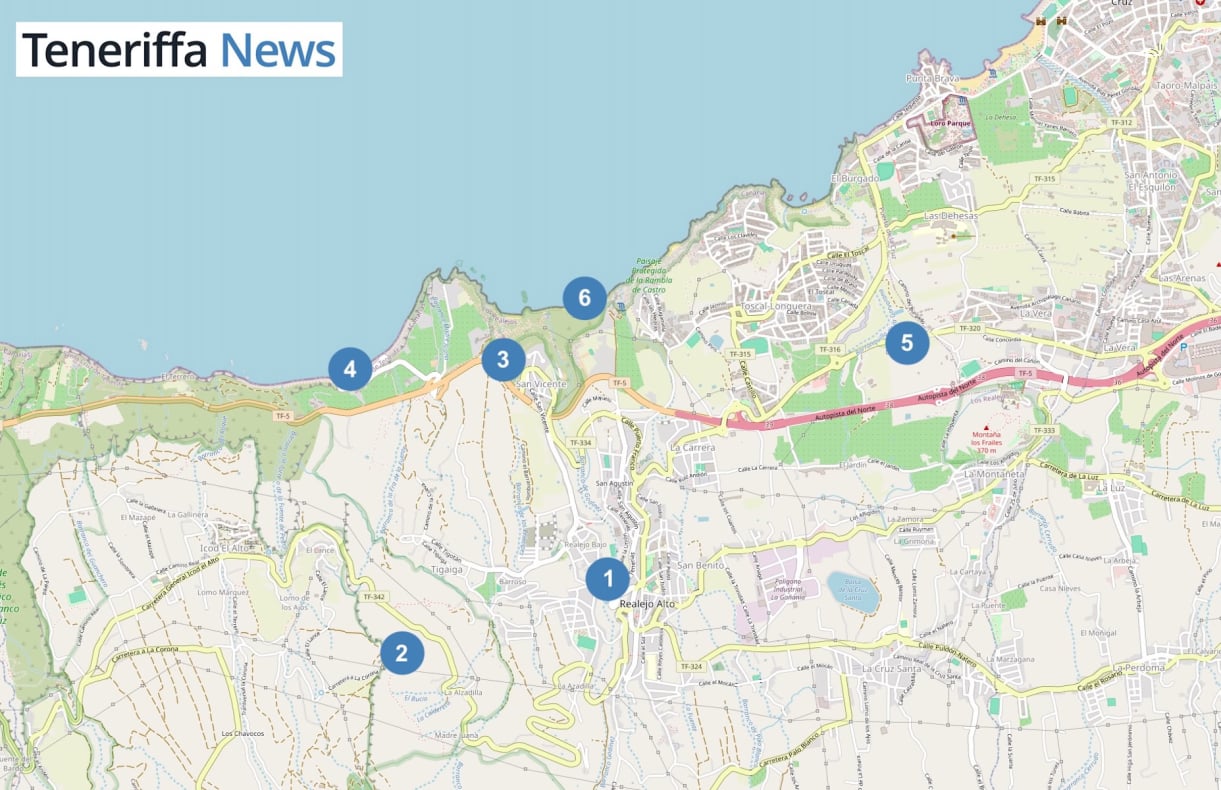
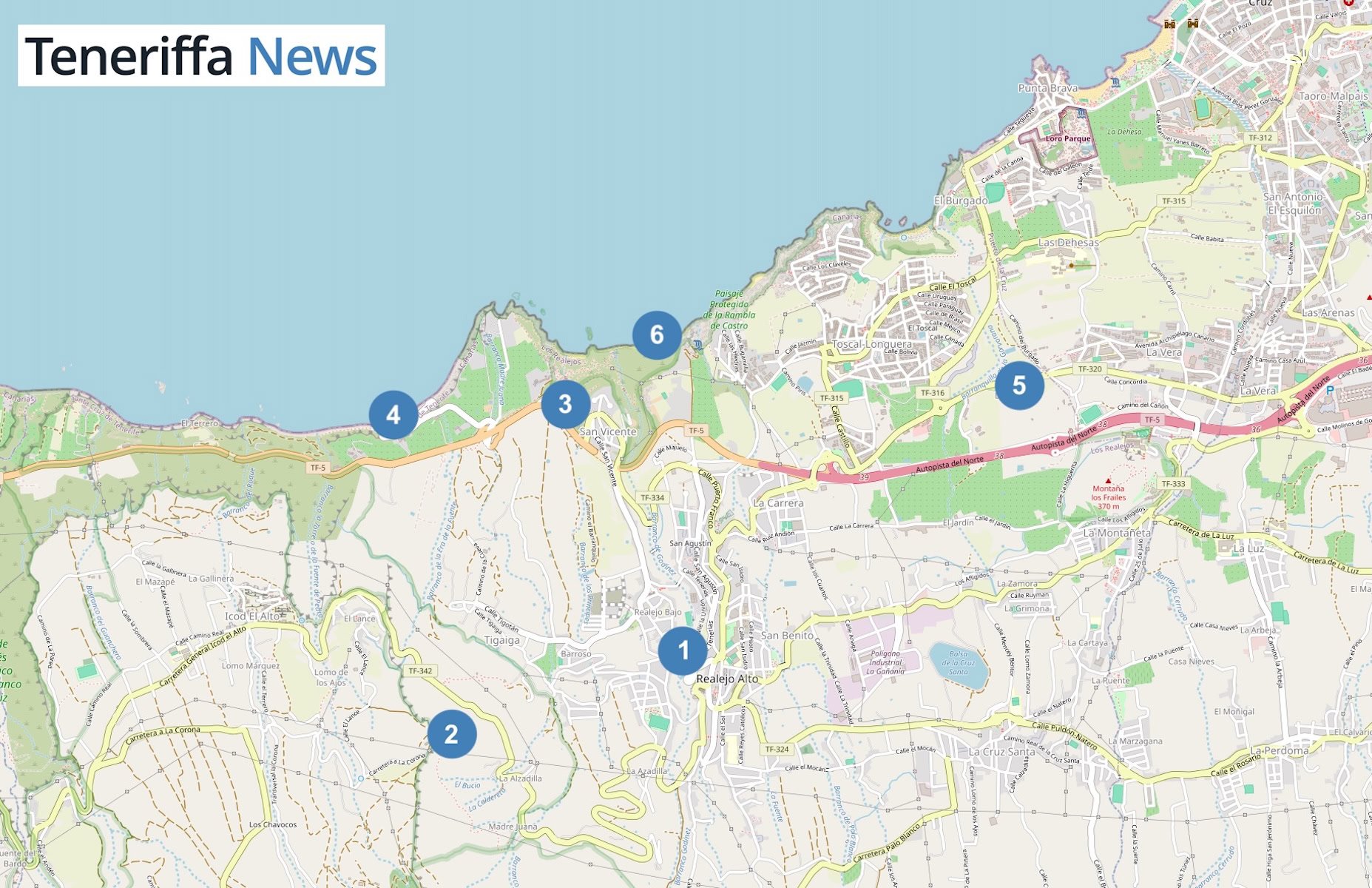
Map of Los Realejos on Tenerife
Iglesia de Santiago Apóstol: the island’s first church
If you want to know where Tenerife’s Christian history began, head to Realejo Alto, the upper, oldest part of the town (point 1 on the map above). On the historic church square stands the Parroquia Matriz del Apóstol Santiago, the island’s first Christian place of worship. It was founded in 1496. This is no coincidence.
It was at this very spot, in the former Mencey kingdom of Taoro, that on 25 July 1496 the last Guanche princes surrendered to the Castilian Crown. The fact that this took place on the name day of Saint James (Santiago), the patron saint of Spain, was interpreted by Fernández de Lugo as a divine sign. He vowed to dedicate a church to the Apostle here. According to the accounts of the poet Antonio de Viana and the historians Juan Núñez de la Peña and José de Viera y Clavijo, the nine defeated Menceyes were baptised in the church’s simple baptismal font. This makes the church not merely an ancient building, but the birthplace of Christianity on Tenerife.
The present-day building is the result of several centuries of construction: in the 16th century, the Realejeros rebuilt the church on several occasions, and the tower was added in the 18th century. It has been protected by the state as a national monument since 1983. Inside, the 18th-century altarpiece of Saint Barbara, the statue of Saint James the Apostle and, above all, the historic baptismal font are well worth a look. The church clearly bears the hallmarks of the Mudéjar style, that Moorish-Spanish architectural movement which shaped early Canary Island architecture.
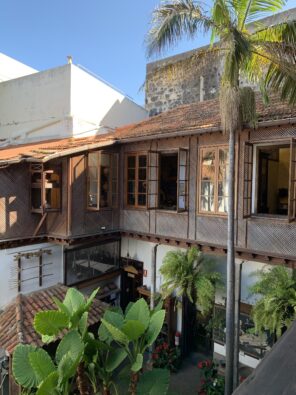
Take some time to explore the town centre: Realejo Alto, around the Plaza and Calle del Medio, has weathered the building boom of the 1970s and 80s remarkably well and retains the character of an old village on the Canary Islands with its carved wooden balconies. From the nearby Plaza de la Unión, the view looks down into the Barranco de Godínez, the scene of the final battles of 1496. José de Viera y Clavijo, the most important Canary Islands scholar of the Enlightenment, was born here in 1731. His birthplace, now a listed building, stands in the historic centre on the edge of this ravine.
The Mirador de la Corona
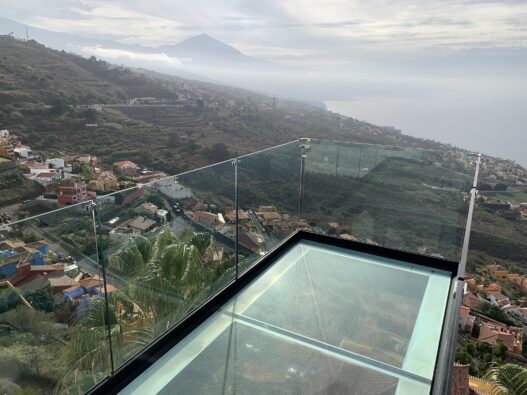
Drive uphill from the town centre along the upper road towards Icod el Alto; after a few minutes you will reach one of the most beautiful viewpoints in the north of the island (point 2 on the map above). The Mirador de la Corona lies at an altitude of around 750 metres on the ridge of the Tigaiga massif, still within the municipal boundaries of Los Realejos. From the viewing platform, a sweeping view unfolds: the entire Orotava Valley, the coastline stretching down to Puerto de la Cruz, the deep blue of the Atlantic and, behind you, towering above everything, Mount Teide.
In the centre stands a pavilion with a cross, which the residents of Realejo Bajo had erected in 1922 after surviving an accident unharmed. Anyone who spots a bright green artificial turf strip there is initially taken aback: it is a launch pad for paragliders. Its altitude, location and reliable updrafts make La Corona one of the best launch sites of its kind in Europe. On calm days, you can glide from here in a wide arc down to the black sands of Playa de El Socorro. Even without wings, the late afternoon is the best time to visit, when the valley is bathed in warm light and the silhouette of Mount Teide stands out against the evening sky.
Rambla de Castro walking trail
The Rambla de Castro is the scenic highlight of Los Realejos. It is also one of the most beautiful coastal nature reserves in the Canary Islands (point 3 on the map above). The nature reserve covers around 45 hectares and stretches along the cliffs as a narrow strip of ancient vegetation between lava rock and the Atlantic Ocean. The groves of palm trees from the Canary Islands, in particular, are regarded as a botanical testament to plant worlds long past and are strictly protected.
The walk itself is easy: the main route is about two kilometres long, is almost entirely flat and can be walked in either direction. Start at the Mirador de San Pedro, close to the coast, and follow a marked path through groves of palm trees, past terraced banana plantations, with frequent views of the sea. Several historic buildings line the route, and each one makes the walk well worth it.
There is the Casona de Castro, the manor house of the once-powerful Castro family, whose entailed estate dates back to the early 16th century. Perched on a rocky outcrop overlooking the water stand the remains of San Fernando Fortress, built at the end of the 18th century to protect the coast from pirates. Some of the old cannons have been preserved. The biggest surprise comes during the descent down more than 200 steps to the coast, where the multi-storey ruins of the La Gordejuela pumping station loom up.
In 1903, the Hamilton trading company erected this imposing building on an almost vertical cliff face. It was here that Tenerife’s first steam engine stood, pumping spring water upwards to supply the banana plantations in both Realejos. For more than a century, the empty building has stood defiant against the Atlantic, providing one of the most striking photographic subjects on the entire north coast.
A practical tip based on experience: stick to the marked path. After heavy rainfall, there is a risk of rockfalls on the cliffs and certain sections may then be closed off. Take these barriers seriously. Birdwatchers will get the most out of their visit early in the morning. At the end of the path lies the small, black beach of Playa de Los Roques.
Playa de El Socorro
Playa de El Socorro is the best-known beach in Los Realejos and is renowned amongst surfers far beyond the island (point 4 on the map above). Black volcanic sand, powerful North Atlantic waves and consistent winds make it one of the most reliable surf spots in the north of Tenerife. At weekends, this is where people gather, whether they want to ride the waves or simply watch.
The beach even has a little internet anecdote to share: as one of the first beaches in the Canary Islands, Socorro also offered free ’surfing‘ on the net . A nice play on words between ‚wave‘ and ‚Wi-Fi‘. Walkers and sunbathers feel just as at home here as water sports enthusiasts. The sunset over the Atlantic is one of the most beautiful along the entire north coast.
La Fajana Beach
Off the beaten track lies Playa La Fajana, in a small cove below the Rambla de Castro (point 6 on the map above). Black sand, hardly any facilities, rarely crowded. Getting there isn’t exactly easy. And that’s precisely what attracts those seeking just that: unspoilt scenery, the sound of the waves, not a sun lounger hire in sight. If you walk along the Rambla de Castro, La Fajana is the natural end point, after which you can dive straight into the cool water.
Parque La Higuerita
Right in the centre of the village lies Parque La Higuerita, a green oasis of calm amongst the houses (point 5 on the map above). This isn’t a tourist attraction, but a place of everyday life: shaded benches, a playground, elderly gentlemen watching the world go by. If you want to get a feel for how Los Realejos really lives, away from any tourist itinerary, stop here for half an hour. A good spot for a break between the town centre and the coast.
Celebrating in Los Realejos: the Fiesta de la Cruz
Los Realejos loves its festivals more than almost any other place on the island. It’s even popularly regarded as the town with the most festivals in Spain. Most of the local festivals take place between May and September, when the Canarios turn out in colourful traditional dress and the sound of the timple and chácaras echoes through the streets. But one festival stands out above all others: the Fiesta de la Cruz on 3 May.
Then the town is transformed into a sea of flowers. The people of Realejo decorate the streets, house walls, fountains and the crosses that give the festival its name with flowers; processions wind their way through the narrow streets; there is music everywhere, accompanied by Canary Islands cuisine. The highlight is a fireworks display, one of the largest in Europe, during which the rival neighbourhoods traditionally try to outdo one another. You can find all the information about the Fiestas de la Cruz here. Anyone who can time their trip to coincide with this event should seriously consider doing so. The Fiesta de la Cruz is not an event for tourists, but is deeply rooted in the life of the community. That is precisely what makes it well worth seeing.
Hikes in the Tigaiga Mountains
If you want to experience Los Realejos from above, head to the Tigaiga massif, the wooded mountain ridge overlooking the village. Walking trails of varying difficulty wind through pine forests, past rock formations and offering ever-changing views of Mount Teide and the Orotava Valley.
A popular starting point is the Chanajiga recreation area. From there, trails lead across the Ladera de Tigaiga, several of which end at the Mirador de la Corona. The tranquillity up here, the scent of pine, the clouds that sometimes hang low: all this is a world away from the hustle and bustle of the coast, even though it’s only a few kilometres‘ drive away. Even less experienced walkers can manage the lower routes easily; the signposting is reliable. Nevertheless, sturdy footwear and water should be packed in your rucksack. In the shade of the woods, it’s easy to underestimate the sun.
Culinary highlights in Los Realejos
After a hike or a day at the beach, no one in Los Realejos will go home hungry. The town isn’t a hub for trendy restaurants. Instead, it offers something far more valuable: a rich array of guachinches and traditional eateries where Canarian cuisine still tastes authentic. Guachinches are a Canary Islands speciality: simple, often seasonal establishments where wine-growing families serve their own wine and a few down-to-earth dishes.
Papas arrugadas with mojo, grilled fish fresh from the Atlantic, gofio in all its many forms: that’s the foundation. Accompanying these are the wines from Realejo Alto, where the upper part of the village still cultivates vines to this day. These local wines have noticeably improved in quality over the years. Anyone who makes the transition from the food back to the historic centre has yet another good reason to stay longer than planned.
This is Los Realejos on Tenerife
Los Realejos is not a holiday resort in the traditional sense. There are no hotel zones, no promenade lined with souvenir shops, and no tourist attractions spruced up for a quick visit. Instead, the town offers substance: the birthplace of Christian Tenerife, a coastline that has not quite lost its wildness, a nature reserve to explore on foot, and a festival culture that takes its traditions seriously.
If you allow half a day, you’ll see the main sights. If you stay for a whole day, you’ll get a feel for the place. And if you’re visiting in May, you really mustn’t miss the Fiesta de la Cruz.
«Los Realejos Travel Guide: Where the north of Tenerife really has its own charm»
No comments on this article yet.