

By Inge Pelka
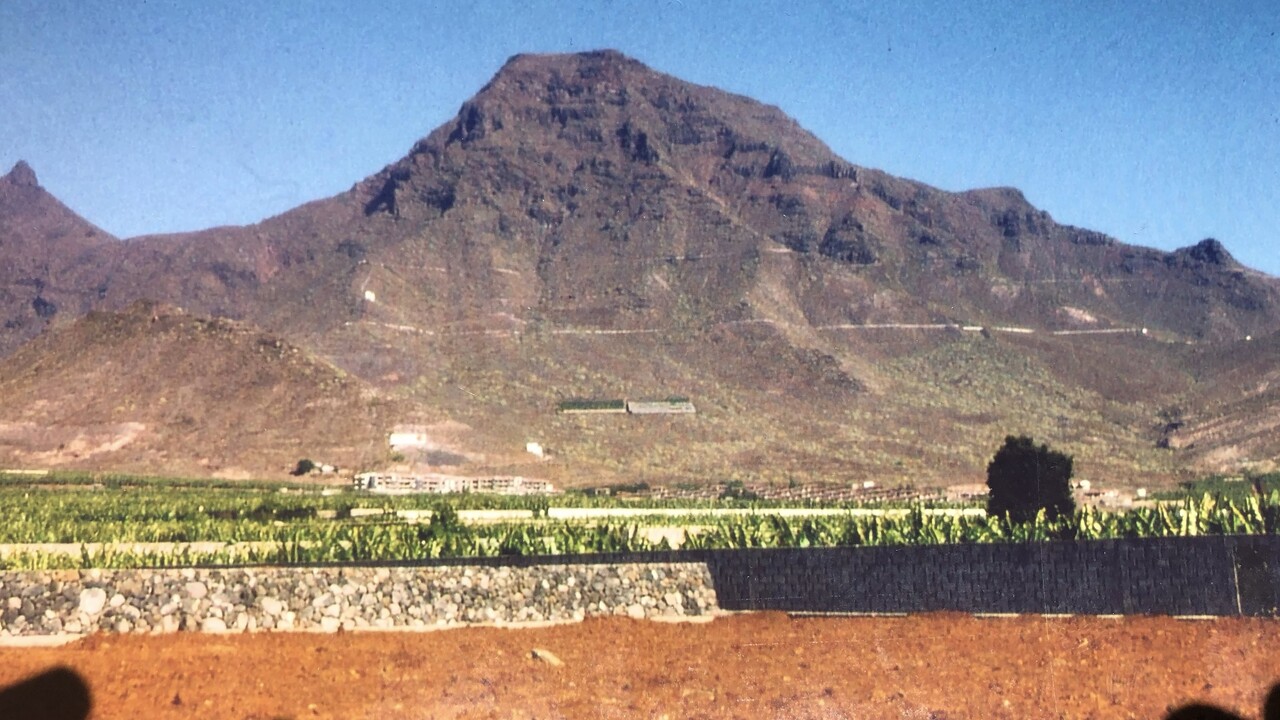
It’s incredible how much has changed over the past 50 years. I recently came across a photograph (above) of our housing estate, which I think my father took in the 1970s. The estate is barely recognisable in that little hollow.
I remember that a minibus used to come by twice a day to take people to the sea. Los Christianos was a village. In Playa de las Americas, there were hardly any hotels at that time. If you wanted to go to the beach, you had to walk through banana plantations and always be on your guard against wild dogs.
In fact, ‚beaches‘ – as we know them today – didn’t exist back then. People from the resort would go to the so-called ‚pensioners‘ beach‘ (roughly where Playa del Duque is today) and climb down a ladder into the water. Shopping was done in a tiny shop within the resort. If you wanted to go out for a meal, you’d walk to Adeje to one of the simple Spanish restaurants.
Back then, whenever my father wanted to carry out some building work or repairs at his little studio, he had to bring all the materials with him from Germany. If you came across a rusty nail somewhere, you’d naturally take it with you, as there weren’t any to buy in the local area.
A narrow, dusty road ran past the complex, along which a car would pass only very rarely. Today, the motorway runs there and there are traffic jams every afternoon. I tried to find the spot from which the photo was taken back then. I didn’t manage it, but this photo still gives an idea of how things have changed:
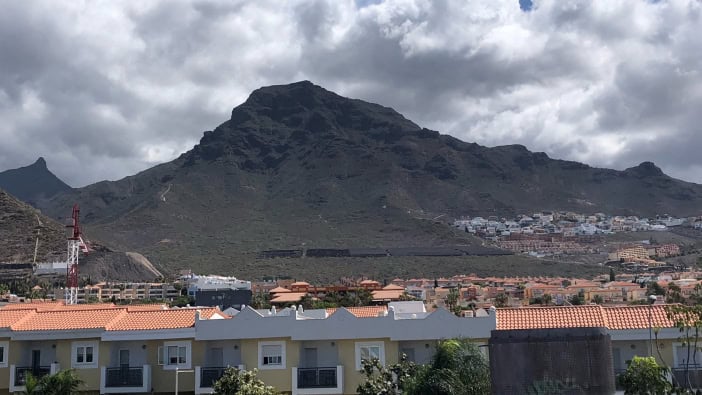
Nowadays, you walk past rows of houses to beautifully landscaped beaches. You can buy whatever your heart desires, wherever you go. Some of the old banana plantations are being replanted.
Anyone who has been visiting the south of the island for some time will have different memories and experiences associated with it. Sometimes one might look back with a touch of nostalgia on the wild, unspoilt past – on landscapes that hadn’t yet been built over or overrun by people, on roads that had scarcely seen a car. Personally, I don’t pine for those days. The only thing I could really do without is the traffic.
A few years ago, I started writing a novel, which I self-published this spring. For the plot, I needed a place where a mother could keep her son away from his father by means of an entry ban. Naturally, an island seemed the obvious choice:

Photo: Publisher
I thought I’d written a romance novel, but my readers reckon it’s turned out more like a crime thriller or a psychological novel. Of course, everyone is free to interpret it as they wish.
The unsung protagonist, however, is Tenerife. 290 of the 326 pages are set on the island. In the south. Apart from one or two fictional locations, I know all the places where the story is set personally, and I enjoyed using them as a backdrop. Of course, only those who know the island can really appreciate this.
Anyone who fancies delving into this world can order *The Storm Diver*, which was published under a pseudonym, here.
«Southern Tenerife 50 years ago and today - with a book recommendation!»
No comments on this article yet.