

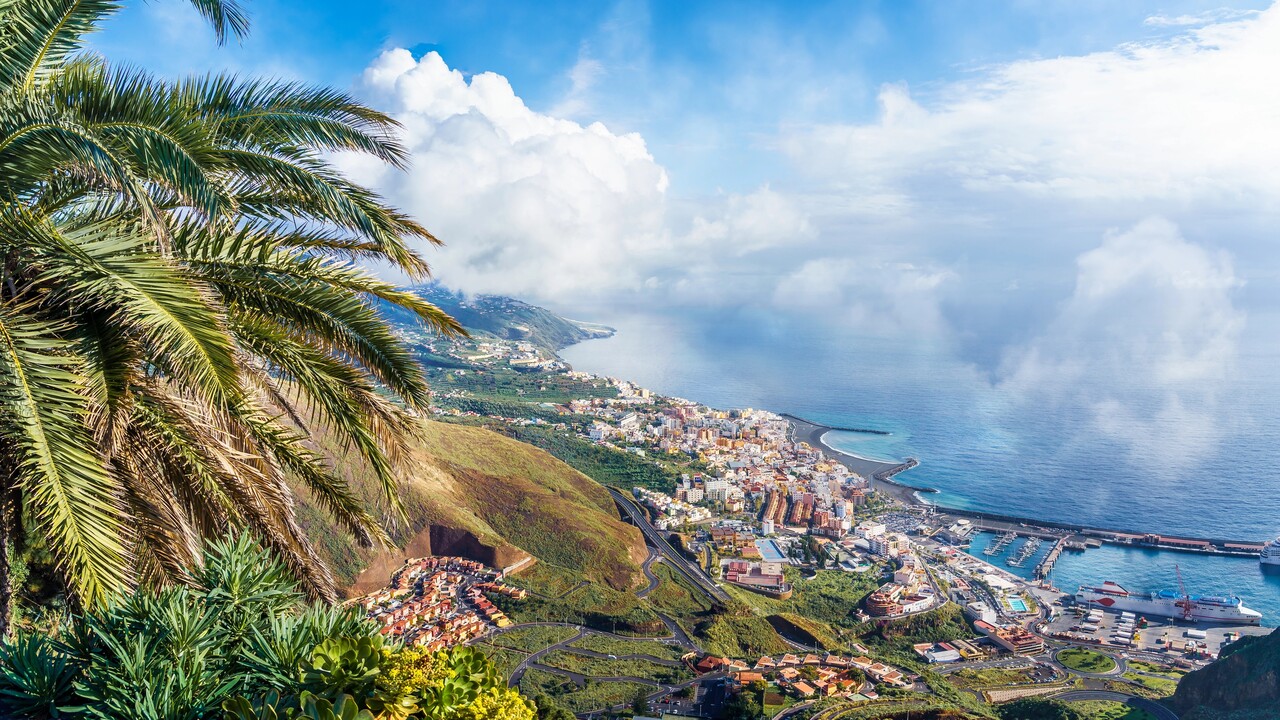
Santa Cruz de La Palma is the capital of the Western Canary Islands island of La Palma and is situated on its east coast. The town is nestled between the sea and the wooded slopes of the Cumbres, leaving only a narrow strip of coastline between the coast and the mountains, with buildings stretching up the slopes. We’ll give you a closer look at the town and offer some tips. The table of contents will help you find your way around:
Sights in Santa Cruz de La Palma
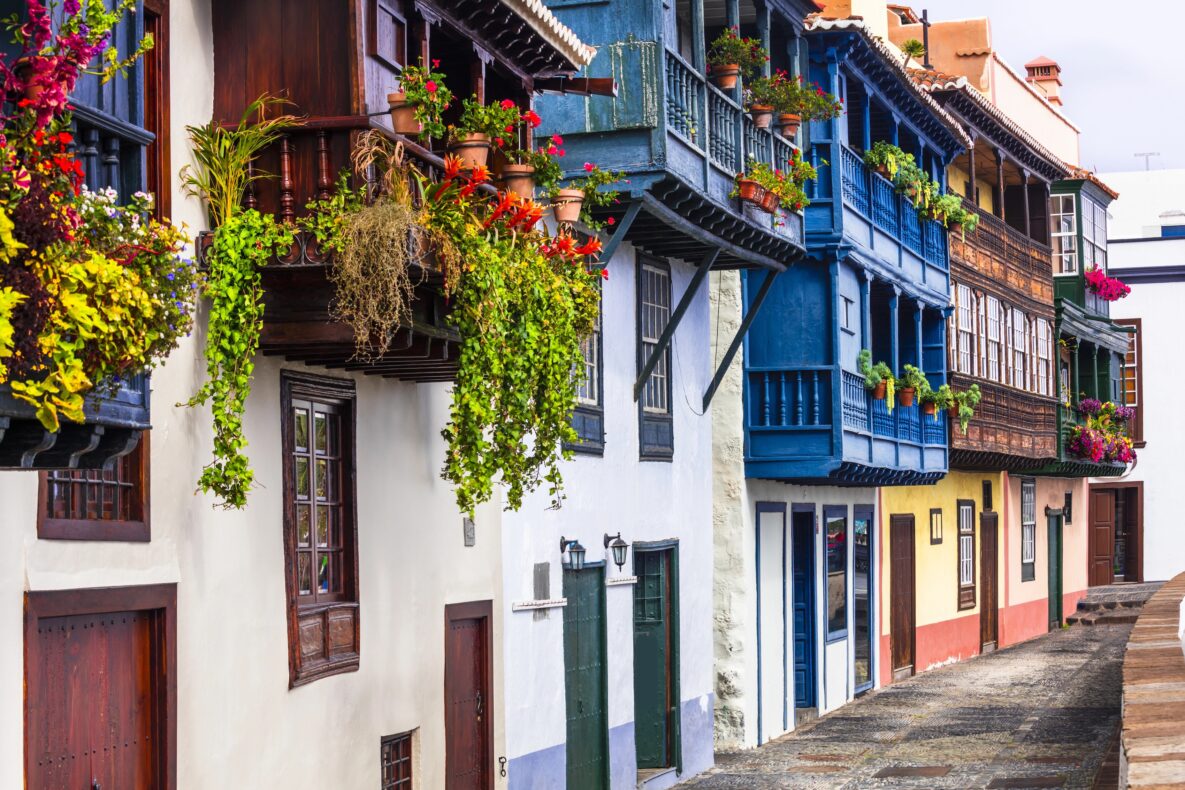
In the 16th century, the harbour was one of the most important in the Spanish Empire for trade with the Americas. The houses with their typical Canary Islands wooden balconies, complete with carved patterns, which characterise the old town centre and its sights, date from this period. It has been declared a historic monument.
Almost all of Santa Cruz de La Palma’s sights are located in the historic centre and are easily reached on foot. The two main thoroughfares are the seafront promenade, Avenida Marítima, and Calle O’Daly, which runs parallel to it. Situated between them and in the immediate vicinity are the Renaissance Town Hall, the main church, monasteries housing museums, a fortress built of black lava rock, and a replica caravel. Above the capital lies the pilgrimage church of Virgen de las Nieves.
Map: City map showing places of interest
The following map shows the twelve sights in Santa Cruz de La Palma described here, with their map numbers. Most of the attractions are situated in the compact old town centre near the coast. Only the Virgen de las Nieves pilgrimage church lies around five kilometres above the town:

Avenida Marítima in Santa Cruz
Avenida Marítima (number 1 on the map) is the main thoroughfare. It runs right along the waterfront. It is built up exclusively on the landward side, where there are old houses in Canary Islands and colonial styles with elaborately decorated wooden balconies. The sea-facing side of the street has been left open; the town beach was created there in 2017.
Calle O’Daly (Calle Real)
Calle O’Daly, also known as Calle Real (number 2 on the map), runs parallel to Avenida Marítima. It is home to the town hall, the Plaza de España, as well as shops and restaurants. Anyone visiting Santa Cruz should make sure to include this street in their itinerary.
Plaza de España
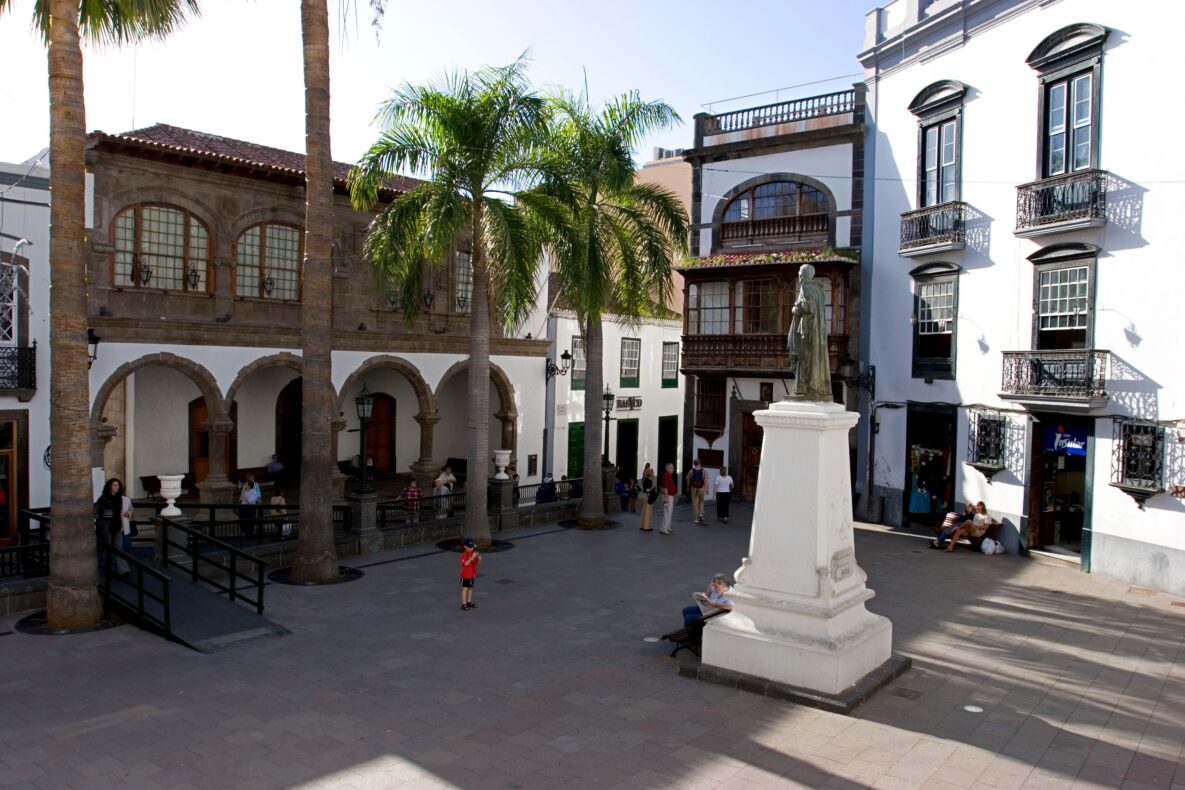
Plaza de España (number 3 on the map) is home to the Renaissance-style Town Hall and the main church, El Salvador. In the centre of the square stands a bronze statue of the priest Manuel Díaz Hernández, who lived from 1774 to 1863; it was cast in 1895 and erected two years later.
Iglesia Matriz de El Salvador
The main church of El Salvador (number 4 on the map) was founded in the early 16th century and rebuilt after 1553. It features three naves with coffered ceilings in the Mudéjar style, as well as a Renaissance façade. The Bajada de la Virgen (Descent of the Virgin) is considered the most important religious festival in the Canary Islands. It dates back to 1676. Every five years, the island’s patron saint, the Virgen de las Nieves, is carried down to the capital in a procession (more on this below).
Santa Cruz de La Palma Town Hall
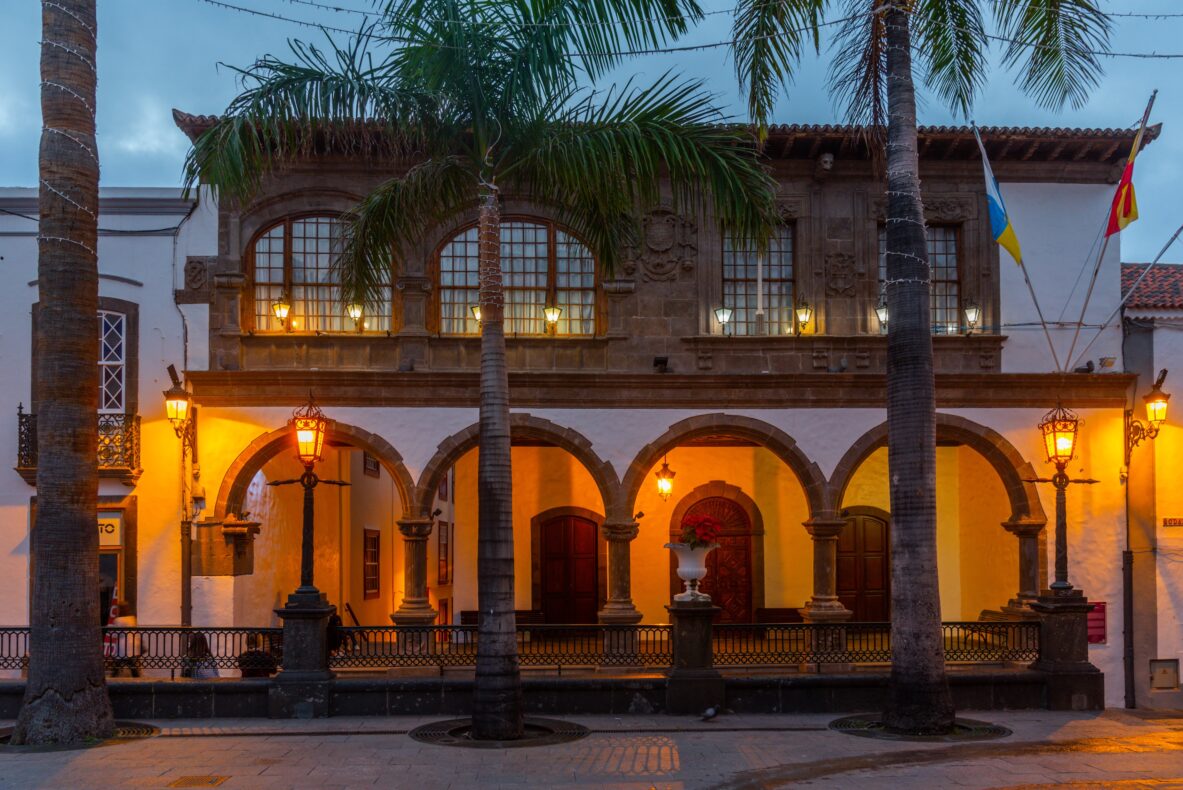
The Town Hall on the Plaza de España (number 5 on the map) was built between 1559 and 1563. This Renaissance building is regarded as an outstanding example of the Plateresque architectural style.
Casa Salazar
Casa Salazar (number 6 on the map) is one of the historic mansions in the old town. The building dates from 1664. Casa Salazar is situated in the heritage-protected centre of Santa Cruz de La Palma. In early 2006, the building and its art treasures were destroyed by fire. The town mansion was once the residence of the Counts of El Valle de Salazar. The façade was designed by Juan González de Castro Illada. The town mansion was built in 1681 by the stonemasons Juan Lizcano and Andrés Rodríguez Bello.
Convento de San Francisco / Museo Insular de Bellas Artes
The former Franciscan monastery, the Convento de San Francisco (number 7 on the map), is now home to the island museum, the Museo Insular, or more specifically the Museo Insular de Bellas Artes. The municipal Museum of Fine Arts (1917) houses a wide variety of exhibits relating to natural history, as well as folklore and local history. The monastery itself is also well worth a visit. Admission costs just over four euros.
Museo Naval (Barco de la Virgen)
In the Plaza de La Alameda (number 8 on the map) stands a full-scale replica of a caravel called the Santa Maria, also known as the Barco de la Virgen. It was originally built from wood and stone and later rebuilt in concrete. Since 1975, it has housed the Museo Naval.
Castillo de Santa Catalina
The Castillo de Santa Catalina fortress (number 9 on the map) was built in 1692 from black lava rock, based on a design by the architect Leonardo Torriani dating from 1585. It served military purposes until 1808 and was declared a national historic monument on 22 June 1951.
Ermita San Sebastián
The Ermita San Sebastián (number 10 on the map) is a chapel within the town of Santa Cruz de La Palma. It is considered particularly beautiful and well worth a visit. It houses a statue of Saint Sebastian, the patron saint of this district of Santa Cruz de La Palma. The chapel also houses a statue of Saint Catherine of Alexandria, as well as other sculptures from Mexico, Cuba and Andalusia.
Playa de Santa Cruz de La Palma
The town beach (number 11 on the map) is situated on the sea-facing side of the Avenida Marítima and was developed from 2017 onwards. It is therefore located right next to the historic centre. Anyone in need of a short break can enjoy a particularly relaxing time there.
Virgen de las Nieves Sanctuary
The Virgen de las Nieves Pilgrimage Church (number 12 on the map) is situated in the village of Las Nieves, about five kilometres above Santa Cruz. It houses the miraculous image of the island’s patron saint, a small 14th-century terracotta Madonna. According to legend, the name dates back to an event in 1646, when a volcano calmed down because the Virgin caused it to snow.
Every five years, as part of the Bajada de la Virgen de las Nieves, which now takes place on the second Saturday in July, the sacred image is carried in a procession about 6.5 kilometres downhill to the Church of El Salvador and returned on 5 August.
Santa Cruz de La Palma: History of the capital
La Palma has been inhabited since the middle of the first millennium BC. Evidence of permanent settlements and links with the Mediterranean region dates back to the 3rd century BC. The indigenous people were the Benahoaritas, who called the island Benahoare. In 1922, a large number of petroglyphs were discovered above the town at the La Erita site, which is thought to have been an important place of worship for the Benahoaritas.
In the 15th century, Castile conquered La Palma on behalf of King Ferdinand and Queen Isabella. The conquest began on 29 September 1492, when Alonso Fernández de Lugo went ashore at Tazacorte beach. On 3 May 1493, the Feast of the Finding of the Cross, he founded the town of Santa Cruz de La Palma, also known as Villa de Apurón. Whether the ancient Canarian settlement of Apunyon or Apurón was situated here is a matter of debate.
In 1508, the Canary Islands were granted the privilege of free trade with the Americas. Virtually every ship sailing from Castile to the Americas called at the islands. In the 16th century, La Palma became the third port city, after Antwerp and Seville, to be granted the royal privilege of trading with the Americas.
Santa Cruz de La Palma developed into one of the most important ports of the Spanish Empire. Initially, the economy centred on sugar production for export to France, England, Flanders, Holland, Hamburg, the Iberian Peninsula and Genoa. Other export goods included wine, pitch and timber. Over the centuries, wine exports replaced sugar. The sweet Malvasia from La Palma was particularly prized in England right up until the 19th century. Shipbuilding also played an important role due to the abundance of timber.
Smuggling was also part of life in Santa Cruz de La Palma
In the 16th and 17th centuries, smuggling was part of everyday life. Towards the end of the 16th century, many Portuguese, Flemish, French and Genoese merchants lived in the town. In 1564, King Philip II had the first Juzgado de Indias established in the harbour – a registry court for trade with the Americas, complementing the Casa de Contratación in Seville.
The town’s prosperity attracted raiders. On 21 July 1553, seven ships from a pirate fleet led by the French captain François Le Clerc, known as Pie de Palo or Jambe de Bois (Wooden Leg), raided the town. More than 500 pirates landed, plundered the town and set it alight as they withdrew on 1 August. In 1584, Philip II sent the Italian military engineer Leonardo Torriani to La Palma to improve the defences. In November 1585, Francis Drake attempted to land in the harbour with around 30 ships and more than 2,000 men. The attack was repelled.
The decline began in 1657: a decree required all ships bound for the Americas to register in Tenerife and pay duties there, which brought trade in the port to a virtual standstill. In 1778, King Charles III lifted the ban on trade with the Americas for all Spanish ports, but Santa Cruz de La Palma never fully recovered from the crisis. From the 19th century onwards, large-scale banana cultivation offered a way out.
The town is now more than 500 years old and thrives on its traditions. Its atmosphere is considered rather sleepy and laid-back.
Santa Cruz de La Palma: Getting there by plane and ferry
La Palma Airport (SPC) is situated around eight kilometres south of Santa Cruz and opened in 1970. Iberia operates scheduled flights from Madrid, whilst Binter Canarias connects the neighbouring islands. There are also flights to La Palma from Germany; the flight time is approximately 4.5 hours.
The Fred. Olsen Express sails from the ferry port of Santa Cruz to Los Cristianos on Tenerife. The crossing takes just under three hours in calm seas. The commercial port is of great economic importance. It is also home to a heavy fuel oil power station. The cruise port is situated right in the town and is called at by numerous cruise ships. A free shuttle bus takes visitors from the ship to the port exit.
Santa Cruz was also once home to an honorary consulate of the Federal Republic of Germany, although this has since moved to Los Llanos de Aridane.
Santa Cruz de La Palma: Climate and location on the east coast
Average annual rainfall in Santa Cruz ranges from 200 to 330 mm. This is one of the reasons why the surrounding countryside, like the island as a whole, is considered green. The town lies at the foot of the wooded slopes of Cumbre Nueva and Cumbre Vieja. During dry and hot spells, the risk of forest fires rises from time to time even there, despite the ‚green lung‘.
Santa Cruz de La Palma: Other historic buildings in the old town
In addition to the main attractions, the townscape is characterised by other historic buildings. The Iglesia Santo Domingo was built in 1530 alongside the Dominican monastery of San Miguel de las Victorias as a three-nave church in the Mudéjar style. Its bell tower dates from 1701. The Teatro Circo de Marte is also well worth a visit.
Frequently asked questions: Santa Cruz de La Palma at a glance
How do I get to Santa Cruz de La Palma?
You can reach the town via La Palma Airport (SPC), which is situated around eight kilometres to the south. The flight time from Germany is approximately 4.5 hours. Alternatively, the Fred. Olsen Express operates a service from Los Cristianos on Tenerife to the ferry port of Santa Cruz, taking around three hours.
What museums are there?
The Museo Insular is housed in the former Franciscan monastery, the Convento de San Francisco. The Museo Naval is located in the replica caravel Santa Maria on the Plaza de La Alameda and has been in existence since 1975.
Why was Santa Cruz de La Palma so historically significant?
In the 16th century, La Palma became the third port city – after Antwerp and Seville – to be granted the royal privilege of trading with the Americas. Santa Cruz developed into one of the most important ports of the Spanish Empire, initially through the export of sugar and later of wine. In 1564, Philip II established the first Juzgado de Indias here.
What is the Bajada de la Virgen?
Every five years, on 15 July, the miraculous image of the Virgen de las Nieves – a 14th-century terracotta statue – is carried in a procession some 6.5 kilometres from the pilgrimage church in Las Nieves down to the Church of El Salvador, and returned on 5 August.
Is it worth exploring the old town on foot?
Absolutely. The old town centre has been designated a historic and architectural monument and is compact: the sights are all situated along the Avenida Marítima and the parallel Calle O’Daly, as well as around the Plaza de España, all within close proximity to one another. Only the Virgen de las Nieves pilgrimage church lies slightly further afield, above the town.


«Santa Cruz de La Palma: 12 places of interest and tips»
No comments on this article yet.