

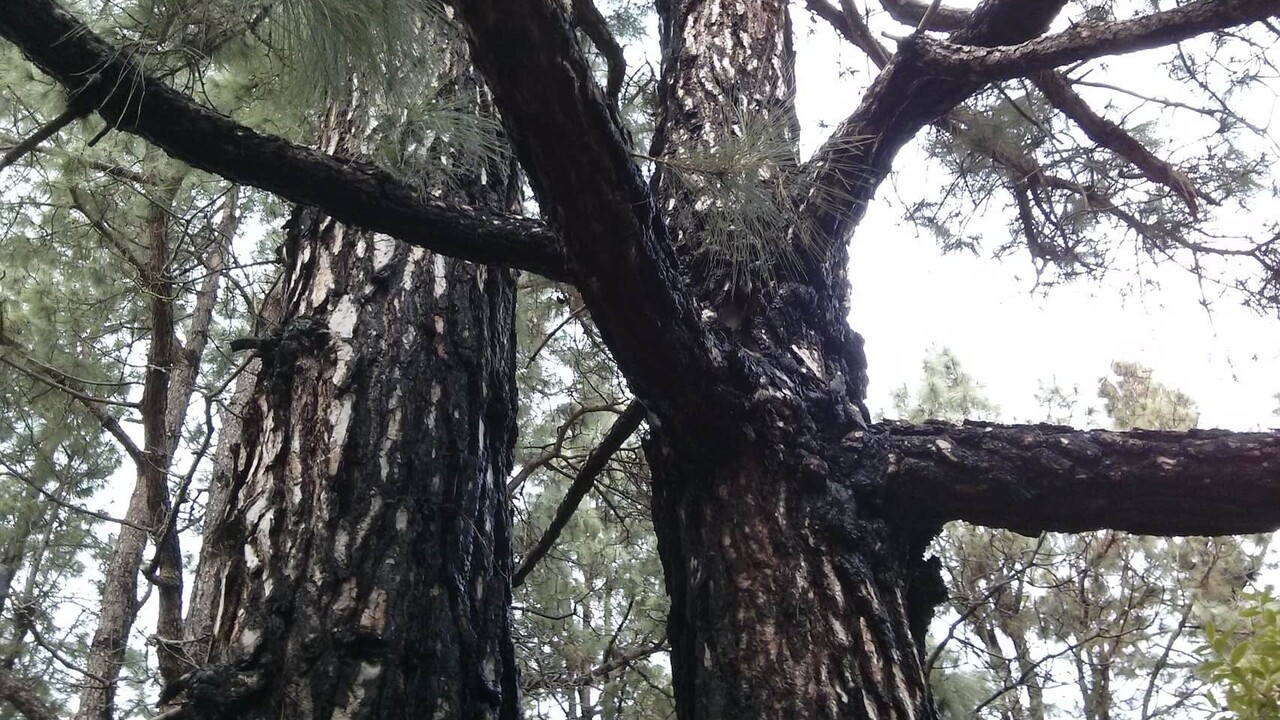
The forests are the ‚green lungs‘ of the Canary Islands; they are found on Tenerife, La Palma, Gran Canaria and other islands, mostly at higher altitudes. The Canary Island pine, which is widespread there, has adapted perfectly to the hot and hostile conditions. With its extremely thick bark, Pinus canariensis can even withstand the extreme heat of a fire that blazes for several hours.
In some cases, these fires can actually help nature. This is the case, for example, when trees have become too old or have even fallen over and are lying on the forest floor, gradually rotting away. A fire clears away these remains and even releases nutrients in the process.
Forest fires in the Canary Islands: how nature recovers
The remaining trees usually sprout again relatively quickly after a forest fire. And some cones only open as a result of the intense heat of the fire, so that the seeds released in the process quickly give rise to entirely new plants.
The vegetation surrounding the old and very hardy trees is, of course, completely burnt out at first. Shrubs, smaller trees and even dozens of animals fall victim to the flames. So whilst the sturdy trees have soon recovered, the regeneration of the forests as a whole naturally often takes several years.
Nevertheless, this phenomenon of nature offers hope. Following forest fires, the Canary Island pine is often seen as a comforting symbol of the fact that even a seemingly great loss can lead to a new beginning.
Further information on forest fires in the Canary Islands is now available here.





«The marvellous Canary Islands pine: how the forest recovers after a fire»
No comments on this article yet.