

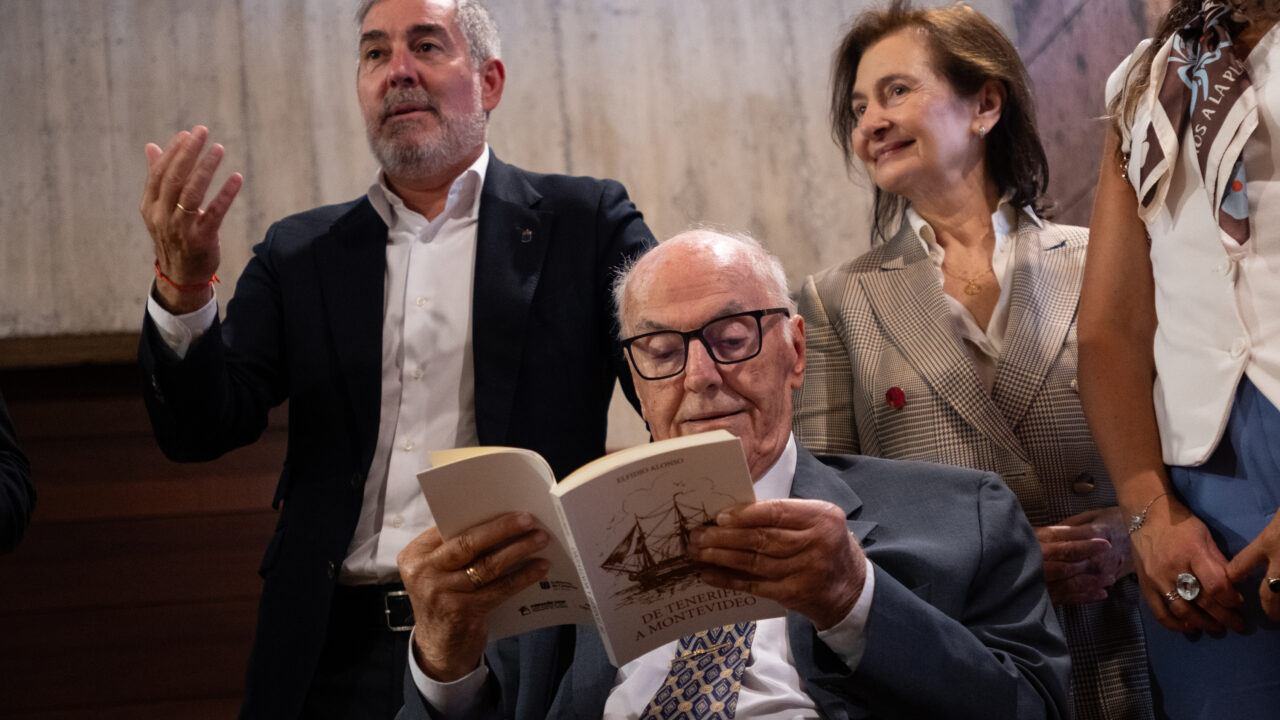
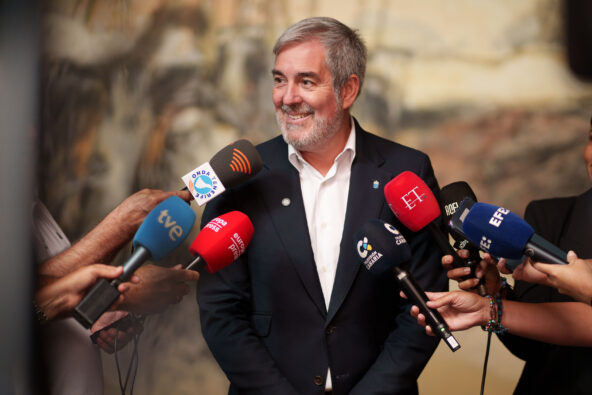
The President of the Canary Islands, Fernando Clavijo, took part on Wednesday in an event to launch the fourth reprint of *De Tenerife a Montevideo* (1987), a book by Elfidio Alonso which chronicles the role played by Canarian families in the founding of Uruguay’s capital, which is currently celebrating the 300th anniversary of its foundation.
The event, held at the Regional Government’s headquarters in Santa Cruz de Tenerife, featured a brief discussion between Alonso and the president of the International Centre for Heritage Conservation (CICOP), Francisco Aznar.
The work highlights the history of emigration from the Canary Islands and the mark left by the islanders in the Americas, thanks to the heritage recovery work carried out by CICOP and by Alonso himself, particularly in Uruguay, but also in other places such as Argentina, Cuba and Venezuela, where even today families from the archipelago pass on their identity to new generations.
Montevideo: Families from the Canary Islands founded the civil town in 1726
In this regard, Aznar pointed out that the city’s origins date back to 1726, following the Spanish Crown’s initiative to settle the eastern coast of what is now Uruguay in response to the Portuguese presence, with a plan that included «the resettlement of families from the Canary Islands and Galicia».
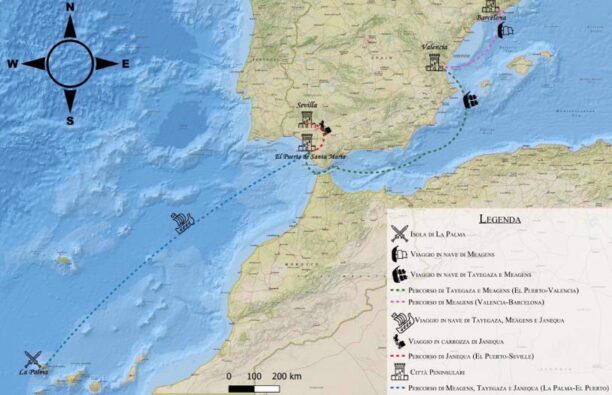
However, he went on to say, the «Galician families did not turn up», which meant that the Canarian families played a key role in this plan; they set sail for the Americas on 21 August and arrived on 19 November, after a 91-day journey, in a land where neither housing nor infrastructure had yet been completed.
«In Uruguay, there has been a very heated debate about the year of its foundation, because some theories maintained that it was in 1724, as soldiers were already building a castle at that time. However, according to the Laws of the Indies, that does not constitute a city or a settlement. It was in 1726, with the arrival of the first families from the Canary Islands, that the first census was carried out,» said Aznar.
This, he went on to say, made it possible to register the new settlers, their origins and the allocation of smallholdings and plots of land, which constitutes «documentary evidence of the formation of Montevideo as a city», where the Canarians played a part in the «civic organisation», which can still be seen reflected in the islanders‘ «traits, words, traditions and ways of being» within contemporary Uruguayan society.
Clavijo pays tribute to the heritage of the Canary Islands in Uruguay
The President of the Canary Islands emphasised that «From Tenerife to Montevideo» represents «the living memory of the archipelago» and thanked Elfidio Alonso for his «tireless and invaluable work» in recovering the history of the Canary Islands, having dedicated «much of his life» to «shedding light on our roots and highlighting the mark that the people of the Canary Islands have left around the world».
«The Canarian presence in these countries is not just a thing of the past; it is the present and the future. I saw this for myself on my recent trip to Uruguay and Argentina, where I was moved to see how that seed sown by our ancestors has been passed down from generation to generation. Young people who speak proudly of their roots, who say, ‚I am Canarian‘, with the same conviction as any of us here would say it,» said Clavijo.
Finally, Alonso pointed out that «being from the Canary Islands is a godsend» to be proud of, because it is a society that has historically «contributed to the prosperity and improved status» of all the countries where its people have settled after emigrating.
«Far from disappearing, the Canarian presence is growing and enriching our international profile. But it is also doing so at home, upholding a legacy of solidarity and generosity. It is a gift that fills us with pride and for which we feel honoured, underpinned by our geographical and human circumstances,» concluded Alonso.



«Montevideo was founded as a town by families from the Canary Islands»
No comments on this article yet.