

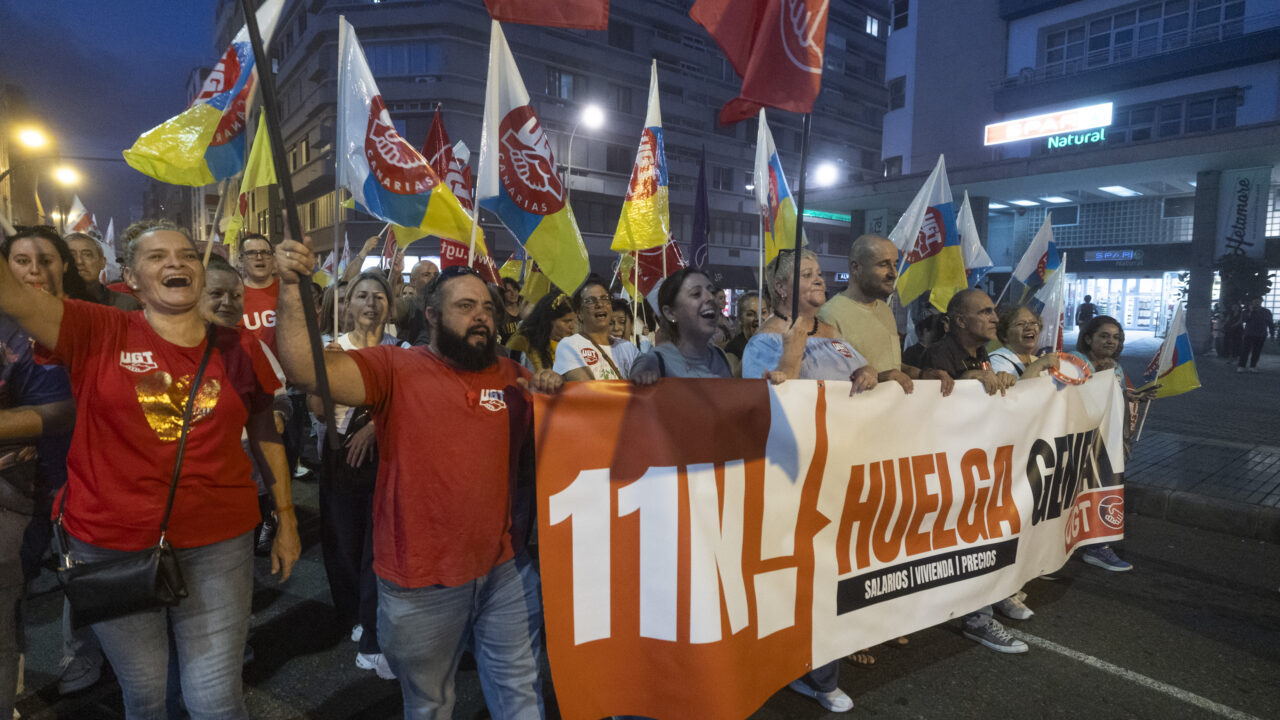
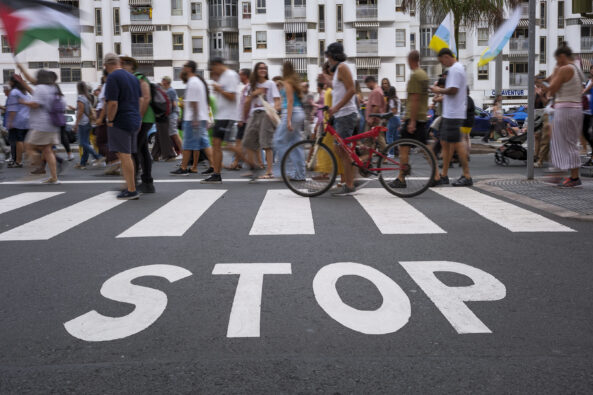
Several thousand people took to the streets this afternoon in the city centres of Las Palmas de Gran Canaria and Santa Cruz de Tenerife to mark the culmination of the general strike, protesting against the difficulties in accessing housing and against wages so low that they cannot afford to pay for one.
In fact, keys and key rings took centre stage on this occasion as a symbol of labour protest, the strike, as participants held them aloft and jangled them to highlight that the strike was triggered by the collective complaint that «houses are for living in, not for speculation», as a banner in Plaza de Weyler read, from where the march set off in the capital of Tenerife.
In this call to action, the UGT and CCOO have taken up the cause championed by the Tenants‘ Union, which a few weeks ago led thousands of people to set up camps in public squares; however, their spokespeople at the demonstrations in the Canary Islands have made clear the other driving force behind the strike: «poverty wages that make it impossible to make a living», they claim.
Canary Islands: Thousands take to the streets in both island capitals
In Las Palmas de Gran Canaria, the march set off from Santa Catalina Park with around 3,000 participants, according to the police; the trade unions are confident that the numbers will swell as the protest makes its way through the city centre towards the Government Delegation.
In Santa Cruz de Tenerife, there is no official estimate of the turnout; only the Tenants‘ Union’s impression that it will exceed «10,000 people», the number they claim took to the streets in the city following the eviction of the elderly woman Maricarmen in Madrid.
Trade unions give a mixed assessment of the general strike
The deputy general secretary of the UGT trade union in the Canary Islands, Francisco González, acknowledged at the demonstration in Gran Canaria that the strike had seen «a mixed level of participation», although he believes that throughout the day there was «a strike atmosphere» across the islands.
This trade union spokesperson hopes that employers‘ organisations and the political parties taking part in the general election «have taken note, because it is impossible to live on wages so low that they do not allow people to access decent housing», he added.
Speaking on behalf of CCOO, its leader in Gran Canaria, Esther Ortega, highlighted the impact of the strike at large companies, such as Global Transport and Correos, «despite the excessive minimum service requirements».
However, Ortega has also acknowledged that compliance has been lower in private companies. In this trade unionist’s view, the situation in these companies is as follows: people are paid ’starvation wages‘, cannot afford to have even a single day’s pay deducted, and have therefore chosen simply to attend the demonstrations.
Whilst the trade union spokespeople were making these remarks, the demonstrators chanted slogans explaining what had brought them out onto the streets: «What’s going on, what’s going on? We’ve got nowhere to live.»
Tenerife: Tenants' association calls for a cap on housing costs
In Tenerife, the spokesperson for the Tenants‘ Union, David González, has stated that this strike is directed against the central government, because its Ministry of Housing «is the ministry of lies», and also against the Canary Islands government, for having so far refused to cap rents by declaring areas on the islands to be under pressure.
According to their figures, over the last thirteen years, rents in this autonomous community have risen by an average of 143 per cent.
La Palma cancels, Lanzarote holds its demonstration earlier
In Santa Cruz de La Palma, the UGT and CCOO trade unions have decided to call off the demonstration due to the weather alert in force on the island, caused by strong winds and heavy rain.
The two trade unions have emphasised that their demands remain valid, but that, out of a sense of responsibility, they would prefer the island’s civil protection and emergency services not to be tied up by the demonstration, but to remain available in the event of any emergency, and that members of the public should not travel in these weather conditions.
In Arrecife (Lanzarote), the demonstration set off from the Casa Amarilla slightly earlier than planned due to the threat of rain, and marched along the seafront promenade and through the Charco de San Ginés, where a manifesto was read out referring to holiday homes and calling on local councils to designate areas as ’stressed areas‘.
There, the protesters have called on the Lanzarote Island Council to allocate more resources and on the Canary Islands Government to fulfil its responsibilities.
According to the organisers, the Assembly for Decent Housing and the trade unions, more than 5,000 people attended, although the police put the figure at around 2,300.






Comments (0)
No comments on this article yet.