

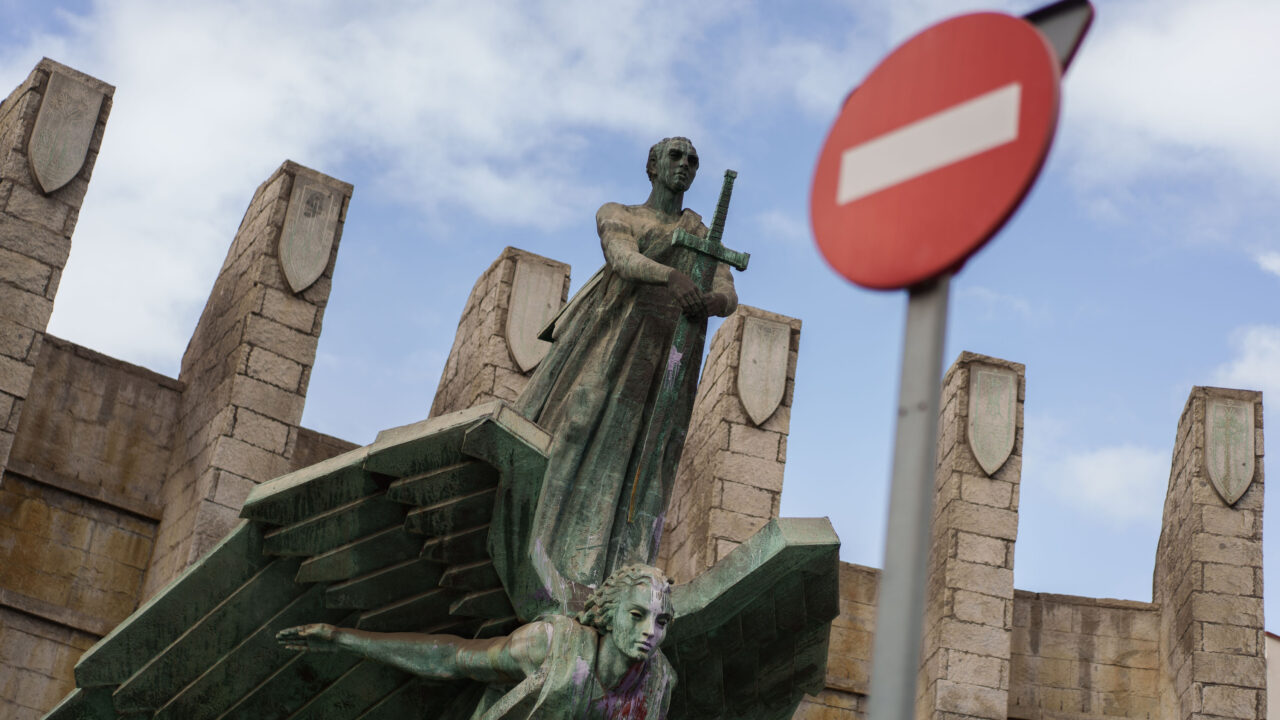
The governing team at Santa Cruz de Tenerife City Council (CC-PP) has lodged an appeal with the National High Court against the inclusion of the monument to Franco in the catalogue of symbols and elements contrary to democratic memory, and against the order for its removal within six months.
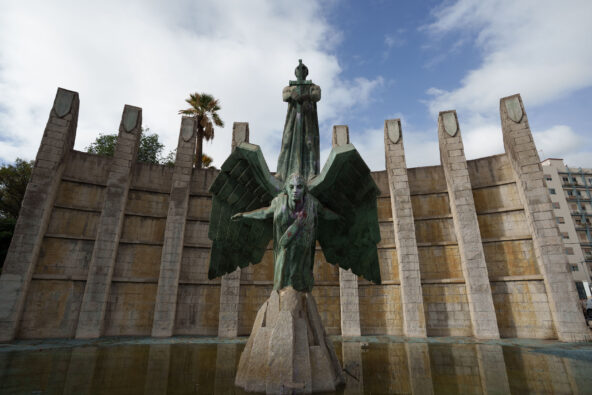
In that administrative appeal, to which EFE has had access, the Town Council chaired by the nationalist José Manuel Bermúnez considers the decision taken this summer by the Ministry of Territorial Policy and Democratic Memory to include the ‚Monument to Victory‘, also known as the Angel Monument, in that catalogue to be unlawful, and is seeking a provisional suspension of the decision.
In her appeal, the council’s solicitor states that «the necessary conditions are met to consider that the actual enforcement of the decision would result in irreparable harm or harm that would be very difficult to remedy».
Santa Cruz: Town Hall warns of irreversible damage caused by mining
Thus, she points out that the removal of the monument will entail ‚large-scale‘ works, which will not only cause significant disruption to the public due to the traffic diversions involved, but also bring about a ‚radical change‘ that will affect the city’s appearance, making it ‚essential to replan the area where the fountain is located and to install elements to replace the monumental complex‘.
Furthermore, she argues that the dismantling and storage of the monument entails a significant financial cost, which will have to be borne by the municipal treasury.
The City Council also warns that the «risk of collapse» of the retaining wall at the Almeyda barracks must be taken into account, and that this necessitates further works; it therefore emphasises that the measures to be carried out «are of such a scale that they could hardly be reversed» should the appeal be upheld.
She also maintains that dismantling the monument would involve the disassembly and ‚irreversible‘ technical intervention on Juan de Ávalos’s sculpture, which is made up of various assembled pieces; this would cause structural, material and aesthetic damage to the work that would be ‚impossible to repair‘.
The Council concludes that dismantling and confining a building of this nature is tantamount to declaring its «technical ruin and physical destruction, thereby completely undermining the legal concept of ‚deposit and custody‘, which requires the preservation of the property».
Franco monument: Artistic merit should justify its preservation, regardless of its origins
In its view, the interest in preserving the monumental complex must take precedence, since, as acknowledged in the contested decision itself and in the report on which it is based, it possesses «undoubted artistic, technical, compositional and urban values», given that it is the only work in the Canary Islands by Juan de Ávalos, an artist who was one of the «most significant figures in 20th-century Spanish sculpture».
As regards its landscape and urban significance, the City Council maintains that the monument has been part of the city’s historic urban fabric since 1966 and serves as a «landmark that has provided a point of reference for several generations».
Its location, it adds, is adjacent to a historic fortification (Almeyda Fort), and the overall impression of the site could be altered if one of its elements were to be removed.
The City Council also argues that the artistic and architectural reasons for its preservation have not been taken into account, ‚regardless of its propagandistic origins‘, as it maintains that this contravenes ‚the legislator’s clear intention to protect works of exceptional artistic value, regardless of the context in which they were originally created‘.
Nor, in its view, have the resolutions taken into account the fact that its inclusion in the Catalogue of Protected Cultural Heritage Assets of Santa Cruz de Tenerife is currently being processed, nor its architectural value as a retaining wall for the Almeyda barracks.


Comments (0)
No comments on this article yet.