

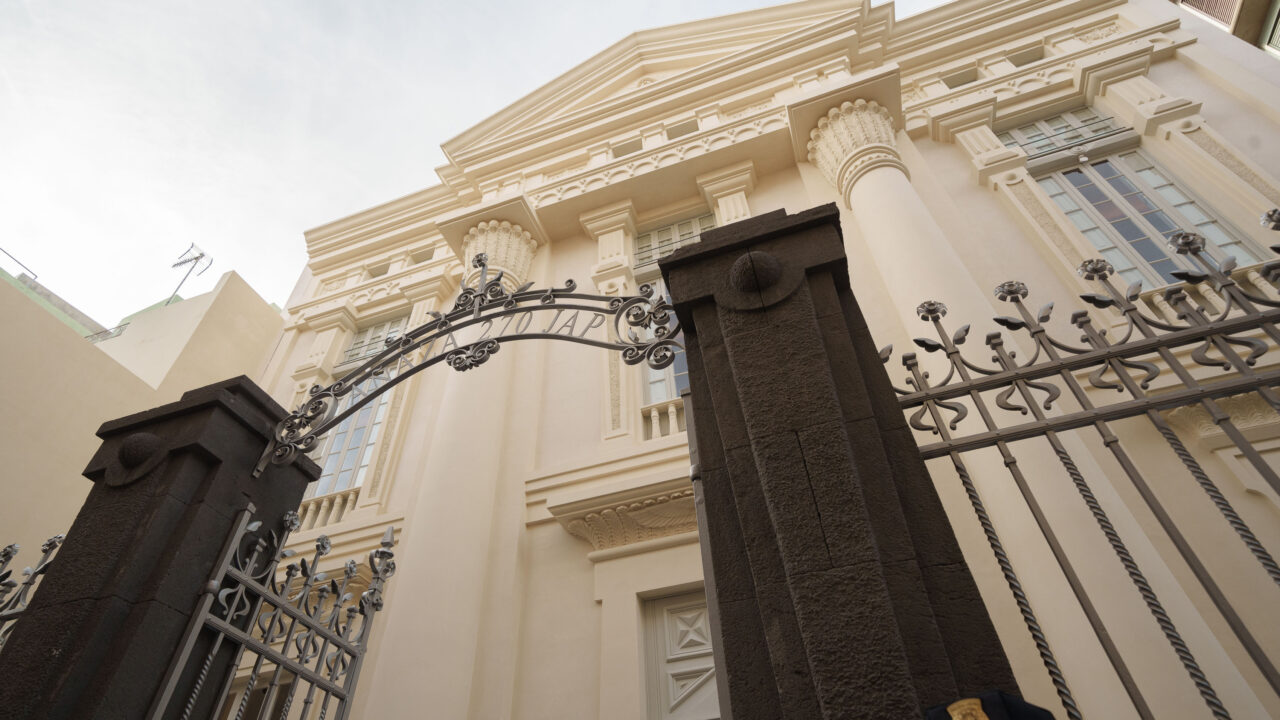
The Government has formally recognised the Masonic Temple in Santa Cruz de Tenerife as a Site of Democratic Memory; this early 20th-century building is regarded as the principal testament to the repression suffered by Freemasonry in Franco’s Spain from 1936 onwards.
In fact, the resolution published in the Official State Gazette (BOE) announcing its new legal status emphasises that the Masonic Temple of Tenerife was «a place where serious human rights violations and crimes against humanity were committed, having been subjected to systematic persecution by the Franco regime from the very first days of the coup d’état in July 1936».
This building in the centre of Tenerife’s capital is the main legacy of the Añaza Lodge, whose «archives and documents were seized, its members arrested, tortured and, in many cases, executed or disappeared, whilst the building itself was used as a centre for repression, interrogations and military storage», adds the Secretary of State for Democratic Memory.
Santa Cruz de Tenerife: Masonic temple granted official commemorative status
Currently owned by Santa Cruz de Tenerife City Council, the Masonic Temple suffered the consequences during the Civil War and the dictatorship of «a campaign of persecution against Freemasonry, epitomising terror, repression and the criminalisation of freedom of thought».
The Government emphasises that all of this makes it «a symbol of political violence and the violation of fundamental rights during Franco’s dictatorship».
The building thus becomes the second Site of Democratic Memory to be designated in the Canary Islands, where the Tefía Penal Colony (Fuerteventura) already holds this status; this was a concentration camp used by the Franco regime to repress and subject detainees to forced labour on the sole grounds of their homosexuality.
The Masonic Temple is one of Spain's most significant Masonic lodges
The symbolism of the Masonic Temple is uniquely linked to the repression under the Franco regime, but its significance goes beyond that, as it constitutes one of the main legacies of Freemasonry in Spain.
It was, in fact, the «largest centre of Freemasonry in Spain until the military occupation of 1936»; it stands out as one of the most significant examples of Masonic architecture in the country and, in the early 20th century, housed a secular school that provided free lessons to adults, «following a curriculum in line with the progressive educational trends of the time».
The building features an Egyptian-inspired façade that displays various elements of Masonic symbolism and which, despite the deterioration it has suffered over time, has essentially retained its original form since the completion of the decorative works in 1923.
The Franco regime used the temple for propaganda and military purposes
During the years when it was seized by the Franco regime, it initially served as the headquarters of the Falange, which used it to organise guided tours in which its significance was ‚distorted‘ and the population’s fears were stoked ‚regarding the supposed sinister aims of Freemasonry‘.
It was then converted into a provisions store and, later on, turned into a military pharmacy.
«In 2009, during repair work on the temple, human remains were discovered which corroborate the testimonies of those who were cruelly persecuted there,» adds the BOE.
Its designation as a Site of Democratic Memory marks the culmination of the agreement signed a year ago between the Ministry and Santa Cruz de Tenerife City Council, governed by CC and the PP, to raise awareness of the history of Freemasonry in the Canary Islands and Spain, to sensitise the public to the persecution it suffered, and to organise activities that contribute to a better understanding of its historical and contemporary role.


Comments (0)
No comments on this article yet.