

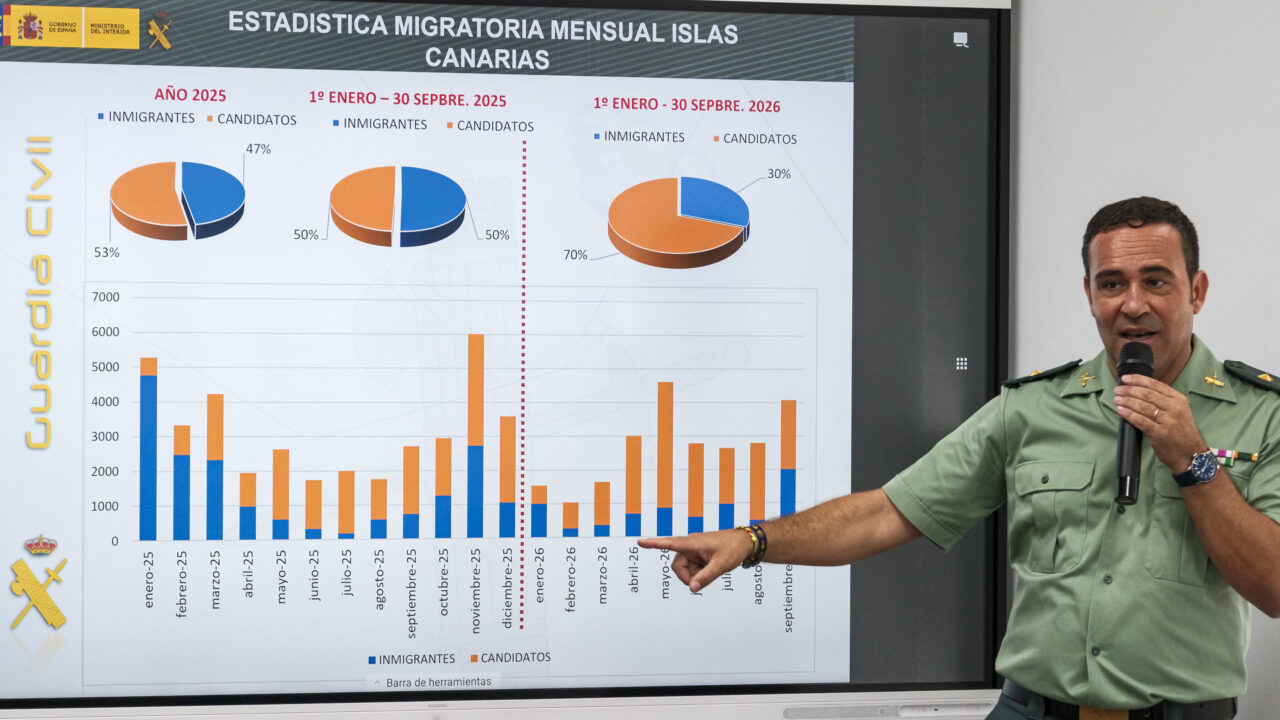
The Guardia Civil’s maritime surveillance operations and on-the-ground cooperation with police forces in various West African countries have this year succeeded in preventing two out of every three small boats or canoes carrying migrants from setting sail for the Canary Islands, 67 per cent.
This Tuesday marks the 20th anniversary of one of the most significant legacies of the so-called ‚cayuco crisis‘ of 2006: the establishment of a single command structure for immigration control along the Spanish coastline and the creation of the Canary Islands Regional Coordination Centre (CCRC), which enables the Guardia Civil to direct all its operations in West Africa from Las Palmas de Gran Canaria
The anniversary has provided an opportunity for the Government Delegation in the Canary Islands and the Guardia Civil to take stock of the situation regarding the Atlantic Route, which has brought almost 236,000 people to the islands over the past two decades, not counting those who have lost their lives at sea.
Canary Islands: Coordination centre centralises operations against people-smugglers
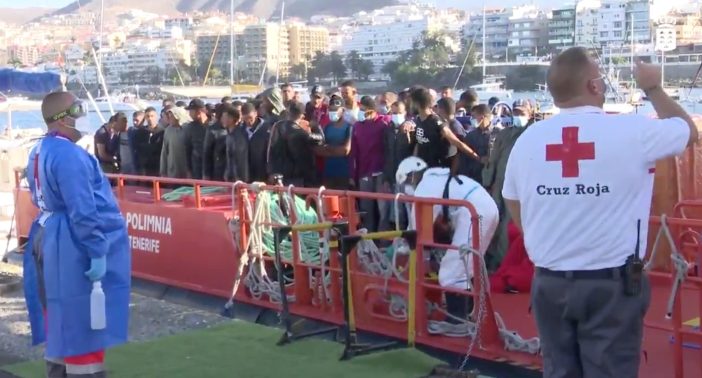
Pestana has emphasised that the CCRC has enabled all the agencies involved, such as the Guardia Civil, the National Police, Maritime Rescue, the Air Force Search and Rescue Service, the Red Cross, the Navy, the Canary Islands health service and Civil Protection, to work together, which has proved crucial not only in preventing departures from Africa, but also in saving lives at sea.
To this end, the police cooperation provided by the authorities in Morocco, Mauritania, Senegal, The Gambia and Guinea-Conakry has proved vital, as has the work carried out on the ground in those countries by Spanish Civil Guards under the command of the CCRC, work which «sets an international example», he emphasised.
The Guardia Civil shares the fruits of all this work with the Moroccan Gendarmerie, the Mauritanian Gendarmerie, the Senegalese Navy and Police, and with all its African partners, organisations which, in turn, already have liaison officers permanently stationed at its facilities in Las Palmas de Gran Canaria.
This has helped to successfully step up investigations into and the prosecution of organised crime groups, to the extent that arrests have been made within a few days of a vessel arriving in the Canary Islands, as highlighted by the head of operations at this coordination centre, Commander Agustín Barroso.
The Canary Islands have recorded a 44 per cent drop in visitor numbers
The Government delegate has stated that, as of 4 October, 7,280 people have arrived in the Canary Islands in small boats, inflatable dinghies and canoes; this is 44 per cent fewer than the number recorded during the same period in 2025, a year which ended with a 62 per cent reduction.
However, even more have been stopped at the border with the cooperation of African partners, some 17,000 this year alone.
The Atlantic route remains dangerous, with arrival figures falling
Anselmo Pestana pointed out that this migration route remains the most dangerous way to reach the European Union and that those who venture along it face increasingly long and perilous journeys, setting off from as far afield as Guinea-Conakry and Guinea-Bissau.
Following two years in which arrivals soared to record highs (39,910 rescues in 2023 and 46,843 in 2025), 2025 ended with just under 18,000. This reduction in migration flows is expected to continue this year, which will help to ease the pressure that has been felt in recent weeks at the temporary reception centres on El Hierro and Lanzarote.
Between 6 per cent and 12 per cent of those arriving on the islands in makeshift boats are women, whilst between 6 per cent and 7 per cent are minors; these percentages have remained more or less stable.
West Africa: Cooperation prevents up to 70 per cent of departures
Thanks to the «extremely close cooperation of the authorities in the migrants‘ countries of origin and transit», the number of small boats and canoes setting sail was reduced by 50 per cent in 2024 and 2025. This year, that figure has risen and has on several occasions been around 70 per cent.
Anselmo Pestana has linked this to the visit that the Prime Minister, Pedro Sánchez, and the President of the European Commission, Ursula von der Leyen, made in 2024 to Mauritania and Senegal to ask both countries to become more involved in the fight against immigration mafias, for which they even went so far as to amend their domestic legislation or enact it almost from scratch, as The Gambia is now doing, introducing prison sentences for those involved in this type of crime.




«Canary Islands route: Two out of three sailings cancelled»
No comments on this article yet.