

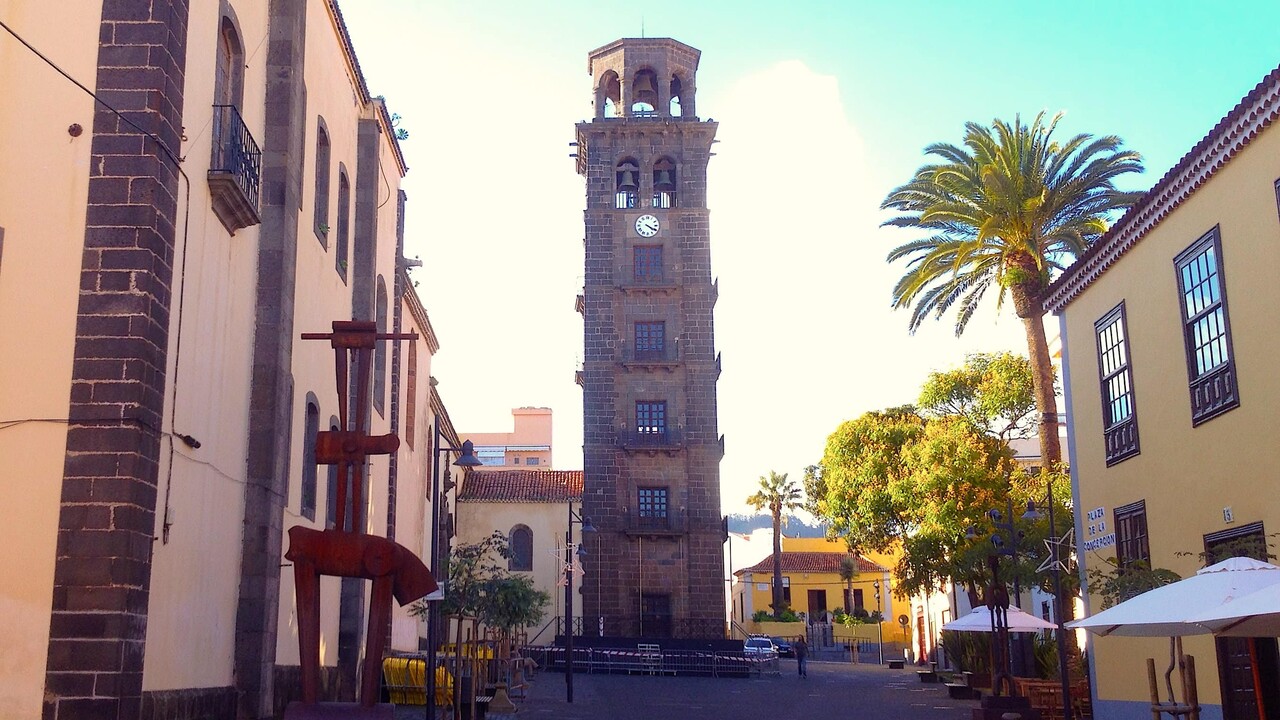
In our travel guide to La Laguna, we’ll take you on a tour of Tenerife’s third-largest city.
La Laguna Travel Guide – the history of the town
La Laguna owes its name to a peculiarity of the Spanish language: whilst lagoons are, in the literal sense, bodies of water connected to the sea and are therefore salty, the Spanish language also refers to freshwater lakes as lagoons. The city in the north of Tenerife was the first colony established by the Spanish conquistador Lugo. It was founded in 1496 on the shores of such a lake. La Laguna’s landmark is the Iglesia de la Concepción. It stands not far from the southern shore of what was then a lagoon. Today, La Laguna is, of course, much larger – and Tenerife’s university city.
Situated at an altitude of just under 600 metres above sea level, La Laguna was once a strategically very important colonial town. As well as offering protection from attacks from the sea, the landscape also provided ideal conditions for agriculture. In the surrounding countryside, this has been partially preserved to this day.
The lagoon from which the city takes its name, however, no longer exists – nor does the name of the capital. Where the water once stood, there are now buildings and the motorway between Tenerife’s current capital, Santa Cruz, and the Orotava Valley. Following extensive restoration work, the city was designated a UNESCO World Heritage Site in 1999. Our La Laguna travel guide presents the most important sights below.
Map: The city map of La Laguna
The numbers on our map will help you find your way around when looking for places of interest. In the following sections, you’ll regularly find references to which number corresponds to each place of interest: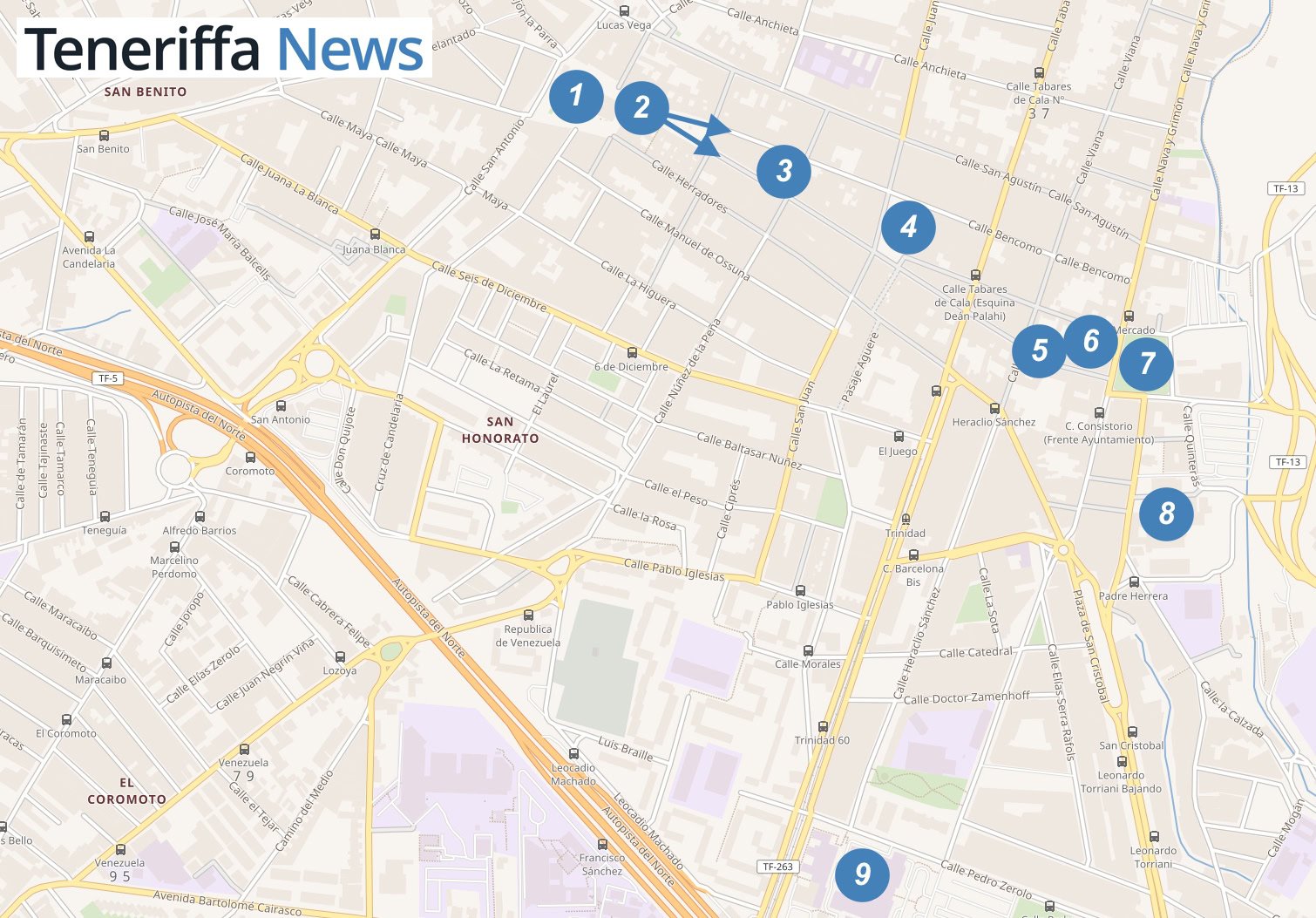
Attractions in La Laguna on Tenerife
The main attractions in La Laguna are within walking distance. We recommend travelling by bus. Alternatively, you should park your car in the upper part of the old town. From there, you can walk towards the old town, which is home to almost all the sights. We’ll tell you exactly which ones visitors to the town should see below:
Iglesia Nuestra Señora de la Concepción
(You’ll find the church on our map of La Laguna marked with the number 1.)
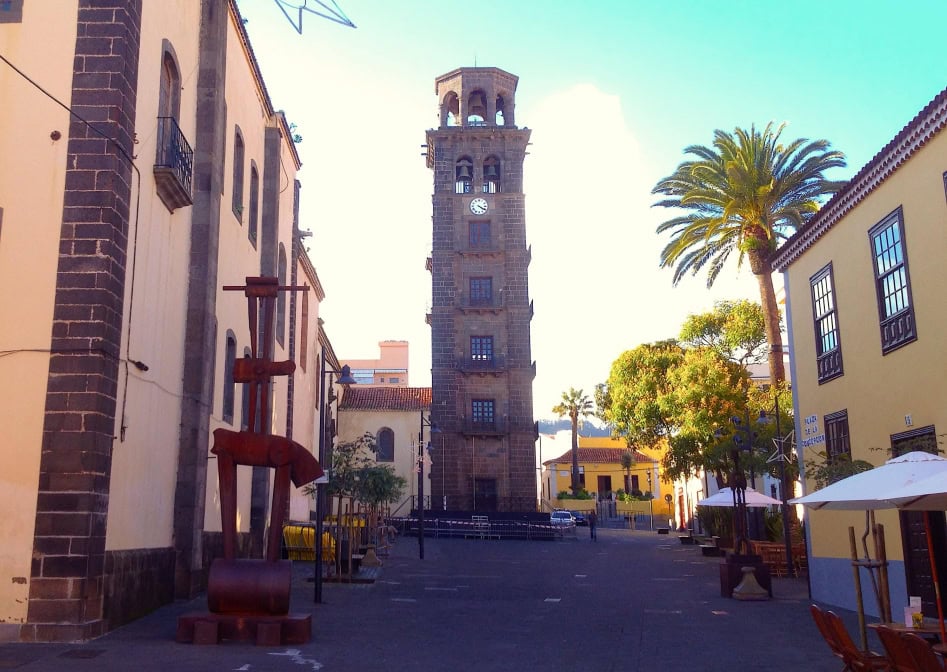
The Church of La Concepción is considered to be the oldest parish church in Tenerife. It dates back to 1496. Nothing remains of the original building today. Indeed, the church has had an eventful history. Following various renovations and new constructions, it is now a complex of interconnected buildings spanning almost every era since its construction began.
The church is the eye-catcher at the upper end of the pedestrian zone, as its black tower is visible from afar. The original tower was built in 1577, but quickly collapsed. A new attempt was made in 1630, but this too came to an abrupt end in a similarly tragic manner. The third attempt was more successful: the structure, built in 1694, still stands today. A number of modifications have been made; for example, a baptistery was added on the ground floor of the six-storey tower.
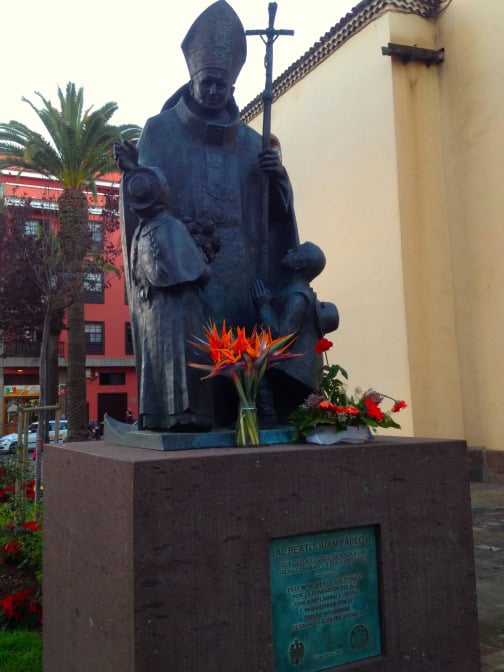
The church can be accessed via its side entrances. Inside, alongside the baptistery, the artesonado ceiling is particularly worth seeing. There is also a sculpture of John Paul II on the forecourt. It was erected in his honour after the then Head of the Catholic Church had visited the island.
La Laguna’s historic old town
(You can find the old town on our map of La Laguna marked with the number 2.)
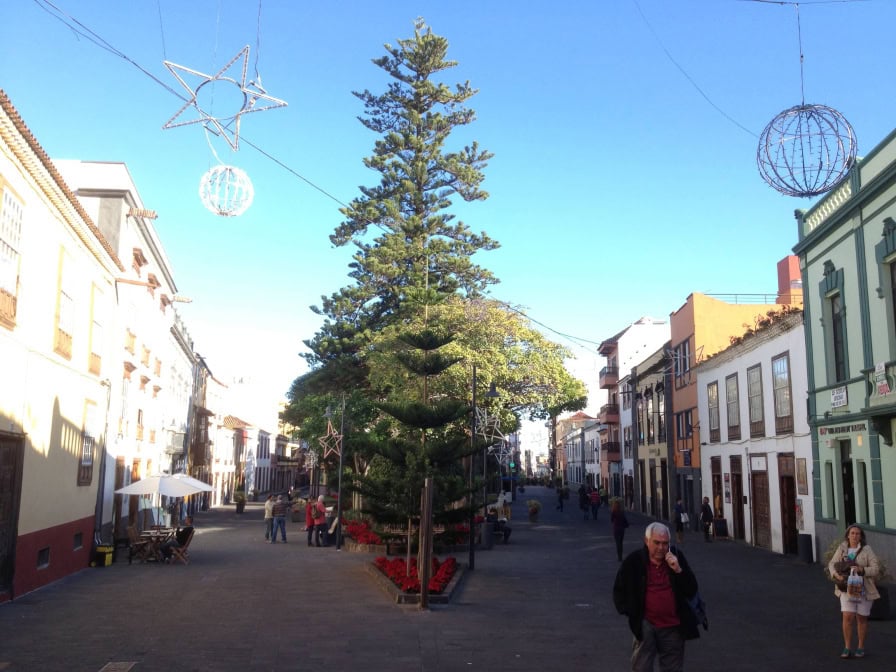
Below the church lies the historic old town, complete with its pedestrianised area. Looking down, the road forks – Calle Obispo Rey Redondo runs to the right, and Calle Capitán Brotons to the left. Both streets lead to the Plaza del Adelantado. On both sides, there are historic buildings, most of which have been lovingly restored. Various shops invite you to have a browse, whilst small cafés and bakeries invite you to linger.
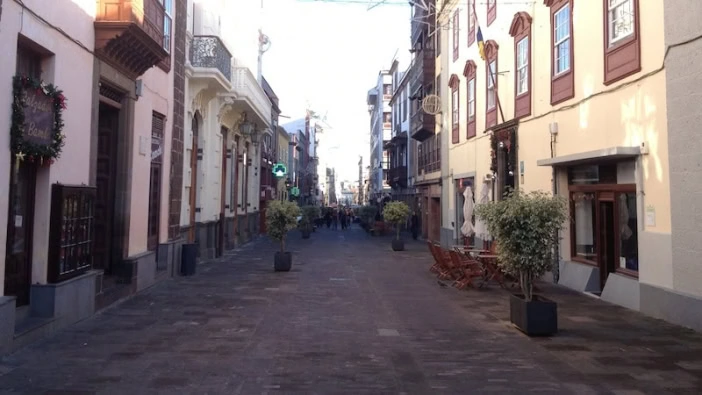
The Teatro Leal
(You can find the theatre on our map of La Laguna, marked with the number 3.)
Architecture enthusiasts in particular should make a point of visiting the Teatro Leal. Commissioned in 1915 by its namesake, Don Antonio Leal, the building, with its typically eclectic façade and beautiful balconies, is situated right on the pedestrianised street. Inside, it can accommodate more than 1,000 people. In the 1960s, it was mainly used as a cinema. Around the turn of the millennium, the Teatro Leal had to close for a full 18 years due to extensive renovation work. It has been open again since 2008. The Spanish Crown Prince Felipe and his wife Letizia even travelled to the island for the accompanying celebrations. Today, it hosts a variety of theatre performances and comedy shows.
The Cathedral of Nuestra Señora de los Remedios in La Laguna
(You can find the cathedral on our map of La Laguna marked with the number 4.)
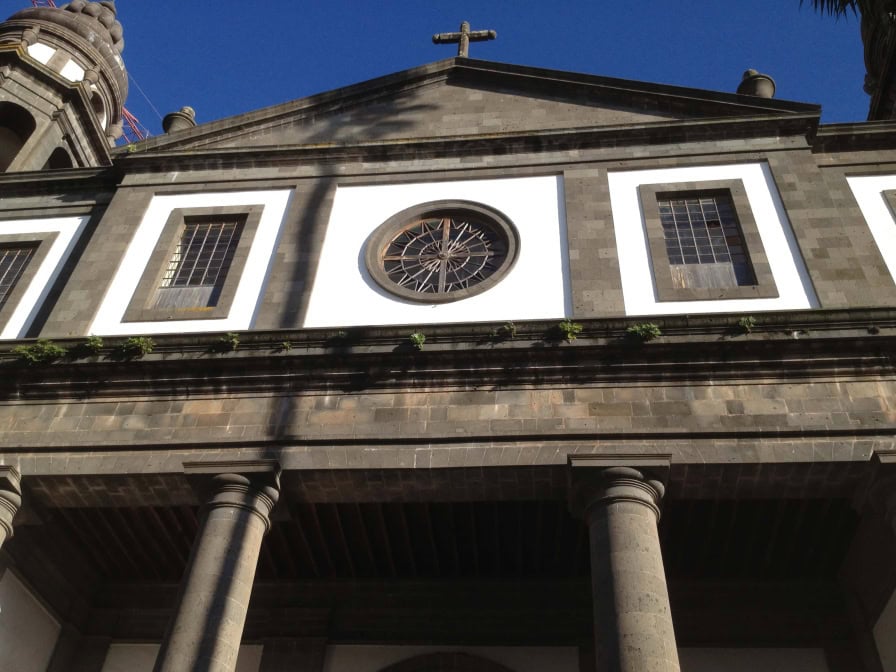
The Cathedral of Nuestra Señora de los Remedios in La Laguna is the city’s most famous church. The decision to build it was taken in 1515. Seven years later, a single-nave church in the style of the Canary Islands was consecrated. In the decades that followed, it was repeatedly extended through the addition of new sections. By 1590, this had resulted in a church comprising a central nave and two side aisles. At the beginning of the 17th century, work finally began on the construction of a church tower, and in 1656 the island’s tallest tower was completed. However, as early as 1691, due to an acute risk of collapse, it had to be replaced by a new structure, which did not reach the original height. In 1751, a church clock was also installed.
However, by the beginning of the 19th century, the tower and façade were once again considered at risk of collapse. Further restoration work, including the construction of some new sections, was initiated using private funds. In 1819, the parish church was designated as the newly established bishop’s see for the Western Canary Islands. However, accompanying alterations towards the end of the century led to cracks reappearing. It was decided to demolish the building and construct a new one, which was consecrated on 6 September 1913.
However, as early as 1950, water was repeatedly seeping through the ceiling. Sand from the island’s beaches had been used in its construction. The salt it contained caused the reinforcement bars in the concrete to corrode. As a result, pieces of the ceiling kept falling down. On 30 June 2002, the church was finally closed and the bishop’s seat was moved to the Church of Nuestra Señora de la Concepción.
Following its closure, the building had to undergo extensive renovation once again. Glass and polypropylene fibres were incorporated into the concrete instead of metal. The roof was also sealed from the outside with copper sheets. The reopening finally took place on 31 January 2014.
Sights in La Laguna Cathedral
Particularly worth seeing are the chancel ambulatory, with its paintings, and the funerary monument to Alonso Fernández de Lugo. The monument is made of Italian Carrara marble. It was designed by Manuel de Oraá and executed by Angelo de Cherubini.
The high altar, with its ten columns, houses a wooden tabernacle. It was designed by the sculptor and architect José Miguel Luján Pérez, who hails from Gran Canaria. To the left and right of it, the artist has placed statues of Saint Paul and Saint Peter. The tomb of Cristóbal Bencomo, Archbishop of Heraclea, is also situated within the chancel. Also worth seeing: the adjoining marble pulpit by the sculptor Pascuale Bocciardo, dating from 1767.
Visitors to the cathedral should take note not only of the high altar but also of the side altars, as well as the windows and the floor of the cathedral. The baptistery, with its baptismal font built in 1969, is also of particular interest.
La Casa de los Capitanes Generales
(You can find the Casa de los Capitanes on our map of La Laguna, marked with the number 5.)
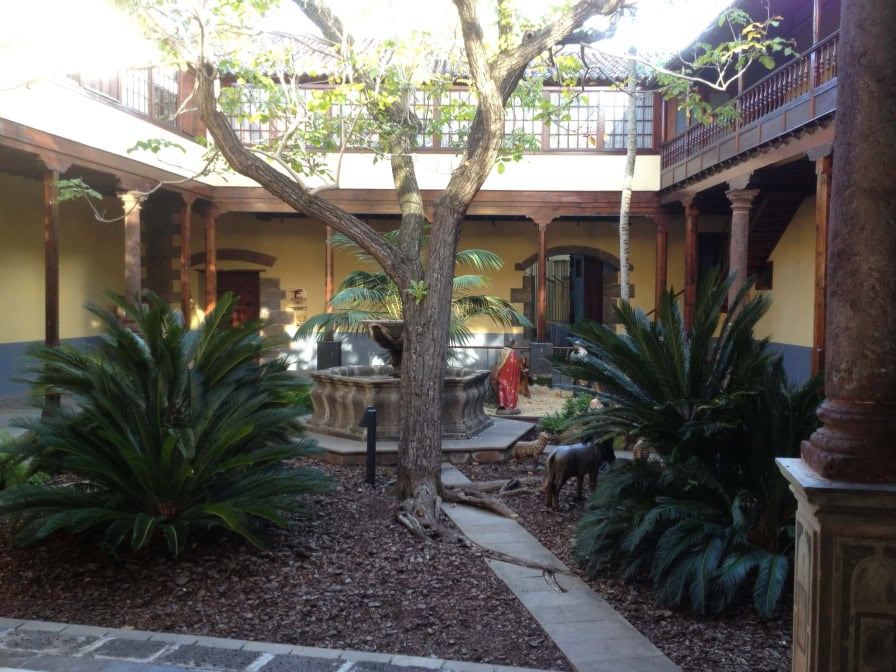
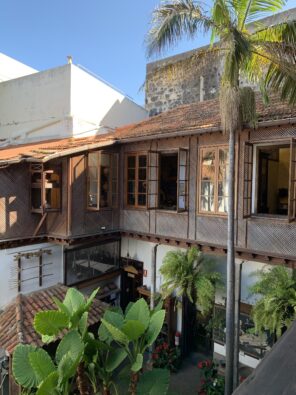
Today, the Casa de los Capitanes Generales houses, amongst other things, a small museum. It’s well worth a visit, and not just because admission is free: the small courtyard alone makes the detour to 7 Calle Obispo Rey Redondo worthwhile. Inside, you can learn about the origins and history of La Laguna.
The house was built between 1624 and 1631 by Diego de Alvarado Bracamonte, who was then Colonel-General of Tenerife. The windows, framed by red ashlar stones, are a real eye-catcher thanks to their asymmetrical arrangement. The same applies to the entrance, above which sits a balcony supported by corbels.
Inside the building, alongside the museum, are the town hall, the mayor’s office, the International Centre for the Conservation of Monuments (CICOP) and the tourist information centre.
The Convento Santa Catalina
(You can find the convent on our map of La Laguna, marked with the number 6.)
Not far from the Plaza del Adelantado stands the Convento Santa Catalina. The convent was built in 1611. A large wall shields the nuns from prying eyes, whilst they themselves – thanks to a large wooden tower – can enjoy a superb view over the city centre.
The convent is dedicated to Saint Catherine of Siena. Around 100 Dominican nuns still live within the convent walls in her name. In addition to the nuns‘ private quarters, there is a small church and a museum. Both can be visited by groups by prior arrangement.
Directly opposite the monastery stands the Palacio de Nava, a palace that has been waiting for years to be converted into a hotel. Consequently, it is no longer possible to visit it.
The Plaza del Adelantado
(You can find the square on our map of La Laguna marked with the number 7.)
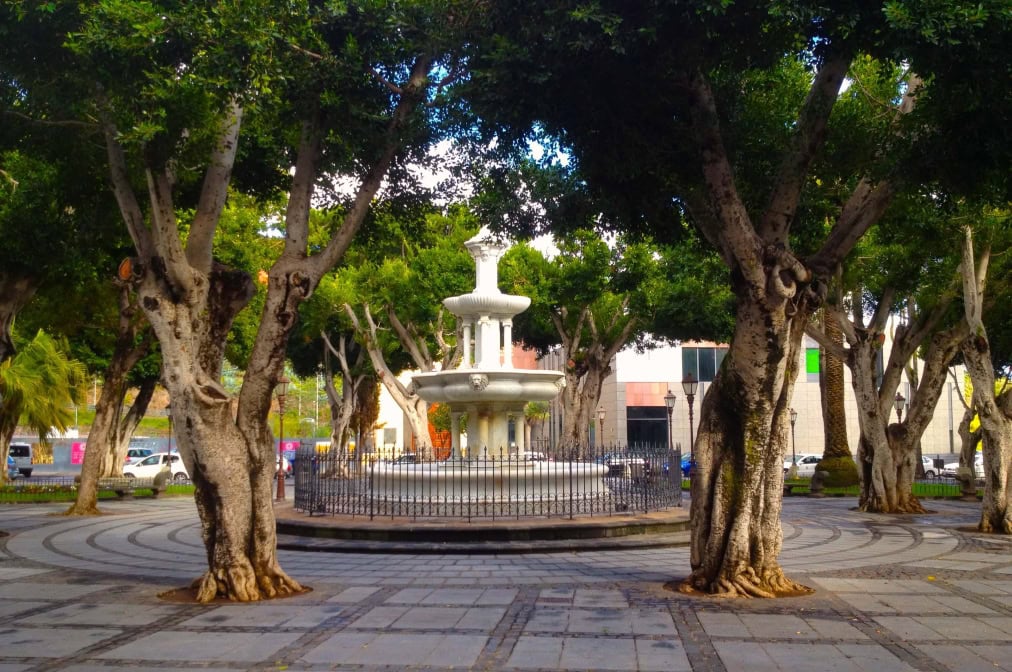
The Plaza del Adelantado is particularly worth seeing. It is dedicated to the city’s founder, Alonso Fernández de Lugo. The conqueror had his residence built on the edge of the square in his day. Then as now, the square is the heart of the city’s life. Whilst in earlier times bullfights were held, punishments carried out or processions taken place here, today the square invites visitors to linger. Locals sit beneath palm and laurel trees, meeting up with friends and acquaintances. It’s well worth a visit – for example, to stop off here for a drink and a rest before heading back up to the upper old town.
The Iglesia de Santo Domingo
(You’ll find the Iglesia de Santo Domingo on our map of La Laguna marked with the number 8.)
Just a few streets away is the Iglesia de Santo Domingo. This 17th-century Dominican church is a simple cruciform church housing a remarkable treasure: the processional monstrance, known as the ‚Custodia‘, is considered the finest in the Canary Islands. It dates from the 18th century. Also worth seeing are the expressionist frescoes in the nave and chancel, painted by the renowned Castilian artist Mariano de Cossio.
The high walls of the church merge into the adjoining monastery walls. It was here that the first chair was established. From 1532 onwards, philosophy, grammar and logic were taught, which, in conjunction with the university that is still based here today, earned the town the unofficial title of ‚the intellectual centre of Tenerife‘. Today, exhibitions are held in the monastery. Visitors should definitely take a look at the wooden balcony that runs around the building. The view is well worth it!
Restaurants in La Laguna
If you’re looking for places to go out in La Laguna, you can use our extensive database. It not only features the best restaurants in La Laguna, but also all the key information on opening times and how to get there, as well as various other filter options, such as
- the best pizza in La Laguna
- the best tapas bars in La Laguna
- the best cafés in La Laguna
- the best bars in La Laguna
and much more besides.
Nightlife in La Laguna
(You can find the university district on our map of La Laguna marked with the number 9. However, it is considerably larger than the marker and extends beyond it.)
Heading further south takes you to the university district. The nightlife there is particularly noteworthy. There are numerous bars, pubs and nightclubs lined up one after the other. Anyone who gets caught up in the vibrant atmosphere of La Laguna can still use the ‚Tranvia‘ tram late into the night; it runs every half hour to and from Santa Cruz.
Special fiestas in La Laguna
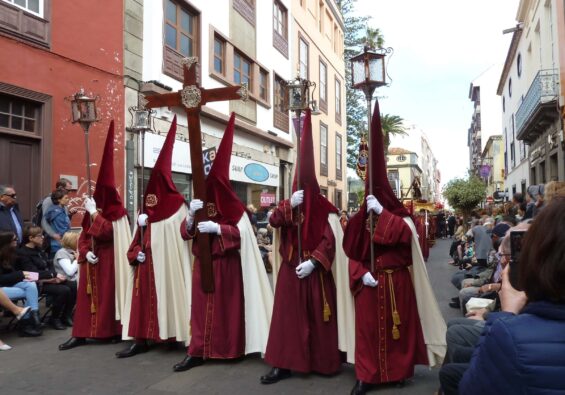
There’s plenty of celebrating in La Laguna, particularly during Semana Santa, the week before Easter. La Laguna is also known for the festivities surrounding Corpus Christi, the Sunday after Corpus Christi. Also worth seeing: the Romería de San Benito in June or July and the Santísimo Cristo de La Laguna on 14 September.
The weather in La Laguna
La Laguna is situated very close to the lush Anaga Mountains. Consequently, there is rainfall that keeps the region green. The sky above La Laguna is therefore regularly covered with thin, and sometimes heavy, rain clouds. The weather can nevertheless be described as good. However, it is not consistently reliable. You can see exactly how the weather in La Laguna is set to develop in our weather forecast under «Weather in North Tenerife» here.
La Laguna in figures
After the town lost its status as the island’s capital in 1823, La Laguna developed into the religious and intellectual centre of Tenerife. Today, around 155,000 people live within its area of more than 102 square kilometres, including some 25,000 students. This makes La Laguna the third-largest city in Tenerife. It is also the episcopal see of the Canary Islands.
La Laguna Travel Guide – More Tourist Information
La Laguna is a remarkable city with numerous sights to explore. It is advisable to allow at least one day for sightseeing. Further information about the city is available at the Tourist Information Centre in the Casa de los Capitanes Generales. It is open from October to June, Monday to Friday from 9.00 am to 4.30 pm, and from July to September until 3.30 pm. The office is closed at weekends and on public holidays.
«Travel guide to La Laguna on Tenerife - sights, information and photos»
No comments on this article yet.