

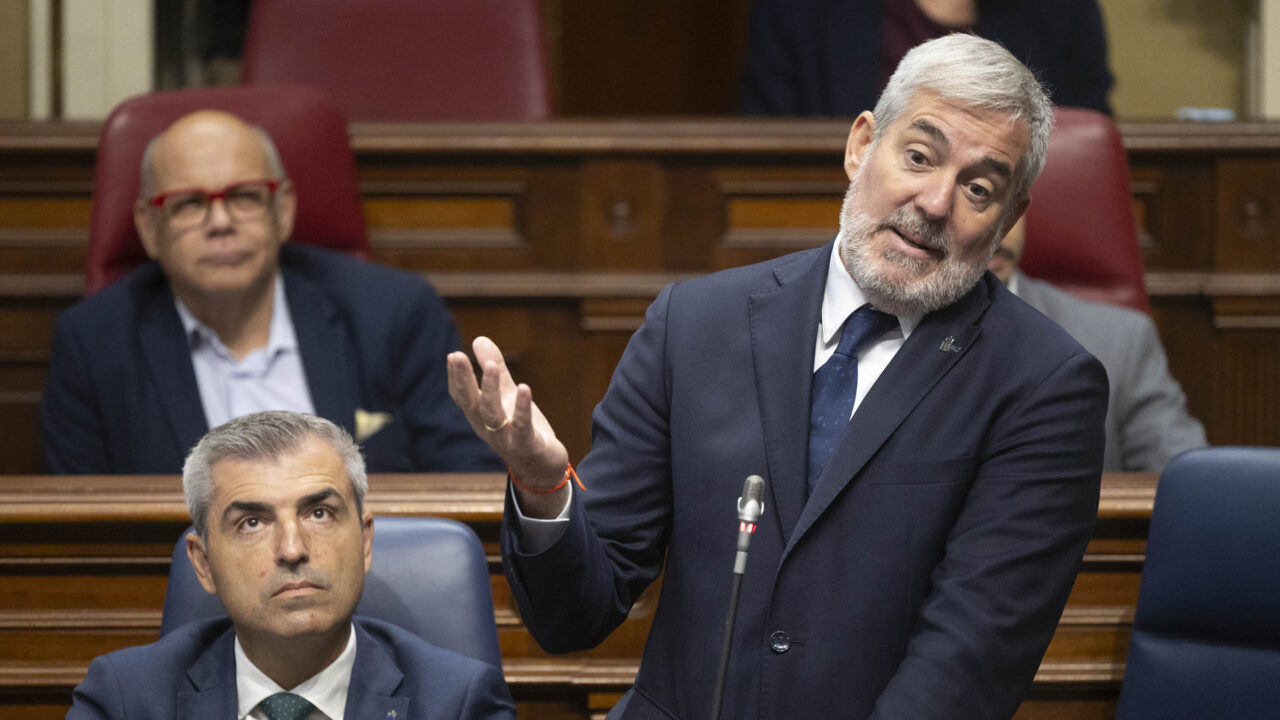
The President of the Canary Islands, Fernando Clavijo, stated on Tuesday that «of course the Canary Islands Government is a real estate company», in response to one of the slogans chanted by housing protesters, and argued that his administration has «more than 20,000 homes in its portfolio» for «the most disadvantaged» and that it leads the way in housing construction and planning permission approvals in Spain.
Clavijo, who answered four questions on housing during the question time session of the Parliament’s plenary sitting, made these remarks after the PSOE spokesperson, Sebastián Franquis, pointed out that the claim that «the Canary Islands Government is a real estate company» highlights the fact that the regional executive «acts as an intermediary for the private interests» of the sector.
Franquis has criticised the president for the fact that, after 38 months in government, families are still facing rises in rent and house prices, and has accused the government of refusing to cap rent increases despite having the means to do so, and of allowing foreign investment funds to operate in the property market with «complete lack of transparency».
Canary Islands: Clavijo highlights 4,000 social housing units under construction
The Socialist spokesperson has maintained that the social housing units currently under construction are part of the plan approved during the previous parliamentary term and not the result of decisions taken by the current Government; he has stated that Clavijo did not build any social housing during his previous term as president and has predicted that he will end this term without having built any such housing resulting from his own political decisions.
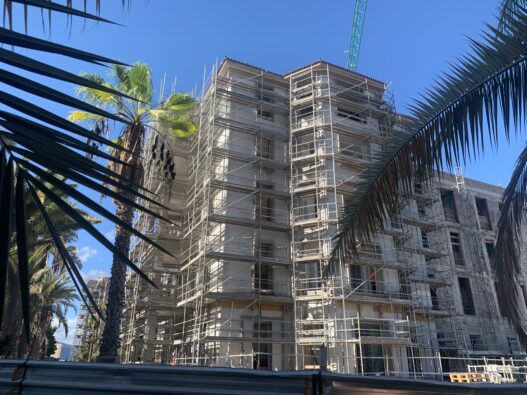
President Clavijo responded that 4,000 social housing units are currently under construction, funded by budgets approved by his Government, despite the Socialists voting against them, and pointed out that 7,500 private homes will be completed by 2026.
He has argued that the Canary Islands are, in relative terms, leading the way in terms of housing construction and planning permissions, according to figures he attributed to the Bank of Spain, and has maintained that his administration has highlighted the «total lack of management» on the part of the previous regional government and the central government.
The president has asked the PSOE whether it will support the restriction on the purchase of homes by foreign nationals that his government has proposed to the central government as part of the process of enacting the housing decree-law, as well as the signing of an agreement to build social housing, with 105 million euros contributed by the State and 200 million by the autonomous community.
Nueva Canarias accuses the government of being too close to the property sector
During the same parliamentary session, the spokesperson for Nueva Canarias, Luis Campos, urged Clavijo to choose between «speculators» and those unable to access housing, and argued that it was the protests that had led Coalición Canaria to support one of the state housing decrees and prompted the executive to initiate the procedure for declaring stressed areas in Las Palmas de Gran Canaria after two years of rejecting it.
Campos has accused the executive of promoting measures in collaboration with the construction and property industry associations, and has criticised the Canary Islands Government for rejecting all his party’s initiatives aimed at improving access to housing.
Clavijo retorted that NC, whilst it was in charge of the Vice-Presidency and the Treasury, had denied Visocan the funds needed to build social housing, and contrasted the 4,000 social housing units currently under construction with the «zero» that, he claimed, were built during the previous parliamentary term.
The President has stated that his Government’s measures «have reversed the trend» in the housing market and has emphasised that the Government stands with tenants, but also with small property owners, given that 92 per cent of property owners in the Canary Islands own one or two properties.
Vox is calling for more building land and lower taxes
Vox spokesperson Nicasio Galván has accused Coalición Canaria of supporting a central government decree that «undermines private property» and which, he claims, has led to properties being withdrawn from the market.
Galván has called for the construction of more homes, the reduction of red tape, the liberalisation of land use regulations and a cut in taxes, which, he stated, account for 30 per cent of the final price.
The president replied that the state decree, backed by Coalición Canaria, was intended to protect tenants and small landlords as tenancy agreements extended during the pandemic were due to expire, although he acknowledged that it would not solve the housing problem.
He agreed with Galván that it is necessary to build more homes and offer guarantees to landlords so that they will let out their properties, as well as providing legal certainty for tenants, and stated that the government has more than 20,000 rented homes.
Foreign buyers: Clavijo defends planned restriction
In response to CC spokesperson David Toledo, Clavijo has defended the restriction on home purchases by foreigners, who account for a third of demand, and has emphasised that his government has submitted a draft decree-law to the central government and has undertaken to hold talks with the political groups in the Permanent Deputation of Congress to secure its ratification.
David Toledo has accused the PSOE of rejecting restrictions on property purchases by foreign nationals in 2024 and 2025 on the grounds that they were unworkable, only to accept them in 2026 when it needed the support of Coalición Canaria in Parliament.






«Clavijo turns housing protest slogan on its head in Canary Islands»
No comments on this article yet.