

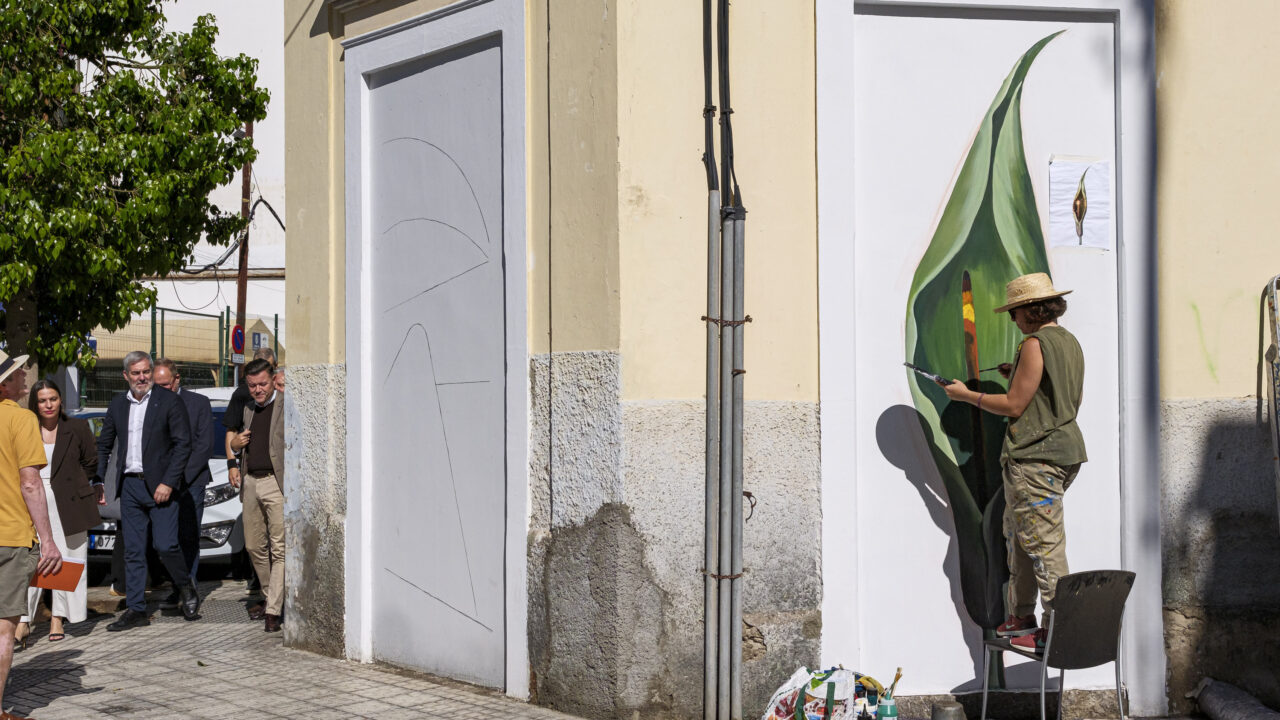
The mural project being run in the Arenales neighbourhood of Las Palmas de Gran Canaria continues to make progress with 17 new artworks at the former La Favorita tobacco factory, a space that local community groups hope to transform into a creative hub open to the neighbourhood.
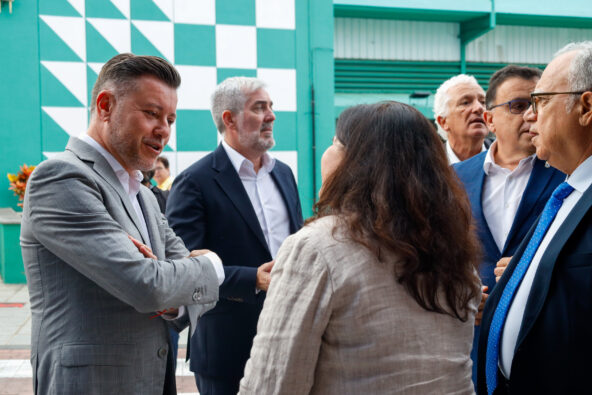
The initiative was discussed on Thursday during a visit by the President of the Canary Islands, Fernando Clavijo, to the artistic events taking place as part of the ArenArte project, which has been launched by the regional government to revitalise Arenales through urban art.
The 17 new murals join those already painted on a façade on Calle Arco, by Capi Cabrera, and another on the façade of LABA (Laboratorio de Barro), created by Irene León.
Arenales: Murals encourage collective expression
The president of the ‚Fuera de la Portada‘ Socio-Cultural Association, Octavio Cardoso, explained to journalists that the idea came about as «an open-air exhibition open to everyone», in which each artist contributes «a specific theme and concept».
Cardoso pointed out that the project came about following the Canary Islands Parliament’s approval of a non-binding motion relating to the cultural revitalisation of Arenales, and he emphasised the value of murals as a means of community expression and neighbourhood participation.
La Favorita is set to become an open creative centre
As he explained, following this initiative, the opportunity arose to rent the privately-owned La Favorita building for community and cultural use, a project on which several groups are currently working, and where they have already carried out basic refurbishment work and now intend to waterproof the roof, upgrade the electrical system and replace several doors.
Cardoso explained that the aim is to transform this former tobacco factory, which was once a landmark of the industry in the city, into a creative hub open to cultural activities, workshops, street markets, film screenings and concerts.
According to Cardoso, there are photographs from 1911 in which the building’s original façade can already be seen, and, following the relocation of industrial activity to El Secadero, the building was used for various purposes, including as a mechanical workshop and a storage facility for amusement machines, before falling into near-abandonment.
Drug addiction is a problem in the Arenales neighbourhood
When asked about the social situation in the neighbourhood, he stated that the main problem is not prostitution but drug addiction, against which «we have no weapons».
«Prostitution has been here since the neighbourhood’s earliest days and, in a way, they were like part of the family; in many cases, they even looked after the children whilst they were playing in the street,» he added, before going on to state that, nevertheless, «there is sex trafficking and abuse of women».
According to Cardoso, what the residents of Arenales want «is for the quality of life here in the neighbourhood, with its little houses where we practically all know one another, to be restored».
Arenales Association opens a library on prostitution and human trafficking
Cardoso welcomed Clavijo’s visit to the neighbourhood and highlighted the work carried out since 2011 by the association at the local community centre, which is run in partnership with the local council under a co-management agreement.
He also highlighted the association’s social initiatives, such as ‚Conviviendo Arenales‘, which focuses on supporting women involved in prostitution, and announced the opening on the 30th of a ‚violet library‘ specialising in publications on prostitution and human trafficking, where book forums will also be organised.
The chair of Fuera de la Portada has spoken out in favour of the self-management of community spaces and has called on the authorities to provide financial support and public funding schemes to ensure the continued running of neighbourhood projects such as these.




Comments (0)
No comments on this article yet.