

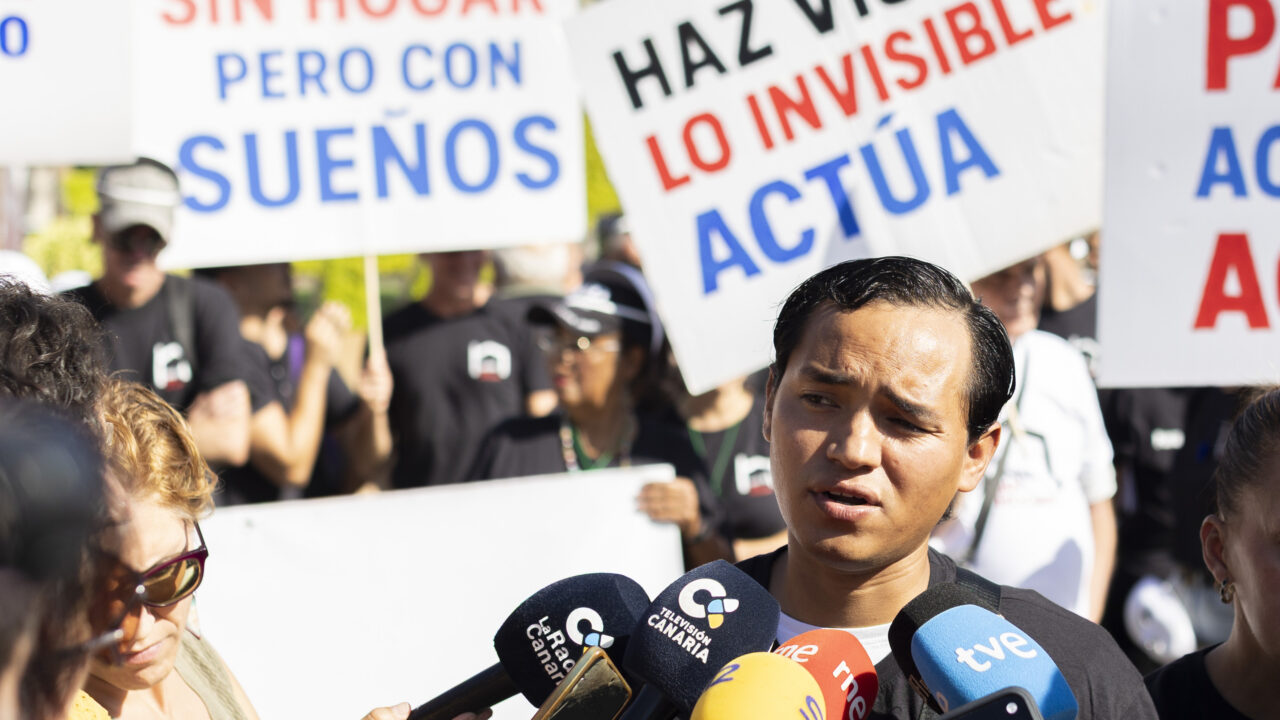
To mark Homeless People’s Day, a young Nicaraguan man and a retired woman from Gran Canaria, who found themselves on the streets after losing the roof over their heads and are now being sheltered by Cáritas, have warned that the housing crisis «affects us all».
Rudy Alorriga and Ana del Pino have come forward to share their personal stories as part of a nationwide advocacy event organised by the Catholic Church’s NGO under the slogan «A home is much more than just a place to live; it is a place where you belong».
At the symbolic event held in Santa Catalina Park in Las Palmas, Eugenia Rochas, head of the housing department at Cáritas in the province, reported that last year the NGO provided support to 1,604 homeless people and 356 families at risk of losing their homes in Gran Canaria, Lanzarote and Fuerteventura.
Caritas: The housing crisis also affects people in work
A support service which, as at 30 September this year, is already helping 1,038 people and 256 families experiencing housing exclusion despite being in work.
Rocha has drawn attention to the extreme circumstances faced by the most vulnerable people, as reflected in the chronic nature of homelessness, which is predominantly experienced by unemployed men with mental health problems or addictions who, in 29 per cent of cases, have been living on the streets for more than five years, and by the normalisation of substandard housing observed in Gran Canaria, Lanzarote and Fuerteventura.
Caravans or caves that are let out as homes
«Spaces such as dwellings that are not actually homes, merely a roof over one’s head, such as a caravan, a shack, a cave or commercial premises, are becoming the norm. They are not suitable places for a person or a family to live, and yet they are currently being let out,» Rocha has denounced.
The head of Caritas explained that this NGO receives «people in precarious employment or living on benefits» who do not earn enough to secure their right to housing.
Most of them are mothers with children who are minors, in many cases single mothers with no support or family networks, who are supporting a household and are faced with the problem of being unable to keep the home they are currently living in, she explained.
Caritas calls for social housing and alternatives to evictions
Although this is the group that gives cause for the greatest concern, Rocha has stated that «the whole of society is affected by the current housing situation we are experiencing» because it also encompasses «exorbitant rents that people cannot afford despite having a job and a more or less stable income».
For all these reasons, Caritas is calling for «public housing policies» and for the relevant authorities to «bear in mind that families and society as a whole need access to a place to live, in some cases, social housing or affordable rented accommodation».
It also calls for «alternatives to evictions to be sought; that, if a family is to be evicted, alternative accommodation should be provided; and that account should be taken of the fact that social and healthcare places are also very important, as are specialised resources» aimed at women.
Rudy and Ana describe their journey out of homelessness
Rudy Alorriga, from Nicaragua, explained that he arrived in Spain in December 2024 and in the Canary Islands in February 2025, «full of hope and in pursuit of a dream». When, after just a few months, his savings ran out, he found himself on the streets.
He currently lives in a Caritas shelter, which has enabled him, following the regularisation of his status, to work as a delivery driver or, at times, to volunteer in a soup kitchen in the mornings.
«Here, for me, it has always felt like a fresh start; despite the difficulties, I have always had the chance to start afresh thanks to the support of these organisations,» he said gratefully, whilst expressing his determination to continue his training so that he can work and build a life for himself in the Canary Islands.
When asked about his professional background, Rudy admits that he enjoys customer service and working with people, which is why he has worked here «in beach bars and at street markets», although he has also «done some work in the building trade».
At the age of sixty, Ana del Pino, now retired, found herself out on the street in the midst of the Covid-19 pandemic, when she was evicted from the room she shared with an elderly lady.
«I’ve seen children on the streets, having a really hard time, and I’m asking the politicians for a little consideration, to help us. I have a roof over my head, thanks to Caritas, and I’ve been with them for nine months, but I’m not going to stay there forever; I’m looking for a flat, even with some colleagues who earn small wages so we can all chip in,» she said.
That’s how she used to live before the pandemic, sharing rooms, because it was the only thing she could afford ‚on what she earned‘, but since she became homeless, ‚everything has gone backwards‘.
«You feel really bad out on the streets,» she recalls, «you see all sorts of situations: it’s not just the homeless, but also those who come from abroad, they have rights too, but they should look after those of us who were born here first and help us as well.»
Ana spent two and a half years sleeping at Gran Canaria airport, a time she recalls with sadness because «more and more people were arriving every day, even with children».








Comments (0)
No comments on this article yet.