

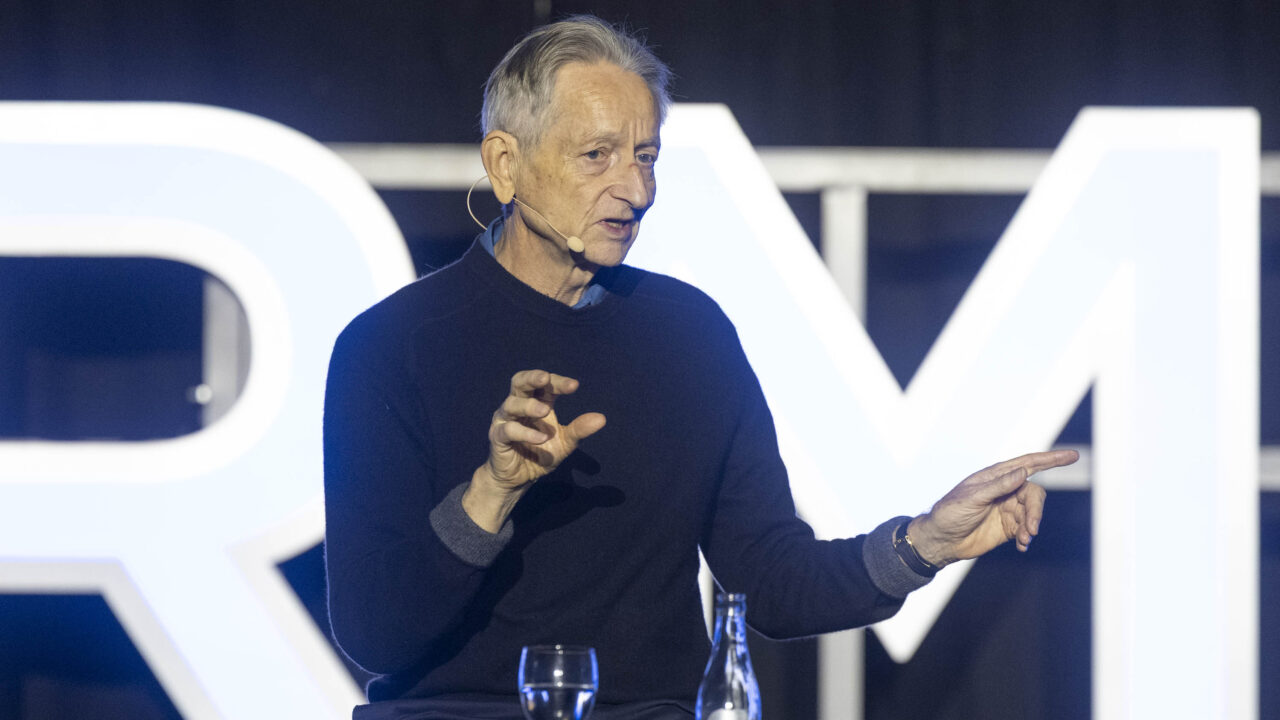
Nobel laureate Geoffrey Hinton, one of the pioneers of artificial intelligence, said on Monday that there will come a time when humans will not understand certain things that AI claims «in the same way that rats do not understand how prime numbers work».
Hinton made these remarks during the opening of the main Starmus conference programme, held in Arona, Tenerife, at a round-table discussion alongside cognitive psychologist and Harvard professor Steven Pinker and former UN climate chief Christiana Figueres.
At the start of Starmus, they discussed the search for truth during a panel discussion moderated by the astrophysicist and founder of the event, Garik Israelian, who posed a question that cuts across artificial intelligence, science and politics: how to distinguish the truth in a world where machines and human beings can make mistakes, collude or select evidence that fits their own convictions.
Artificial intelligence: Hinton expects systems that humans cannot comprehend
Hinton recalled how some linguists initially dismissed the idea that large language models (LLMs) could understand and generate language in a sophisticated manner, even as their capabilities were beginning to become apparent, and cited Noam Chomsky as an example of a researcher who, in his view, did not allow the evidence to prompt him to revise his positions sufficiently.
Hinton has also suggested that artificial intelligence will come to understand matters that may lie beyond the scope of human cognition.
«Just as rats will never understand prime numbers,» he went on to say, «human beings may find themselves faced with systems capable of understanding things that they themselves will never be able to comprehend.»
In that scenario, he added, if a far superior AI claims that something is true, «you’d better believe it», he remarked.
The hallucinations of AI
Regarding what are known as AI ‚hallucinations‘, Hinton has warned that their existence does not prove that machines lack understanding, as human beings themselves also reconstruct memories and fabricate stories about events they believe they know.
He pointed out, therefore, that language models learn from human behaviour, so it is only natural that they repeat such patterns.
During the debate, Steven Pinker agreed that the capabilities of large language models (LLMs) and their implications for the study of human cognition had been underestimated.
Pinker has emphasised, however, that the usefulness of these systems will depend on their ability to provide correct answers and subject them to verification mechanisms, rather than simply optimising user interaction.
Figueres has also put forward a different perspective by asking about ‚my truth‘, understood as the set of accepted principles and facts by which each person guides their life, although she has acknowledged the difficulty of reconciling these differing perceptions.
The truth: Hinton defends the facts, Pinker calls for corrective mechanisms
She has also proposed, as an alternative to the search for absolute certainties, ‚falling in love with uncertainty‘ and using it as a tool to scrutinise what is presented as true.
Hinton has taken issue with that formulation and has defended the existence of an objective truth: «People or cultures may use different concepts, but once the terms have been agreed upon, determining whether a statement is true ceases to be a matter of opinion,» he has argued.
Hinton has brought that discussion to a close by making a distinction: those in power may be able to control what a society perceives as true, but they cannot control the truth itself.
The debate has therefore turned to the question of why evidence does not always succeed in changing people’s beliefs.
Pinker has pointed out that people tend to behave rationally when it comes to immediate matters in their everyday lives, but find it more difficult to deal with complex questions or those far removed from their direct experience, for which, for centuries, there were no reliable methods of verification either.
That is why Pinker has identified this very point as the strength of science, responsible journalism and democracy: not in being infallible, but in having mechanisms in place to ensure that a claim can be challenged and corrected, with institutions capable of maintaining trust by showing how they reach their conclusions, accepting the possibility of being corrected and avoiding identification with ‚political tribes‘.
Climate change: Uncertainty and ideology are hindering concrete action
Figueres has cited climate change as an example of this gap between evidence and action, pointing out that whilst there is broad scientific consensus, those who reject its conclusions may focus on the margin of uncertainty and use it to sow doubt.
In her view, having evidence is not enough either if the social, political and psychological conditions necessary to act on that evidence are not in place.
Finally, Pinker added, with regard to resistance to climate change, that acceptance of the scientific evidence on this issue has been closely linked to ideological identity, in his view, due to the influence of Al Gore, Bill Clinton’s vice-president, and he warned that the politicisation of a scientific issue makes it easier for people to reject evidence associated with the opposing political camp.









Comments (0)
No comments on this article yet.