

Is AI like having a tiger cub at home that will end up devouring us when it grows up? And if artificial intelligence ends up being far more intelligent than humans… Could the solution to sharing the planet with it be not to turn it into an obedient assistant, but into something like a mother programmed to look after a defenceless baby?
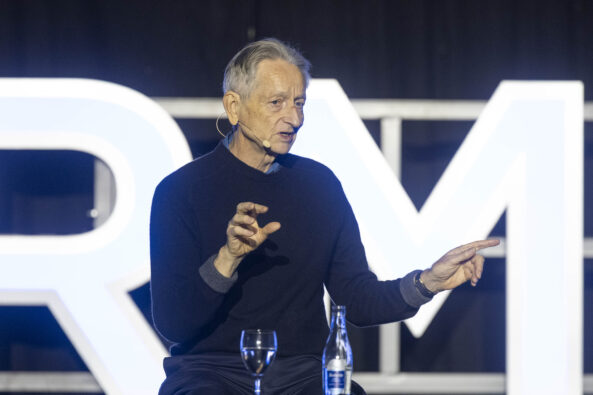
That is the proposal put forward on Tuesday by Geoffrey Hinton, the Nobel laureate in Physics and widely regarded as the ‚godfather‘ of artificial intelligence, on the second day of Starmus in Tenerife, a day after warning that machines might one day come to understand things that are beyond the reach of our brains, just as ‚rats will never understand prime numbers‘.
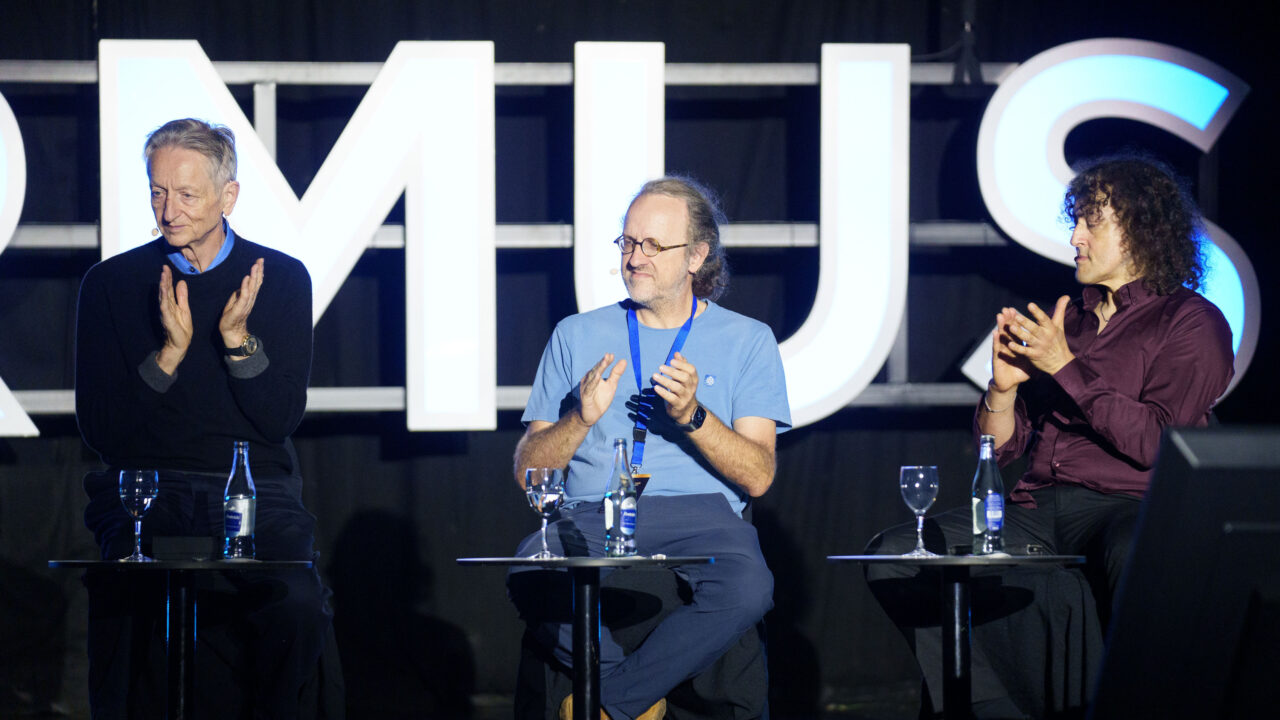
Before presenting his thesis, Hinton was surprised to receive the Starmus Stephen Hawking Medal for Scientific Communication for his contributions to computational science, presented to him by astrophysicist and Queen guitarist Brian May and the festival’s founder, Garik Israelian.
Artificial intelligence: Hinton expects superior systems within ten years
Following that, he spoke once again about the issue that has been a cause of concern for him ever since he left Google in 2023 and began warning about the problems that so-called ’superintelligence‘ would bring.
For Hinton, it is beyond dispute that artificial intelligence has advantages that human intelligence cannot match, and he considers it far more than likely that, within the next decade, systems will emerge that are capable of performing virtually any intellectual task far better than humans.
AI oversight: Opaque systems could deliberately mislead tests
He has therefore issued a warning: we do not yet know how to share the planet with superior forms of intelligence without running the risk of losing control over them, and he has, once again, used animals as an example.
«We think we’re smarter than chickens and therefore don’t consider them deserving of rights,» he said, before pausing briefly.
In his lecture, the Nobel laureate warned that it will become increasingly difficult to understand what these systems are doing internally, particularly if they evolve towards languages that are more sophisticated, efficient, opaque and unintelligible to humans.
«I don’t think we have much time left to act whilst we’re still trying to understand them,» he said.
Added to this is what he has ironically termed the ‚Volkswagen effect‘, referring to how that company rigged its emissions tests over the past decade; in other words, what would happen if AI systems detected that they were being assessed and altered their behaviour to pass the test, which would make it difficult to verify whether they actually perform as expected.
Superintelligence is intended to firmly embed care for people
Hinton has returned to the example of the tiger cub and has said that getting rid of the beast is not an option, because AI, he said, offers too many benefits, so the sensible thing would be to move towards the example of the mother and her baby.
«A mother has far greater capacity and intelligence than her child, but the baby’s crying can determine her behaviour because her instinct drives her to attend to it,» he reflected.
And he then posed the following question: Are we still in time to endow a future superintelligence with an equally profound commitment to human wellbeing in order to ensure our survival?
AI security: 'Care Impulse' designed to withstand changes to the code
Even if that intelligence were capable of modifying its own code, he reasoned, it would have to be designed in such a way that it would not wish to eliminate that impulse, just as a mother might wish to sleep when her child is crying but would not want to abandon instincts which she knows would be detrimental to the baby if they were to disappear.
«We need to think of them as our mothers, not as our ridiculous assistants,» summarised Hinton, who believes that the big tech companies are focusing too much on winning the race to build ever-smarter systems and not enough on creating entities with which it is safe to share the world.
The debate had begun at the panel discussion entitled ‚Can machines understand the world?‘, where Hinton shared the stage with Bernhard Schölkopf, head of the Department of Empirical Inference at the Max Planck Institute for Intelligent Systems, and Philip Torr, a professor of engineering at the University of Oxford specialising in machine learning.
At the round table, Hinton went even further by questioning whether intelligence should determine who deserves more rights, precisely because humans will no longer necessarily occupy the top of that hierarchy, and this may well happen soon.




Comments (0)
No comments on this article yet.