

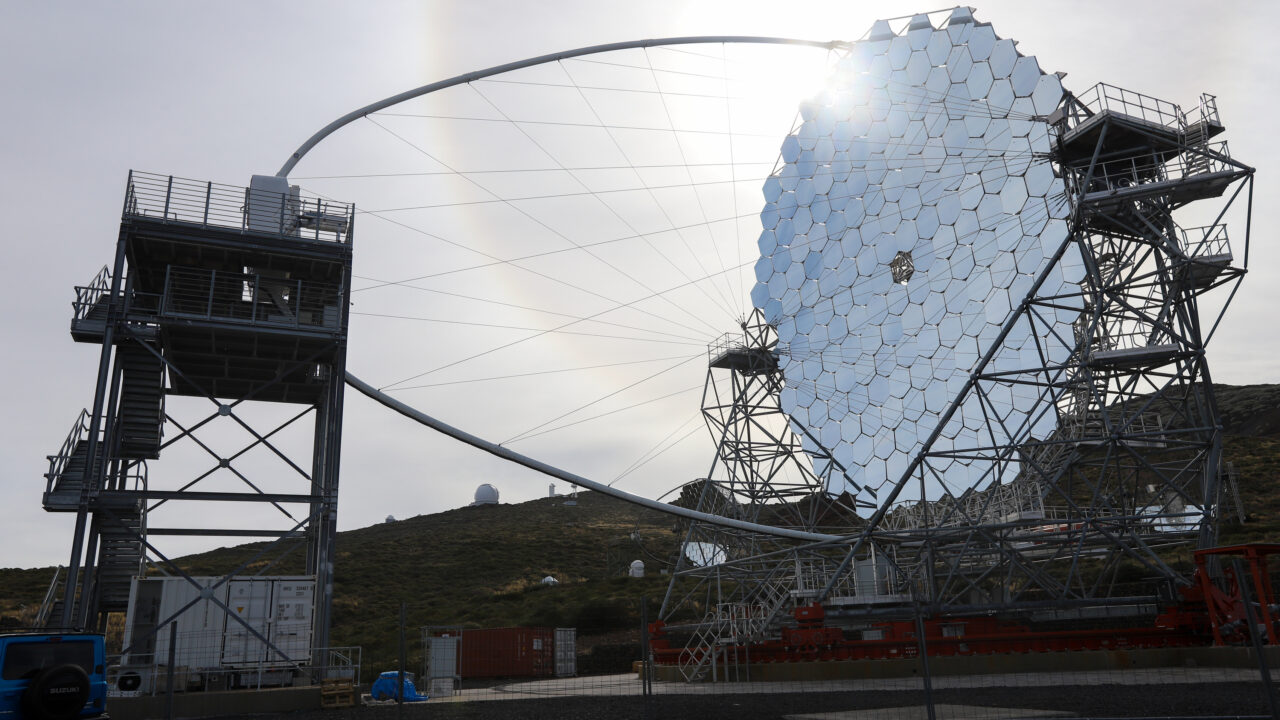
Nobel Prize-winning physicist Takaaki Kajita is confident that the four new telescopes on La Palma will not only help answer unresolved questions about the most energetic phenomena in the cosmos, but will also lead to the discovery of some that scientists «have not yet even imagined».
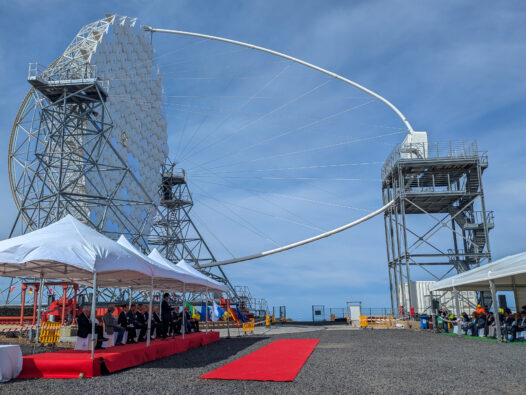
Kajita, speaking at a briefing to explain the scope of these new tools on La Palma, highlighted this ability to open up new avenues of observation as one of his main expectations for the Large-Sized Telescopes (LST), which were inaugurated this Thursday at the Roque de los Muchachos Observatory and will form part of the future Cherenkov Telescope Array Observatory (CTAO).
The Japanese physicist, who was awarded the Nobel Prize in 2015 for the discovery of neutrino oscillations, focused his talk on what is known as multi-messenger astronomy, which studies a single cosmic event by combining information from different signals, such as gamma rays, neutrinos and gravitational waves.
La Palma: Combined signals provide a more comprehensive picture
«Each messenger tells us something different about the universe,» summarised Kajita, who cited the merger of two neutron stars as an example, as this is capable of generating gravitational waves and different forms of radiation.
He explained that combining these observations provides a much more complete picture of the phenomenon than any of them would on its own.
LST telescopes respond to alarms within twenty seconds
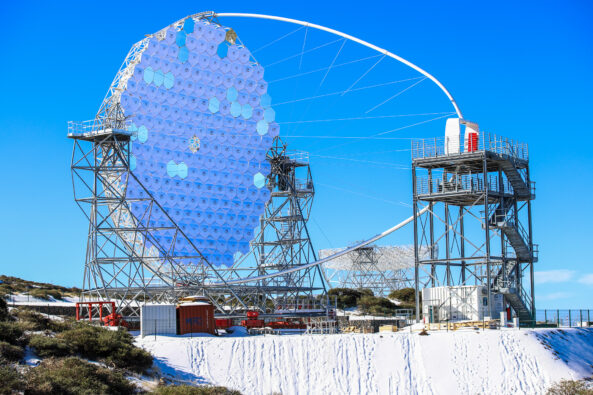
LSTs are specifically designed to respond rapidly to transient phenomena: despite being 45 metres tall and weighing around 100 tonnes, they can be pointed at any point in the sky in around twenty seconds, each with a 23-metre-diameter reflector.
In this way, an alert from gravitational-wave detectors such as LIGO, Virgo or KAGRA, or from neutrino observatories, can trigger an immediate search for a possible associated gamma-ray signal.
Kajita has argued that this communication should also work in the opposite direction: if the LSTs detect a transient source of gamma rays, other observatories can point their instruments at the same location to study it using visible light, radio waves or other types of radiation.
«Whenever we have opened a new window onto the universe, we have discovered phenomena we did not expect,» said the Nobel laureate, for whom this possibility represents one of the greatest promises of the new observatory.
Dark matter is coming under the spotlight alongside black holes
Researcher Masahiro Teshima, the scientific lead for the LST collaboration, has also highlighted the potential of these instruments for studying supermassive black holes, supernova remnants and other objects capable of accelerating particles to extreme energies.
Another of the main objectives will be to search for possible signals associated with dark matter, the nature of which remains unknown.
Teshima explained that one of the hypotheses under consideration suggests that certain dark matter particles could annihilate and produce gamma rays; therefore, regions where a high concentration of this matter is expected, such as the centre of the Milky Way, are particularly interesting targets.
CTAO is set to study thousands of gamma-ray sources
CTAO Director-General Stuart McMuldroch, for his part, has highlighted the significant leap that will be made in moving from the hundreds of gamma-ray sources currently known to potentially studying thousands of them, which will enable physical models to be tested with greater precision.
In his view, this increased sensitivity could lead to a scenario similar to that seen at other points in the history of physics, when new observations forced a re-evaluation of theories that were considered well-established.
«We don’t know what dark matter is,» McMuldroch pointed out, adding that it is precisely the ability to observe the universe in a way that was previously impossible that may enable us to discover unexpected phenomena, he concluded.






Comments (0)
No comments on this article yet.