

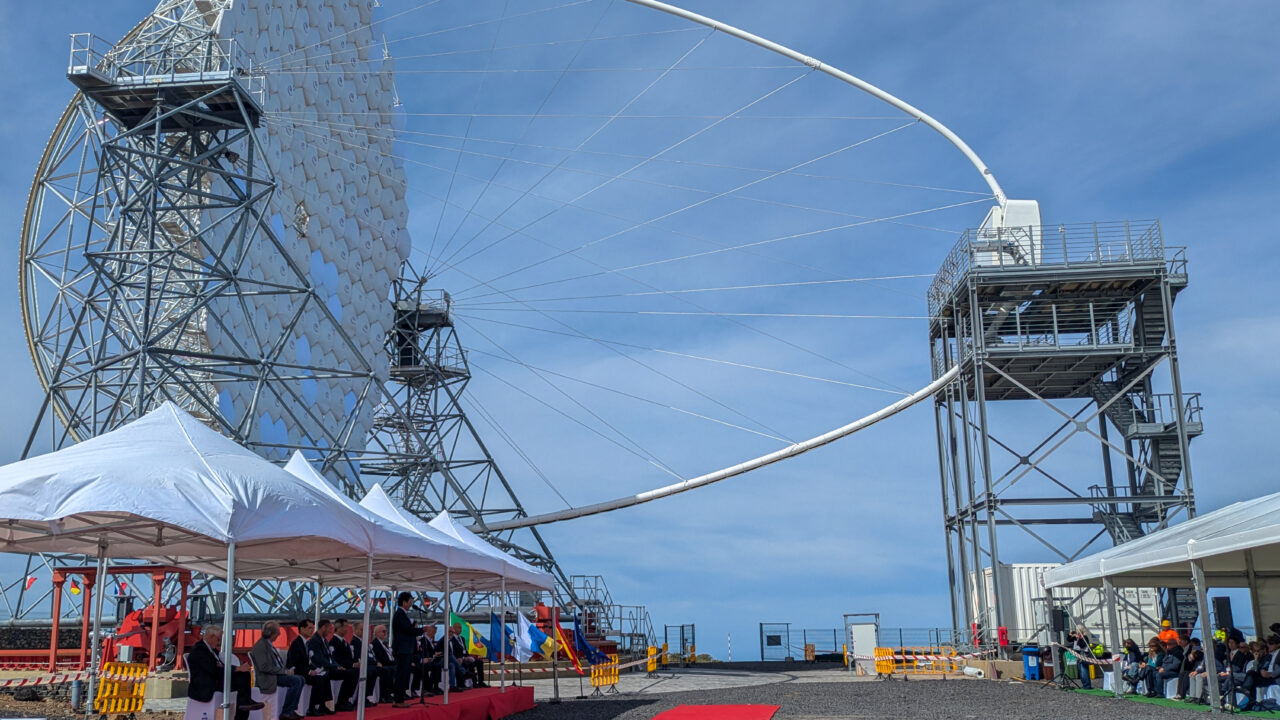
The four large telescopes of the future Cherenkov network, which are due to begin operations this Thursday on La Palma, will spring into action with remarkable speed as soon as explosions in the ‚highest-energy‘ part of the Universe are detected at any observatory worldwide, according to the director of the IAC, Valentín Martínez.
The head of the Canary Islands Institute of Astrophysics (IAC) made these remarks in statements to the media to mark the «day of celebration» being observed this Thursday by the astrophysics community, following the launch, by a scientific consortium comprising eleven countries, of the four LST telescopes that will form part of the future Cherenkov network.
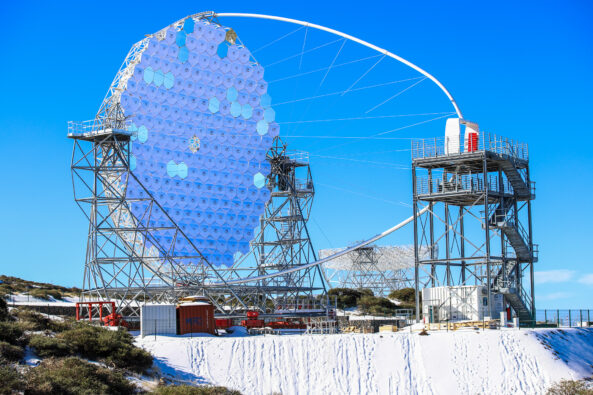
These telescopes are different from the traditional ones housed at the same site, the Roque de los Muchachos Observatory, as they have no dome and will enable us to study the most energetic part of the universe, the largest explosions «that we now know occur in the universe», as Valentín Martínez explained.
La Palma: Cherenkov telescopes react quickly to explosions
«These are very rapid energetic phenomena which ‚we suspected were there, but now we know exactly where to look, and we need specially designed telescopes to study them‘, which is precisely what the Cherenkov telescopes will do,» continued the director of the IAC.
And their optical characteristics mean they do not need a dome to ‚hide‘ in, whilst what astrophysicists need is ‚for them to move very quickly because what we are going to do is respond to a call from other types of observatories telling us that there has been an explosion here‘ and direct them towards that point ‚faster than any other, that is what makes them so spectacular‘, he continued.
The four telescopes can operate independently, but the idea is that they should work together to determine where the high-energy particles are coming from and where the explosion took place, explained the director of the IAC, who added that whilst it was known that high-energy particles existed, their origin was unknown, and «we now know that they are astrophysical phenomena».
«We need to work out roughly where that astrophysical object is so that later, for example, the Gran Telescopio Canarias (GTC) can observe it in another spectral range and determine its other properties. It’s a combination of everything: someone tells us ‚the explosion happened here‘, these instruments detect the gamma rays and their energy, and finally the GTC analyses the characteristics of that explosion,» he explained.
Roque de los Muchachos is to receive nine more telescopes
He also pointed out that each LST telescope has required an investment of between 25 and 30 million euros and that they will form part of the CTAO observatory being built in Chile by the European Southern Observatory (ESO).
In addition, a further nine medium-sized CTAO telescopes will be installed at the Roque de los Muchachos Observatory, home to the Gran Telescopio Canarias, the world’s largest telescope for infrared observations, which will be collaborating with the Cherenkov telescopes.
The director of the IAC has explained that this means there is, at Roque de los Muchachos, «a window onto the Universe across the entire electromagnetic spectrum that we can use».


Comments (0)
No comments on this article yet.