

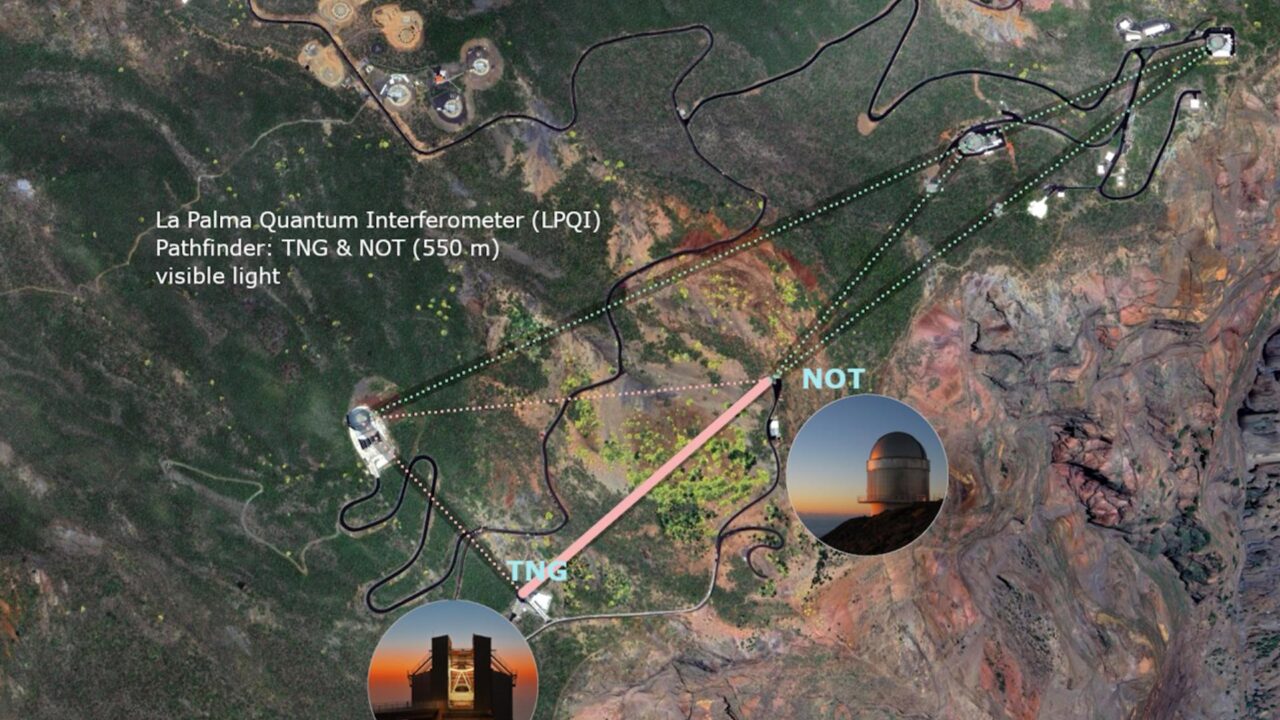
The Canary Islands Institute of Astrophysics (IAC) is working on a project to use quantum technologies to link several optical telescopes at the Roque de los Muchachos Observatory on La Palma, enabling them to operate with a resolution far superior to that of any single telescope.
The first phase of the project, known as the La Palma Quantum Interferometer (LPQI), will link the Nordic Optical Telescope (NOT) and the Telescopio Nazionale Galileo (TNG), which are separated by around 550 metres, with the aim of validating the technology and obtaining the first scientific results in the spring of 2028, the IAC has stated in a press release.
The system will use interferometry techniques to combine visible light captured by various telescopes and SPAD sensors capable of detecting individual photons and recording their arrival with a temporal resolution of picoseconds.
La Palma: Telescope network set to significantly exceed Hubble's resolution
A picosecond is equal to one trillionth of a second, and in that time, light travels approximately 0.3 millimetres.
By comparing the arrival of these photons at telescopes separated by great distances, it will be possible to distinguish details much finer than those that each facility can observe on its own.
According to the IAC, the future network could achieve angular resolutions of tens of microseconds of arc, up to a thousand times greater than those of the Hubble Space Telescope.
In the first phase, known as LPQI Pathfinder, the aim is to achieve a resolution of 160 microseconds of arc.
The project’s principal investigator, Francisco Prada, explained that Pathfinder will enable the angular size of the brightest stars to be measured and will constitute «the first step towards a wider network of telescopes equipped with spectrographs».
The project’s potential scientific objectives include the study of black holes and other extreme phenomena, the search for new ways to detect Earth-sized exoplanets, the measurement of the Hubble constant using nearby supernovae, and the analysis of the diameters and atmospheres of stars.
Fibre-optic cables are to synchronise telescopes with picosecond precision
One of the main technological challenges is to ensure that telescopes share a time reference, via fibre optics, with picosecond precision.
The Spanish teams taking part in the project plan to install and calibrate the synchronisation system this autumn.
The director of the IAC, Valentín Martínez Pillet, has stated that the project represents a commitment to developing technologies at the Roque de los Muchachos Observatory that can «transform the way we observe the universe» and reinforce La Palma’s role as a leading centre for astronomical innovation.
FIRNAS is preparing to integrate the Isaac Newton Telescope
The project also plans to incorporate other telescopes from the observatory in later phases.
Among the planned developments is FIRNAS, the LPQI’s first spectrograph, designed for the Isaac Newton Telescope.
Research is also being carried out into synchronisation experiments using quantum clocks and techniques involving entangled photons, with the aim of recovering information about the phase of light and reconstructing images with greater precision.
Arturo Manchado, head of the LPQI at the IAC, has explained that FIRNAS will enable the light from the stars to be split into different bands in order to improve the sensitivity of the measurements and facilitate the future integration of the Isaac Newton Telescope into the network.
LPQI: International partners discuss the next steps in the project
The project’s progress and next steps were discussed during the LPQI Workshop 2026, held in La Laguna (Tenerife) from 8 to 10 September, with the participation of scientists, technologists and institutional representatives.
The LPQI brings together institutions from Spain, Italy, Taiwan and the Nordic countries; in addition to their astronomical applications, the technologies developed could have uses in fields such as quantum communications, satellites, marine sciences and medicine.








«La Palma links two telescopes using quantum technology»
No comments on this article yet.