

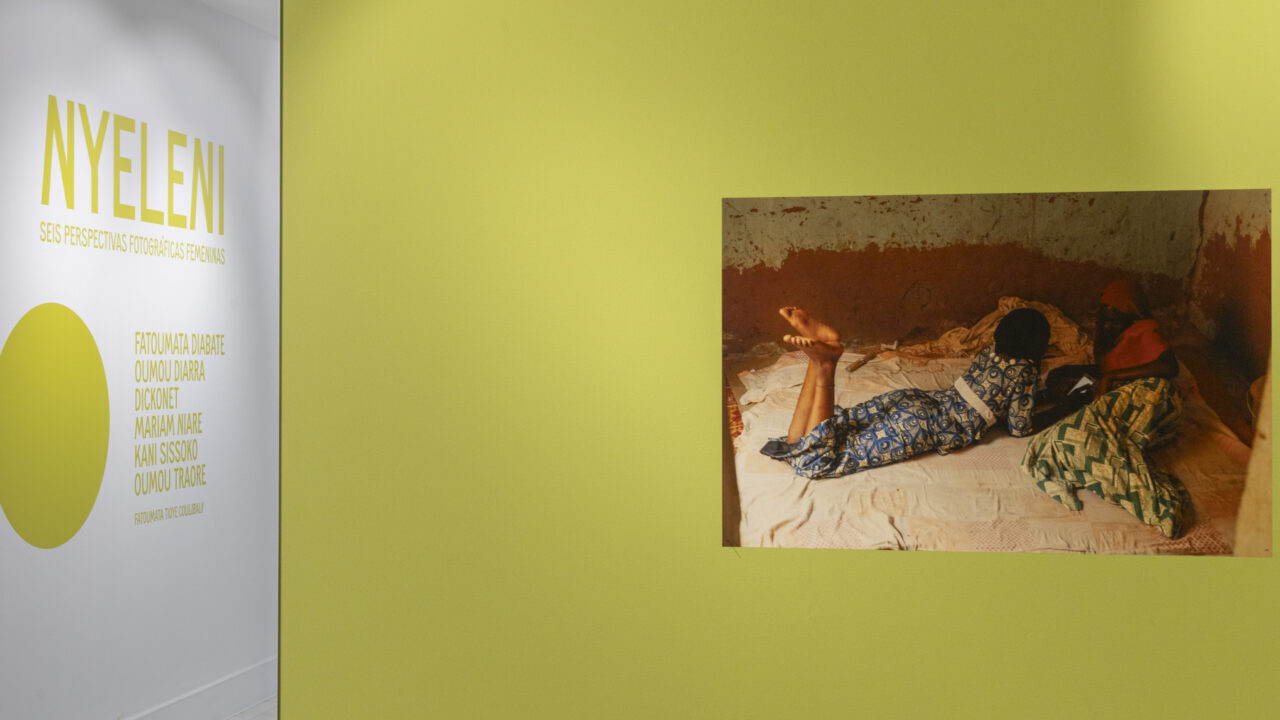
This Thursday, Casa África is opening the exhibition ‚Nyeleni: Six Female Photographic Perspectives‘, a group exhibition by six Malian female photographers that explores issues such as gender, grief, violence and female identity from a contemporary perspective.
The manager of the Casa África Consortium, Ana María Hernández, told the press that the exhibition will run until 12 March and aims to «raise the profile» of African women, who are no longer portrayed as «objects of others‘ gaze» but as protagonists of their own stories.
The exhibition takes its name from Nyeleni, a legendary figure from Malian culture associated with bravery and resilience.
Casa África: Nyeleni stands for courage and perseverance
«Nyeleni therefore reflects these brave, bold and steadfast women, of whom there are many in Malian and African society,» explained Hernández.
One of the exhibition’s curators, Joyce Pennekamp, has explained that, according to a legend from the Segú region of Mali, Nyeleni was the only child of a couple who were accused of lacking courage because they had only one daughter.
«But the daughter said, 'I am braver than all men',» she recounted, explaining that she worked in farming and harvesting and achieved better results than they did.
Female photographers develop a visual language to convey experiences that are difficult to put into words
Curator Franziska Jenni explained that the participating female photographers spent a year working on personal projects with the aim of «working together to find a visual language to express feelings or life events that are not easy to address».
Among the projects on display, she mentioned the one by Oumou Traoré, which pays tribute to her late mother and, at the same time, to Malian mothers.
«She decided to pay tribute to her mother, who passed away in 2013, and when the workshop began, she herself gave birth to her first daughter. That little girl became Nyeleni,» explained Jenni.
Mali: The traditional broom brings together everyday life, rituals and magic
Fatoumata Diabaté, one of Mali’s best-known photographers, presents a visual study of the traditional Malian broom. As she has explained, this object is not only associated with domestic chores, but also with traditional medicine, circumcisions and other rites of passage, and can also be used to harm another person through black magic.
Diabaté has argued that photography «is a profession open to everyone» and has stated that she has never felt «disappointed as a woman» throughout her professional career; «on the contrary, for me it’s something magnificent, it’s a passion and, well, photography is my life».
Photographic projects explore divination, violence and women's freedom
For her part, the photographer and visual artist Mariam Niaré is exhibiting ‚Mouna‘ (‚Why?‘), a series on divination practices in West Africa and the role of women in seeking answers relating to work, family or personal relationships.
Niaré pointed out that, as well as the fact that it is usually women who take part in these practices, the kauri shell, used in Mali and West Africa for divination, is associated with femininity «because when you look at it, it looks very much like a woman’s private parts».
Also taking part in the exhibition are Kani Sissoko, with the series ‚Bùlon‘ (Lobby), which uses this space, traditionally reserved for men, to address gender-based violence, trauma and female resilience, and Dickonet, with an audiovisual installation that brings together testimonies on sexual violence and reflects on silence and healing.
Finally, in ‚La habitación de chicas‘, Oumou Diarra explores these domestic spaces occupied by young Malian women to reflect on privacy, freedom and the various forms of everyday exclusion.
The exhibition also includes workshops organised in collaboration with the Casa de Colón and forms part of the European Interreg MAC programme, as part of the HER (Horizons, Empowerment and Resilience) project, which focuses on women’s empowerment in African countries.

Comments (0)
No comments on this article yet.