

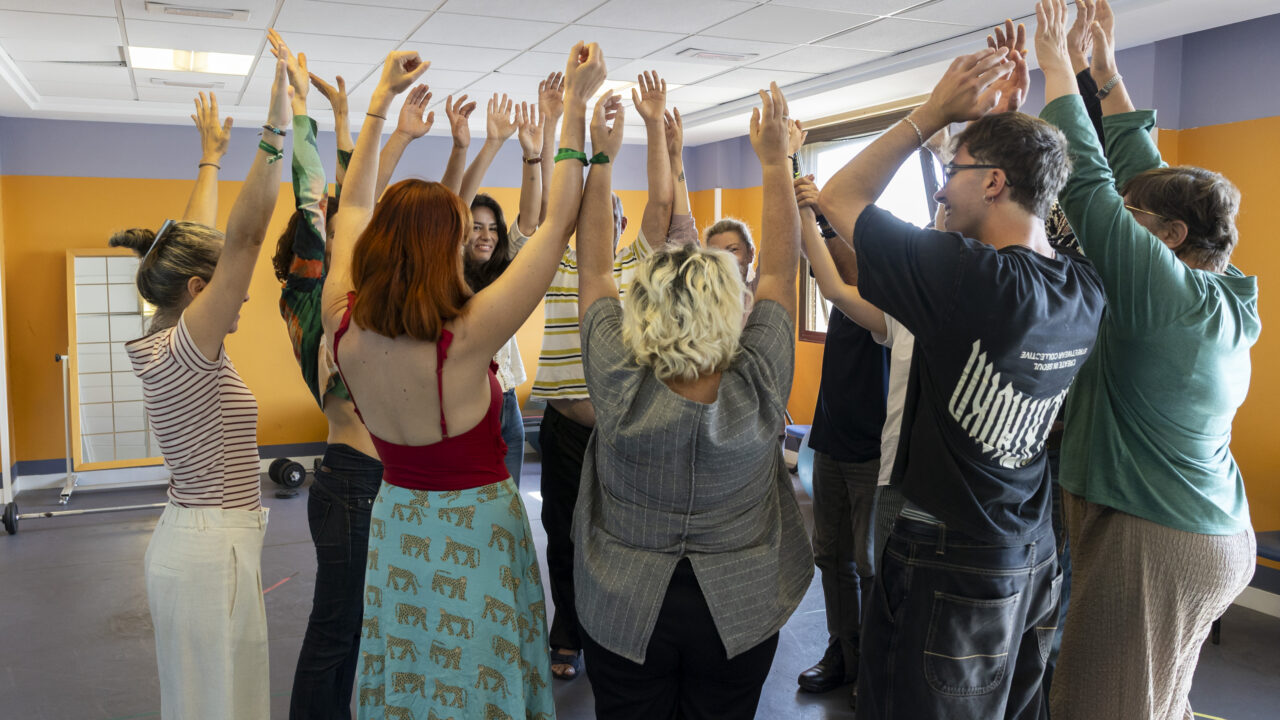
When Sara, Aida, Mónica, Laura and Eduardo attend the social theatre sessions run by the NODO project, they are healing. There, they explore their emotions and work on their self-esteem through activities in which they feel part of a group, and which also help to break down barriers and dispel stigmas surrounding mental health amongst the general public.
They are just five of the around 60 people who take part in this project each year. The project was launched in 2023 and is now run by the Travesía Socio-Cultural Association in collaboration with the Canary Islands Health Service and the psychosocial rehabilitation department at Juan Carlos I Hospital, which specialises in mental health treatment and is affiliated with the Doctor Negrín Hospital in Las Palmas de Gran Canaria.
Las Palmas de Gran Canaria: Social theatre breaks down personal barriers
Everyone agrees that socialising with others is good for them because it helps them open up to others, overcome their shyness and interact with people beyond their screens.
This is, in fact, one of the benefits that theatre offers to people diagnosed with mental health conditions. Elena Martín, a specialist in social theatre at Travesía, confirms this: «It has the power to take away our shame and help us break down the personal barriers we put up for ourselves.»
She also sees working with the body as ‚raw material‘ as beneficial, as it helps to increase ‚vitality and flexibility in the body‘, she notes in an interview with EFE.
She also talks about expressiveness through «a whole range of emotional states» that everyone needs to let out.
And finally, the collaborative nature of the group sessions, which allow participants to experience seeing themselves whilst being seen by others. «That enables me to experience seeing myself from different perspectives. And being able to see myself from different perspectives, within the context of people who have been diagnosed with mental health conditions, enables me to work on, transform and change the issue of stigma,» she says.
The NODO project combines workshops, meetings and performances
The NODO project, funded by the Ministry, comprises three spaces designed to help participants find a new lease of life, not only socially but also on a personal level.
These spaces include the weekly workshops held at various units and psychosocial rehabilitation day centres; the so-called ‚Enrédate‘ sessions, in which people with and without mental health diagnoses come together in public spaces; and the social theatre performances created collectively.
The project lead, clinical psychologist Hiurma Gil Santiago, explains that the activities are not only aimed at people with a mental health diagnosis, but are also open to the wider community and to the staff of the psychosocial rehabilitation units and centres themselves, as part of a ‚horizontal‘ approach.
According to Itziar Vaquero, one of the facilitators at Travesía and a graduate in Drama, this is important because a horizontal structure helps to break down barriers. «Society must be prepared to accept people like this, who have certain personal characteristics and who must be given a place within it,» she told EFE.
«In social theatre, you see how people are transformed; they bring out aspects of their personality they didn’t know they had, and it moves us all. It’s truly magical, both for the performers, for whom it’s a genuine transformation, and for the audience, who break down barriers and challenge stigmas,» she notes
Participants experience social theatre as a form of therapy and liberation
Martín talks about what has struck her, in the time she has been running these workshops, namely the sense of cohesion within the group, which has come to describe itself as ‚the tribe‘, the emotions that surface amongst the participants, and also how they experience these moments of therapy on stage.
The fact is that, for each of them, theatre means something. Sara insists that it has helped her to socialise better, to have fun and to improvise, not only on stage but also in everyday situations. Aida, on the other hand, highlights the fact that she can express herself and experiment with different emotions as a form of therapy.
After each session, Mónica feels «really happy and full of energy» because she has such a good time with her classmates, especially when she’s doing improvisation, which she admits is what she enjoys most.
Meanwhile, it helps Laura overcome her shyness: «When we’re away from the theatre, I’m shyer and I don’t talk as much, but here we all get involved and that helps me overcome it.»
Finally, Eduardo admits that acting is liberating and stress-relieving for him, and it has given him food for thought: how he had lost so much in recent years in terms of relating to others and not feeling self-conscious, and how he now feels better about himself.
Theatre is the remedy that ultimately cures the problems we all face.


Comments (0)
No comments on this article yet.