

Is it really a time-honoured German right to be allowed to set off rockets, multi-shot fireworks and firecrackers next to a zoo? If that is the freedom which people are increasingly voicing fears would be curtailed by a ban, then perhaps we are far too well off.
Whether it was fireworks that caused the fire at Krefeld Zoo or whether banned sky lanterns were to blame, as the police and the zoo have recently suggested, is irrelevant. Because another question springs to mind: why can burnt-out remnants of fireworks be seen in the television footage and photographs from Krefeld taken around the zoo?
Why am I interested in this? Because, year after year, I drove hundreds of kilometres by car to spare my dog exactly that. When Elli was a young dog – and, at the time, still unfazed by fireworks – a drunk girl threw a firecracker between her legs. Ever since then, every bang or howler has filled her with mortal fear. Even the smell of burnt black powder soon began to unsettle her noticeably. And the dog owners we met on our New Year’s Eve trips told us a whole host of similar stories.
A single firecracker is enough to terrify an animal
In our case, a single firecracker was enough to send the animal into hours of panic as a reflex. Perhaps these experiences have, however, affected me more than my dog. Because I am able to question things. And after thinking about it for several years, I would still, even today, argue against a blanket ban on fireworks. Why? Bans often have the opposite effect. They provoke defiance and pave the way for the black market. I am convinced that, alongside often endless discussions on social media, any ban primarily serves to gradually erode the individual’s inherent ability to make decisions and the public’s natural corrective mechanism.
It is therefore far more important to understand the reasons behind these bans than to constantly reignite debates about them. And in this case, the reason is remarkably simple: many living creatures – from some people, to monkeys and dogs, right down to the rabbits in allotment hutches – are frightened by sudden flashes of light and the sound of firecrackers. If, nevertheless, we wish to bid farewell to the old year with a loud bang and welcome the new one in fitting style, it would be great to bear at least two things in mind: that the turn of the year actually takes place on New Year’s Eve itself, and not – as has become widely believed – over a period of around three weeks centred on New Year’s Eve. And that there are certain zones – including no-go areas for noise and fireworks – where fireworks, from rockets to sparklers, are prohibited for humanitarian reasons alone: forests and zoos are among them.
The debate over fireworks: animals have a natural flight response
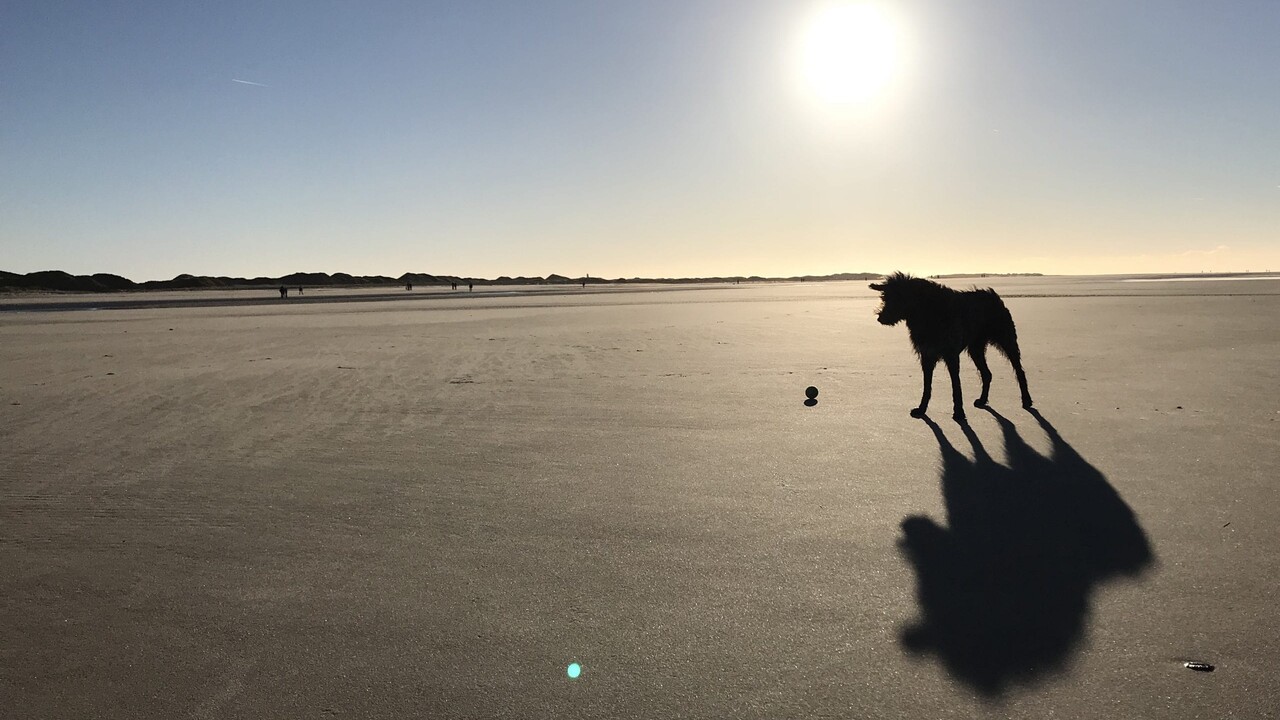
Despite all the environmental debates and the personal effort involved, Elli and I managed every year to drive the roughly 1,300 kilometres to our fireworks-free North Sea island and back, to escape it all. Animals in captivity, however – and this is certainly worth a further discussion – cannot act on their natural flight reflex. Nor can the deer, whose woodland is bombarded with fireworks from all sides for days on end, as if it were a cauldron.
Prompted by his dog, our author has been reflecting on fireworks and their impact on nature for years. Following the events in Krefeld – where, on New Year’s Eve 2019/20, close to his home town of Düsseldorf, more than 30 great apes perished in a fire – he decided to write down his experiences of fireworks and their interaction with wildlife. This is because he does not see fireworks themselves as the problem, but rather the location and timing of their use. So even though the events in Krefeld may, at first glance, seem a long way from the Canary Islands, it is worth taking a closer look at the issue.










No comments on this article yet.