

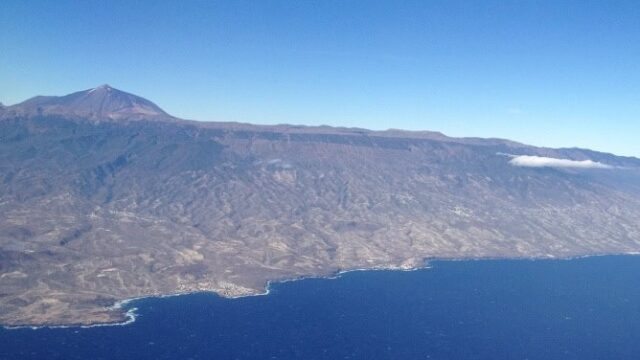
The southern part of Tenerife now relies almost exclusively on tourism. The industry promotes guaranteed sunshine and a mild climate all year round. In contrast to the lush north, the south attracts visitors with its sun-centred tourism and hotel complexes offering affordable beach holidays. A journey through the development of southern Tenerife.
The Development of the South
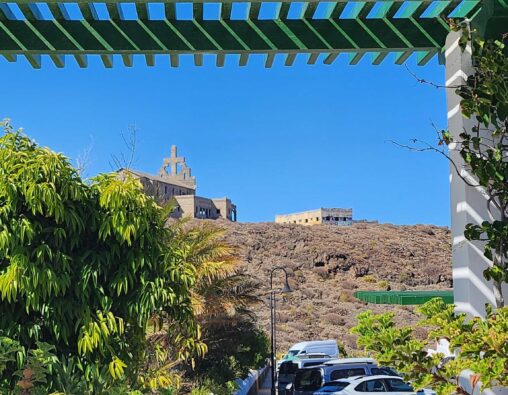
First-time visitors to Tenerife are usually taken aback: as the plane approaches to land, the view from the window reveals a barren, yellow-brownish lunar landscape, where the only bright spot seems to be the greenery of the golf courses. Although the south of the island certainly has more to offer, this impression is not entirely misleading. There are historical reasons why the vegetation in the south of the island is so sparse.
Around two to three million years ago, the south of Tenerife was formed by another volcanic eruption near the present-day towns of Arona and Fasnia. During the lava eruptions, numerous air bubbles became trapped in the cooling rock. Vast quantities of tuff were formed.
Indigenous people settled in the south of Tenerife to fish
This subsoil does not retain water, so only a few plants are able to establish themselves. Where any vegetation can be glimpsed on the stony ground, it is mostly shrubs. Thus, in the south of the island, the main plants are thistle-like species, sweet spurge and, at higher altitudes, cacti.
Nevertheless, the indigenous people of Tenerife, the Guanches, also settled in the barren south, as the waters there were shallow, making it much easier to make a living from fishing than on the steep slopes of the west and north coasts.
Later, the island’s inhabitants became resourceful. In order to be able to grow vegetables despite the conditions, a water system was installed. From 1860 onwards, underground water reserves were tapped into. However, this was not done using a conventional well system, but horizontally. Through water tunnels stretching for many kilometres, even the coastal areas were suddenly supplied with sufficient fresh water. The region could now be settled and continued to grow from then on.
The inhabitants began growing fruit and vegetables. The list ranged from tomatoes, sugar, wine and carmine to bananas, and in some cases back again. Time and again, there was a risk of monocultures. Gardens were laid out to protect the soil, but also because of the strong winds. The aim was to prevent the outer soil from being depleted and to shield the plants grown inside from the sometimes strong winds using high stone walls, tarpaulins and, later, plastic sheeting. These gardens continue to mar parts of the region to this day.
>>> Continue to the chapter: Tenerife South: Tourism as an economic factor


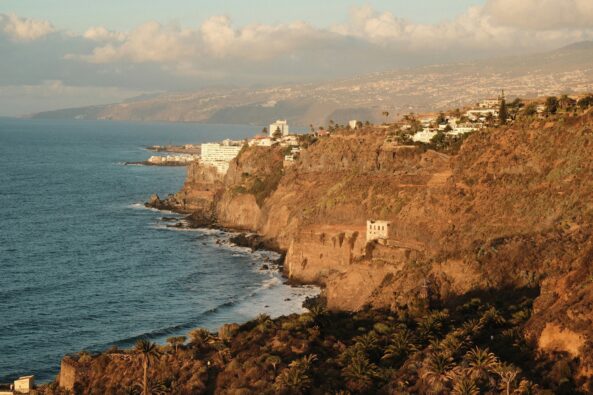
«The Formation of Southern Tenerife»
No comments on this article yet.