

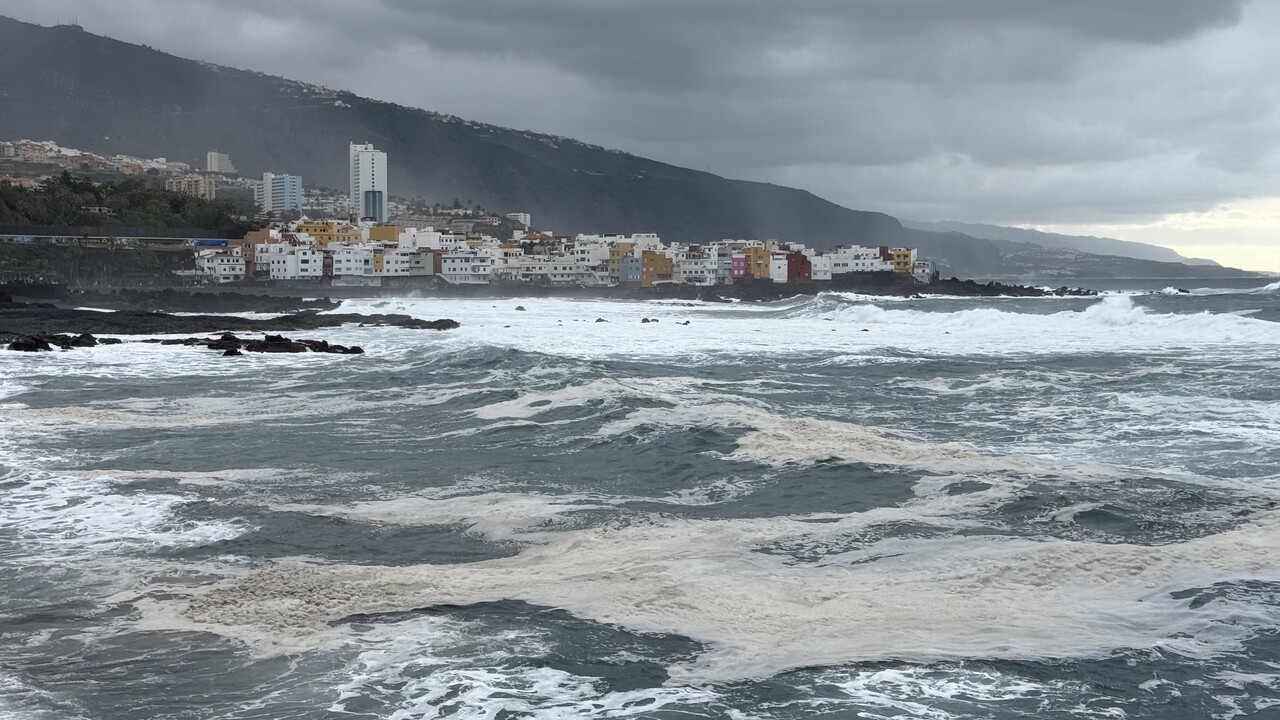
To paraphrase Moses Pelham, the town hall in Puerto de la Cruz would rather chase flies than clear away the faeces. The musician and producer was probably completely unaware of just how apt this image is for this town in the north of Tenerife when he wrote these lines in 2017.
A sewage pipe has burst off the town’s most popular beach. The sewage is supposed to be pumped one kilometre out to sea, where the problem is then left to the sea to sort out. This arrangement worked for decades. However, since the pipe burst around 95 metres off the beach, swimming there has recently been banned more frequently again.
The town hall is taking the easy way out: Playa Jardín has been closed off yet again due to poor water quality. A day later, our editorial team received a letter announcing its reopening. The letter emphasises that water quality is now officially good. Those in charge still do not seem to have realised how much their own image suffers as a result of all the talk and so little action.
Puerto de la Cruz on Tenerife cannot get to grips with the sewage scandal
The fact that the sewage issue in Tenerife has all the hallmarks of a full-blown scandal is evident not least from the fact that several politicians from the largest of the Canary Islands are standing trial. The court is set to determine whether they knowingly turned a blind eye whilst the environment was being polluted on a daily basis. Every year, more than 62.5 million cubic metres of partially or untreated sewage flows into the sea off the coast of Tenerife or into the ground on the island.
In Puerto de la Cruz, the local council has now started commissioning its own tests. It is consistently emphasised that these independent samples have confirmed good water quality. The bathing area has already had to be closed on two occasions in recent weeks. Bacterial levels were too high, and the Tenerife health authorities have therefore advised against swimming as a precautionary measure.
At such times, the town hall is quick to highlight the favourable water quality results from the analyses it commissioned itself, as soon as possible after the closure. As soon as these results are within the ’safe range‘, this is publicised to great effect. What is still missing, however, is the repair of the sewage outflow near the beach.
The Mayor of Puerto de la Cruz, Leopoldo Afonso, says: «From the very beginning, we have acted in accordance with the principle of exercising the utmost caution. If there is even the slightest doubt regarding water quality, our priority must always be the safety of residents and visitors, even if this means temporarily implementing restrictive measures.» However, the full story is that, at the time of the closure in July, the town hall reacted angrily and chose to emphasise its own analyses rather than accepting those of the health authorities as fact.
Sewage off the coast of Tenerife continues to be tolerated
It is high time that Puerto de la Cruz exerted more pressure to secure a repair, rather than arguing over analysis results. Neither the previous nor the current administration has managed to do so thus far. After all, it has been known since 2020 that brown sludge is flowing into the sea right next to the beach. Despite a beach closure lasting almost a year between 2024 and 2025, as well as further short-term closures, the permanent repair of the discharge pipe is still a long way off. A genuine solution that would put an end to the discharge of contaminated sewage off the coast is currently out of the question.
Instead of solving the problem – that is, removing the faecal matter – the authorities in Puerto de la Cruz prefer to carry on swatting flies whenever they become visible. This is neither a solution-oriented approach nor conducive to the long-term sustainability of a region so heavily dependent on tourism and, consequently, on its own reputation.








Comments (0)
No comments on this article yet.