


By Marlis Zoschke
Every week there is a lot of negative news about Tenerife. Do the islanders ever stop to wonder whether things can go on like this forever? There are 470 people living per square kilometre on an island that, due to its topography, is only partially habitable.
Twice as many people live there per square kilometre as in Germany – and that is the most densely populated country in Europe. Doesn’t anyone in politics realise that overtourism needs to be curbed and that the influx of so many sun-seekers needs to be better controlled?
In the past, tourists to the Canary Islands were wealthy people
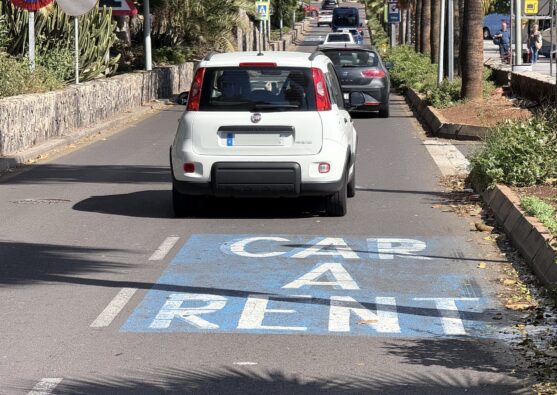
Politicians always imagine that lots of tourists mean lots of money. But they forget that large numbers of people also cause a great deal of damage, commit criminal acts and place an excessive strain on the environment. There’s public transport – is there really a need for so many hire cars? Anyone on a holiday lasting no more than two weeks should be glad they don’t have to squeeze into a clunker.
Back when the south was still a no-man’s-land and the islanders were delighted to see every tourist, they naturally longed to own a car themselves one day, especially when they saw people arriving by taxi from the airport, which is understandable. Our friend’s wife always practised on the ‚road‘ in front of their house so that her driving test wouldn’t cost so much when the time came.
To the locals in the south, tourists were rich people. The pubs were delighted when they could sell plenty of alcohol. A measure of spirits was always half a wine glass and cost just a few pesetas. Many men’s clubs spent a week in Tenerife. Back then, you rarely saw anyone looking for a bit of relaxation who wasn’t tipsy.
Meanwhile, more and more tourists were flocking to the south, and there was a lot of building going on. We often feared that one day the place would be teeming with tourists. Our dream of spending the winter here seemed to have receded into the distant future. Our friends, however, were convinced that it would never come to that.
Loss of natural habitats and rubbish dumps are increasingly taking their toll on Tenerife
The situation has now gone far beyond my worst fears. I deeply regret this, as a great deal of nature has been destroyed in the process. Many measures were necessary. However, with less tourism, fewer artificially created beaches would have been needed. And in many places, the coastline could have retained its original character. Blasting must have taken place on a large scale here, as otherwise the many beaches would not have been possible. You can still see where nature has been spared. Here you’ll find the dark sand, which is said to be so beneficial for people with rheumatism.
But now there’s something new again: rubbish dumps. They’ve always been around, mind you, just not in such vast quantities. With these problems, we find ourselves back at the back of the queue. On Tenerife, everything just takes a bit longer.

Comments (0)
No comments on this article yet.