

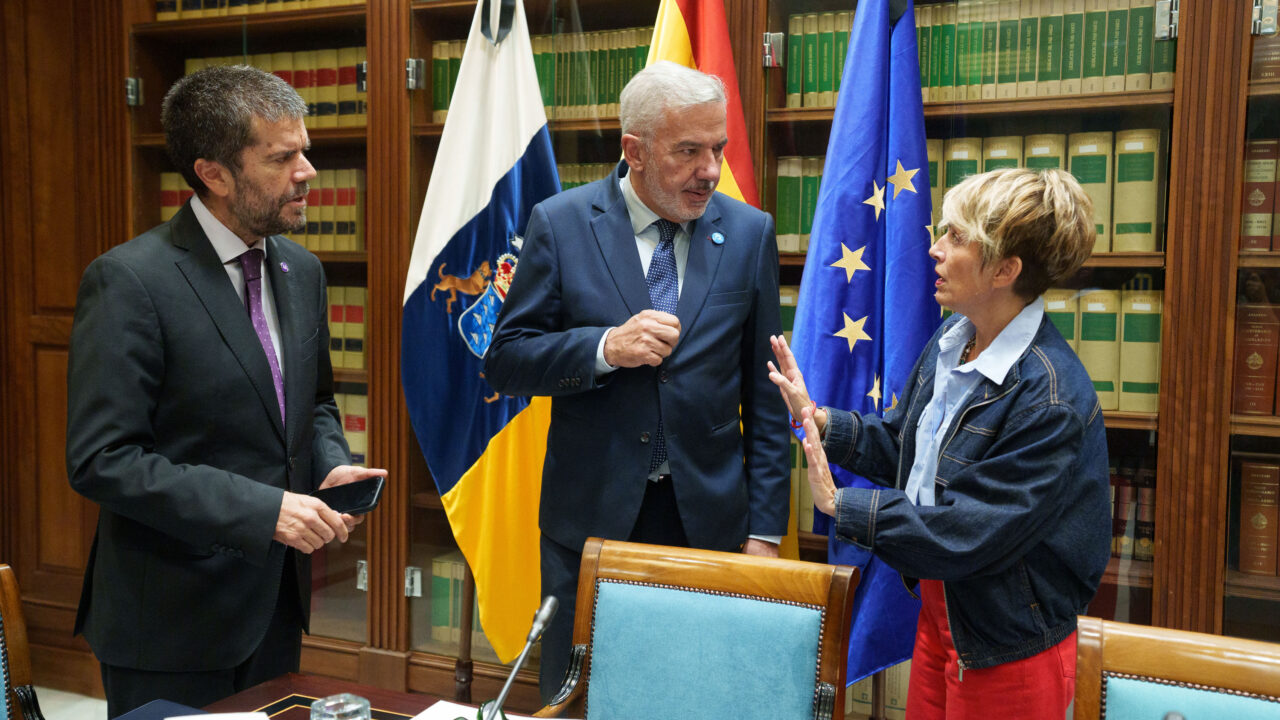
The vice-chancellors of the two public universities in the Canary Islands warned on Friday that when they call for sufficient and stable funding, they are not asking for «a blank cheque», but rather for the resources needed to address the archipelago’s challenges and future capabilities.
The heads of the University of Las Palmas de Gran Canaria (ULPGC), Lluís Serra, and the University of La Laguna (ULL), Francisco García, have reviewed the situation at both institutions before the Parliamentary Committee on Universities, Science, Innovation and Culture, which began with a minute’s silence to mark the death of CC MP Cristina Calero, her party’s spokesperson on these matters.
The Vice-Chancellor of the ULPGC, Lluís Serra, noted at the start of his presentation that the university has 4,385 new students this academic year, the highest figure in the last decade, and that the academic success rate is close to 90 per cent, whilst, according to employment data, 84 per cent of graduates have held some form of employment in the two years following their graduation.
Canary Islands universities: ULPGC boosts research and knowledge transfer
Furthermore, the ULPGC has secured more than 25 million euros for research projects and received some 4.6 million in revenue from knowledge transfer, figures which demonstrate that it is an active university that contributes to the economic and social development of the Canary Islands, the Vice-Chancellor added.
Serra has stated that he will not become complacent because «we have a lot of room for improvement» in areas such as reducing bureaucracy, improving employability, attracting and retaining talent, as well as strengthening relationships with businesses and public authorities.
«And we must do so in an accountable manner, because when we talk about funding, we are not asking for a blank cheque, but rather requesting resources in a responsible manner,» he explained.
Higher education funding should be stable and predictable
As an example, he pointed out that public universities in the Canary Islands have 9,228 euros per student for structural costs, compared with the national average of around 9,500, a figure which is itself far below that of the rest of Europe.
Whilst fully respecting the needs in the areas of healthcare, social services and housing, universities do not compete with these policies, Lluís Serra has pointed out, given that they train doctors, nurses, engineers, teachers, social workers, lawyers and scientists.
For this reason, funding public universities does not mean investing in an administrative structure but rather «investing in the future potential of the Canary Islands», he added.
In this regard, he has called for reflection on the fact that, whilst there is now a preliminary agreement between the universities and the Canary Islands Government on multi-annual funding, for which the institutions proposed a figure of around 315 million euros, he has pointed out that the draft bill for the Autonomous Community’s General Budget for 2027 has allocated 301.6 million.
The outline of the draft agreement is clear, but we will need to keep an eye on the ’small print‘, said the vice-chancellor, who also referred to an amendment tabled during the budget debate to allocate 10 million euros to the universities.
«We are not proposing any extraordinary expansion, but rather to adequately cover structural costs and the funding needed to ensure the universities can carry out their activities. Another issue relates to targets, because we are fully prepared to be subject to measurable evaluation and accountability targets, but resources cannot depend on having to compete for them every year: we need stability and predictability,» said Serra.
The University of La Laguna receives significantly less than the Balearic Islands
For his part, the Vice-Chancellor of the ULL, Francisco García, pointed out that both institutions face a problem with funding and, by way of example, noted that La Laguna receives 181.5 million euros for 21,000 students, whilst the University of the Balearic Islands has 203 million for 15,000 students.
If the funding were proportional, the ULL would receive 284 million euros; yet, the Vice-Chancellor went on to say, «we are pursuing innovation and looking to the future», for which a thorough analysis of degree programmes has also been carried out in order to adapt them to new demands.
But he also agreed with Serra that «we need to make our financial structure sustainable, consolidate the draft agreement with the Canary Islands Government and implement other complementary measures to harness the potential of the universities and tackle the challenges facing the Canary Islands».
ULPGC is planning degree programmes in new, forward-looking fields
The Vice-Chancellor of the ULPGC has also spoken of increasing the number of student places when there is demand for new degree programmes linked to artificial intelligence, cybersecurity, the energy transition and the blue economy, as well as retaining researchers, modernising laboratories and ensuring there are sufficient teaching staff.
The aim is to ensure that no talented young person from the Canary Islands is prevented from studying because their family cannot afford a private school or one outside the islands, as, he emphasised, public universities are the true means of ensuring equal opportunities and social mobility.
«The question is not just how much we want to invest in public universities, but how much we want them to contribute to the future of this region,» Lluís Serra explained.



Comments (0)
No comments on this article yet.