

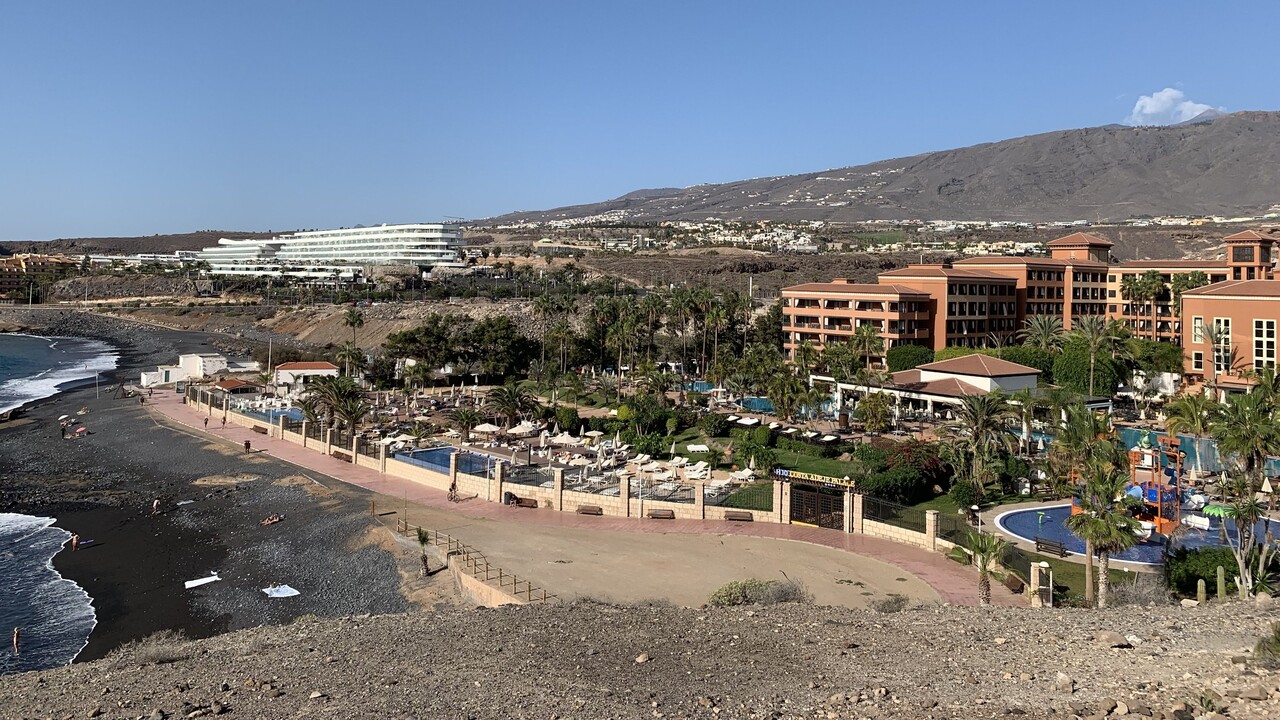
The north of Tenerife had long been settled and was reaching its limits. Then two men came up with an idea: they settled the barren south. Although initially met with derision, they went on to create one of Europe’s most popular tourist destinations. This is their story:
Sixty years ago, Rafael Puig Lluvina and his son Santiago were the first to view the then unspoilt coastal areas between Adeje and Arona from a very specific perspective. They planned to develop a major tourist region on this barren land, which enjoys a mild climate all year round. The name: Playa de Las Américas. But the road to get there was a rocky one.
The plots of land belonged to the large-scale landowner Antonio Domínguez. The building contractor Luis Díaz de Losada had already expressed an interest and was seeking investors. In the late 1960s, the Puig family began using private funds to carry out the initial infrastructure work, such as water mains, street lighting, telephone lines and access roads.
Tenerife: The Rise of Playa de Las Américas
The completion of the first hotels – the Gran Tinerfe opened in 1973, followed a year later by the Park Hotel Troya – coincided with the onset of international tourism and the oil crisis. Furthermore, the suspension of construction work at the South Airport and the sudden death of Rafael Puig Lluvina in 1974 (at the age of just 59) caused uncertainty.
Santiago Puig was facing a major turning point. He finally decided to invest all his resources in building a beach, in order to save the first two hotels and send a signal to future investors. And this decision proved to be the right one:
Civil engineers Juan Alfredo Amigó and José Luis Olcina were commissioned to design the first major bathing area. They took on the task at the suggestion of Díaz de Losada. Both engineers were aware of the significance of their project for the region’s future and approached the challenge with a great sense of responsibility.
Following an analysis of the coastal conditions, they decided to build breakwaters. Their specific layout was designed to encourage sand deposition along the coast through the flow of water, without the need to bring in sand from other regions – as was common practice at the time at Las Teresitas or other beaches in the south of Tenerife.
The launch of tourism in southern Tenerife: breakwaters as the key
The innovative solution was tested at what was then Europe’s leading laboratory in Grenoble. There, Amigó and Olcina simulated numerous variations in wave conditions, slopes and weights to find the optimal model for the southern coast of Tenerife. The experiments confirmed that their concept met the requirements.
Although the French laboratory had enabled the breakwaters to be positioned perfectly, the engineers were not certain until all the tests and construction work had been completed. The breakwaters were built using stones from a quarry in the south of Tenerife. The current carried the sand onto the beach as planned.
This is how the beaches of Troya I, Troya II and El Bobo came into being. After almost two years of construction under difficult economic and political conditions, these three beach areas were completed. Today, these three beaches are regarded as having been crucial to the eventual rise of the south of Tenerife to become the international tourist destination it is today.



«Playa de Las Américas: How the south of Tenerife became a tourist hotspot»
No comments on this article yet.