

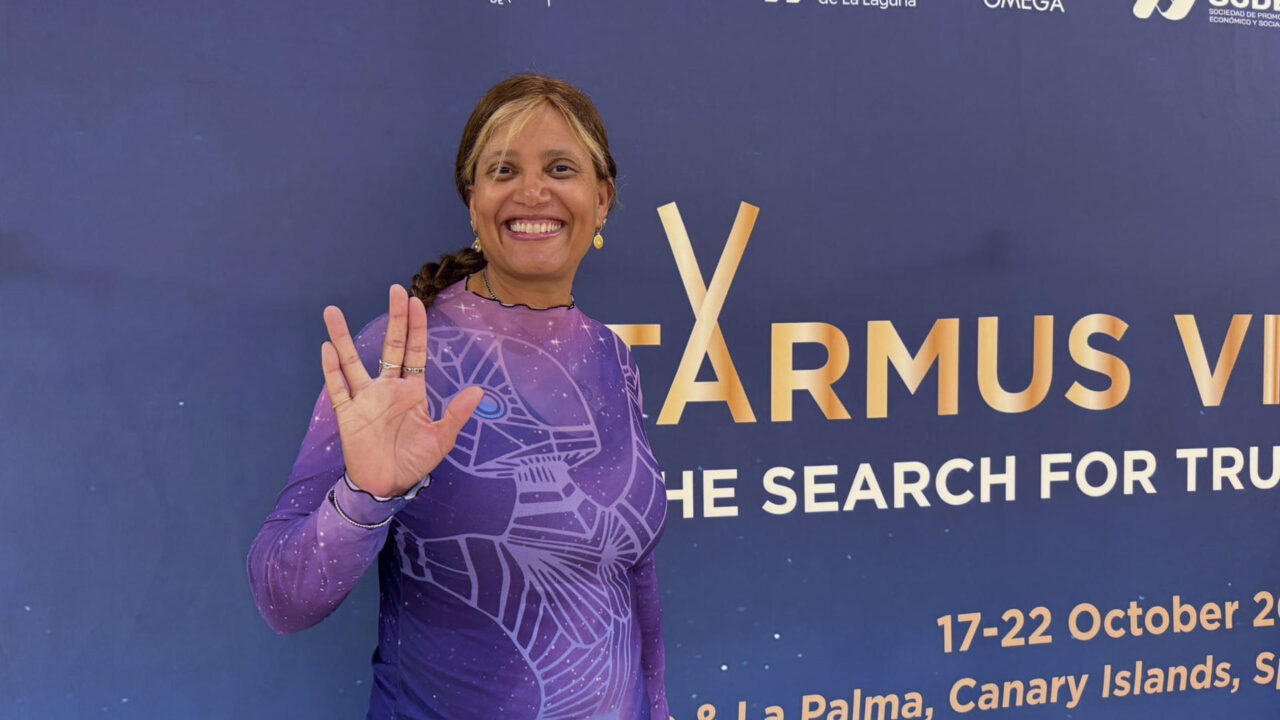
The American geoscientist and astronaut Sian Proctor, who has already eaten pizza in space and now hopes to enjoy it on the Moon, emphasises that the advances made in the space race in terms of efficient resource management can also be applied on Earth.
«When we solve problems for space, we are solving problems for Earth. To survive on the Moon or Mars, we have to be efficient in our use of food, water and energy, and in our management of resources and waste,» Proctor summarised in an interview with EFE during the Starmus festival in Tenerife.
Sian Proctor: Lunar missions should benefit Earth
According to the astronaut, these are precisely the areas that present the greatest challenges on Earth.
Proctor spent three days in space aboard Inspiration4, the first orbital mission comprising solely civilians, where she made history as the first African-American woman to pilot a spacecraft and the first female pilot of a commercial spacecraft.
In her view, all the technology and efficiency improvements developed for life beyond Earth should also serve to make the planet more sustainable.
«There is no better planet than Earth,» she emphasised.
That is why, in her view, reaching Mars is part of humanity’s future, but she does not believe it should be achieved at any cost or in a hurry.
Before that, she adds, we will need to return to the Moon, build infrastructure and learn to live, work and even enjoy ourselves in an extremely hostile environment.
Mars: Robots to prepare for future colonisation
Whilst humans are gaining that experience there, she proposes that increasingly advanced robotic systems should prepare Mars for a future human arrival.
The Moon would thus become a laboratory for learning how to do better what has not always been done well on Earth.
Proctor insists that space exploration should not be a way of escaping Earth’s environmental problems, but rather an opportunity to learn from our mistakes.
In this regard, technologies developed to close water cycles, produce food using minimal resources, reuse materials or reduce waste should serve the planet that made them necessary.
The Moon and Mars need more than just technology
Proctor, who is an artist as well as a scientist, does not want to imagine lunar or Martian settlements reduced to survival capsules inhabited exclusively by astronauts and engineers; instead, she invites us to consider how the things humanity takes with it, which are not just technology but also food, art, music, customs and ways of understanding the world, will intermingle on the Moon or on Mars.
Perhaps, she suggests, «one of the children who dreams of becoming a chef today might end up working as a chef on the Moon or on Mars».
Space: Proctor calls for more diverse participation
The astronaut, whose connection with space began through her father, who worked for NASA at a ground station in Guam during the Apollo programme, believes in the mission to increase the number and diversity of those involved in space exploration, as she is part of the change taking place in this field.
In this regard, Proctor does not see competition between professional and commercial astronauts, but rather complementary roles within a much larger ecosystem that also includes those who design rockets, work on the ground or contribute expertise from fields seemingly unrelated to the space sector.
That is the «fair, equitable, diverse and inclusive» space she advocates for, she says, and in which the benefits of venturing into space must truly be felt by all of humanity on Earth, she concludes.
Comments (0)
No comments on this article yet.