

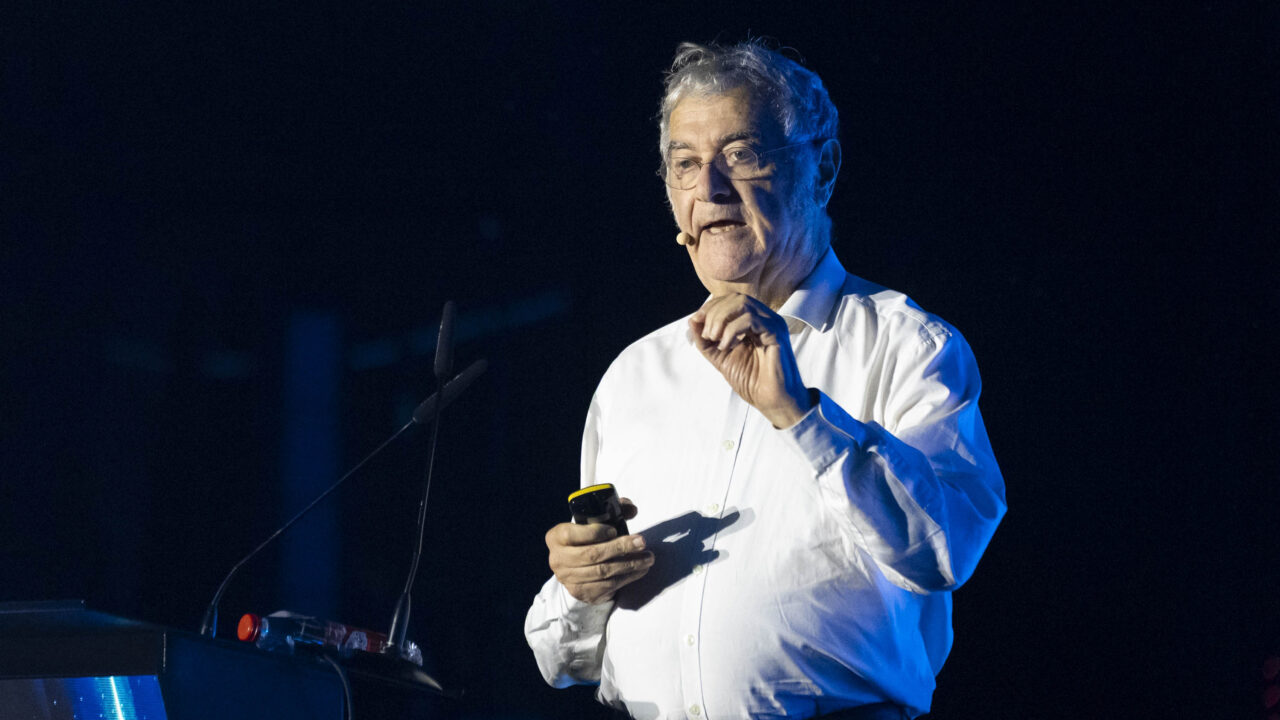
Monthly journeys to other stars, lunar cities, settlements on Mars and a humanity that will one day become an interstellar species, a far-reaching vision of the human race that clashes, head-on and for now, with the laws of physics, as was highlighted at the eighth edition of the Starmus science festival.
The French physicist Serge Haroche, winner of the 2012 Nobel Prize in Physics, was particularly emphatic on Wednesday from Tenerife, where the event is being held, and stressed that neither imagination, nor artificial intelligence, nor humanity’s desire to colonise the stars can alter the theory of relativity.
«We must distinguish between reality and science fiction,» argued Haroche, for whom travelling faster than light is simply impossible, and doing so at speeds approaching the speed of light poses physical and energy requirements that are incompatible with the usual fantasies about interstellar colonisation.
Starmus: Serge Haroche warns against interstellar 'fake news'
He conceded that imagining it is fine, but he stressed that leading non-scientists to believe it will happen in the future is truly problematic and constitutes «fake news».
He quipped that videos showing such journeys should carry a warning labelling them ‚AI-assisted science fiction‘.
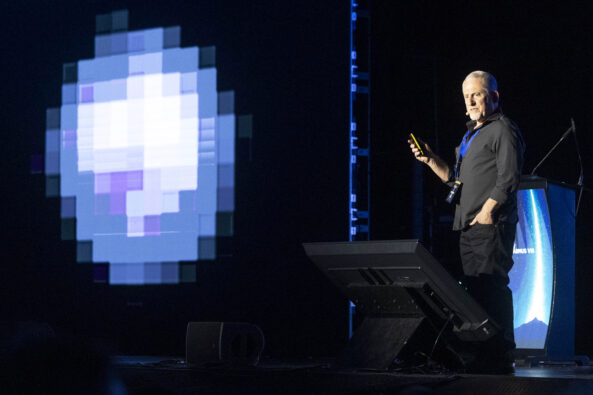
This reflection came a couple of days after the Iranian-American space entrepreneur Kam Ghaffarian, co-founder and chief executive of Axiom Space, painted a very different picture of the future on the same stage as Haroche.
Ghaffarian, who was born in Isfahan and recalls gazing at the stars as a child and wondering whether it would one day be possible to live amongst them, believes that the «destiny of humanity» is to become an interstellar species, in line with other, somewhat more, billionaire counterparts such as Elon Musk of SpaceX.
Ghaffarian’s roadmap begins with commercial space stations, continues with a permanent base on the Moon and settlements on Mars, and ends beyond the solar system; he has envisaged a future beyond 2050 with daily launches to the Moon, weekly launches to Mars and, as a matter of course, regular missions to other stars.
During his lecture, he even presented a simulation of a hypothetical journey to Proxima Centauri which, according to his speculations, would last just over six months.
Proxima Centauri: Michel Mayor calculates that the journey would take millions of years
That is where another Nobel laureate, the Swiss astrophysicist Michel Mayor, who, together with Didier Queloz, discovered the first exoplanet orbiting a Sun-like star and was awarded the Nobel Prize in Physics in 2019, has put the calculator on the table.
Mayor has no doubt that the Milky Way is home to millions of rocky planets and probably many worlds situated in regions where liquid water could exist.
«The problem isn’t finding them. It’s getting to them,» he pointed out.
If a potentially habitable planet were to be discovered just 30 light-years away, practically in our neighbourhood on a galactic scale, a spacecraft travelling at speeds similar to those reached by the Apollo missions would take several million years to get there, as he has illustrated.
There is no Planet B
The usual response to that problem cannot simply be to ’speed up‘; that, he has said, does not solve the problem either, because increasing the speed to the required levels requires amounts of energy that Mayor considers unattainable.
«If the Earth becomes uninhabitable, humanity will have no chance of migrating to another exoplanet. We don’t have a Planet B. We have to look after the Earth. It’s simple physics,» he concluded.
What about the quantum computer?
For his part, the Spanish physicist Ignacio Cirac, director at the Max Planck Institute for Quantum Optics, pointed out at Starmus that quantum computers exploit phenomena as strange as superposition, but still face enormous difficulties in controlling errors and scaling up.
Cirac believes that extraordinarily powerful technologies will eventually be developed, although he has warned against the cycle of unrealistic expectations.
«Nobody knows whether it will take five, ten or twenty years, or how many of the applications currently being promised will actually materialise,» he said.
Mars: Female astronauts prioritise cooperation and sustainability
Leaving Earth?
The discussion about leaving Earth has also featured in other talks at the festival, such as that given by the astronaut and geoscientist Sian Proctor, who said yesterday that Mars may form part of humanity’s future, but first, she insisted, we would need to learn to live on the Moon and use that effort to make the use of food, water, energy, materials and waste on Earth more efficient.
And Julie Payette, the Canadian astronaut who took part in the establishment of the International Space Station, also considered it likely that one day someone would walk on Mars, although she hopes this would not be with the intention of planting a national flag, but rather as the result of a collective endeavour.
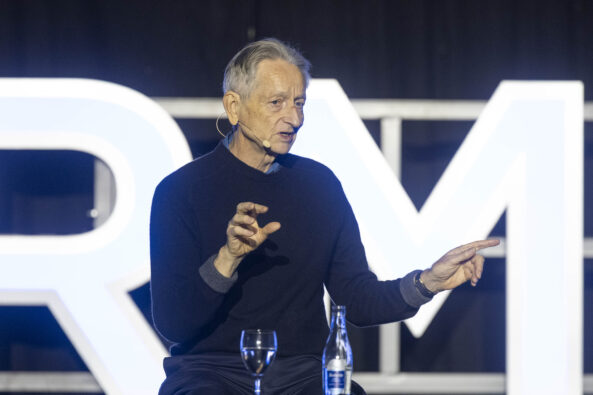
Even Geoffrey Hinton, a Nobel laureate in Physics and one of the pioneers of artificial intelligence, has offered a harsher political interpretation by criticising the idea of Mars as a ’new beginning‘ where a technological elite can establish its own rules ‚far from states and taxes‘, a vision he explicitly linked to certain strands of ‚techno-feudalism‘.


Comments (0)
No comments on this article yet.