

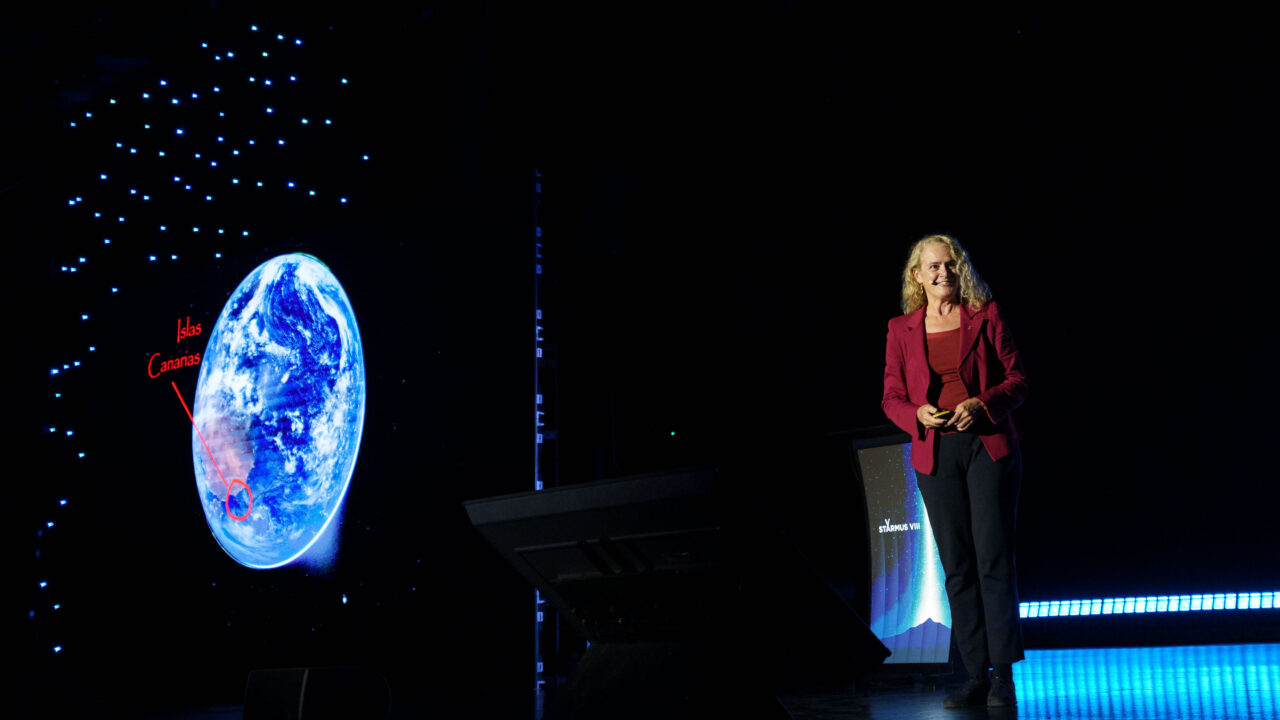
Canadian astronaut Julie Payette is convinced that one day a human being will walk on Mars, but she has one wish for when that happens: that they do not go there alone, that they do not plant a country’s flag, and that they do so on behalf of all humanity, in keeping with the spirit of cooperation embodied by the International Space Station.
That aspiration was evident throughout her speech at Starmus on Tuesday, which focused on highlighting the value of human collaboration as one of the great legacies of space exploration and, in particular, of the International Space Station (ISS), where Russians, Americans, Europeans, Japanese and Canadians have worked together for a quarter of a century despite the political crises unfolding on Earth.
Payette, who flew on two space shuttle missions and took part in the construction of the ISS, recalled how, in 1999, she arrived at a station consisting of just two modules and returned ten years later to find a structure roughly the size of a football pitch.
ISS: Collaboration to serve as a model for the Moon and Mars
In her view, centuries from now, perhaps few will remember the names of those who passed through there, but they may remember it was the first time that humankind was able to jointly build and maintain something extraordinarily complex in one of the most hostile environments imaginable.
And from up there, she added, it becomes difficult to make out the differences on the ground.
Astronauts from different cultures, languages and countries share the urge to step up to the window to gaze at a planet that Payette has described as a ‚blue wonder‘ suspended above the darkness, alive, ever-changing and free from the political borders that shape the lives of those who remain on its surface.
She believes that this model should underpin the return to the Moon and future exploration of Mars.
Mars: Everyday issues are holding back rapid manned missions
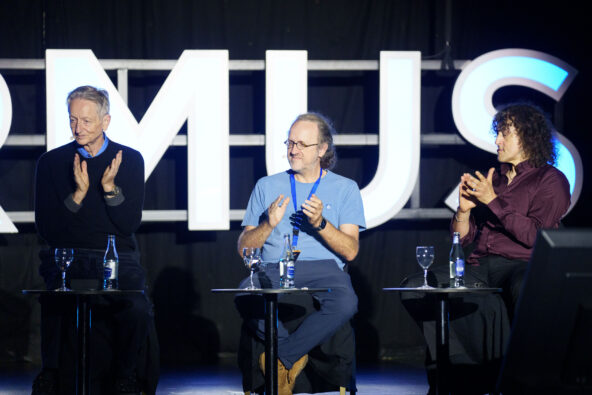
At the subsequent panel discussion, ‚Room for Everyone?‘, Payette shared the stage with the Norwegian filmmaker and astronaut Jannicke Mikkelsen and the geoscientist and astronaut Sian Proctor, who agreed that going further will require not only technology, but also cooperation, time and careful consideration of who is involved in that expansion.
In it, Payette has played down expectations of a rapid journey to Mars, pointing out that there are still some extremely basic issues to be resolved first, including how to wash clothes during a journey that could last up to two years without wasting water or using toxic substances.
«Nobody wants to set foot on Mars in dirty underwear,» she quipped.
In this sense, the Moon will serve as a laboratory, as exploration of its south pole may enable us to determine whether the ice found in permanently shadowed craters can be turned into a resource for future crews to exploit.
«It will happen,» said Payette regarding human expansion beyond Earth, although «not as quickly as some would like»,
And, she has insisted, it will require «the brains of many people and the leadership of many nations».
Proctor has emphasised that such cooperation should not, either, perpetuate a mindset in which space is measured solely in terms of what benefits the global North or South, whilst Mikkelsen has highlighted the role of astronauts not only in inspiring future generations, but also in convincing political decision-makers of the value of exploration.
Earth as seen from space inspires hope and a sense of responsibility
Payette has described the sensation of gazing down from orbit at a ‚living‘ planet, with volcanoes, oceans, weather systems and shifting tectonic plates, and has emphasised the hope that comes from realising the extraordinary uniqueness of the only place where, for the time being, life is possible.
«I hope that this one planet we have is worth looking after,» she summed up.
This idea tied in with the next presentation, in which the view from space inevitably brought the debate back to Earth.
Biodiversity: Sandra Díaz calls for far-reaching change
The day’s programme also included a lecture entitled ‚A future for the «factory of life» on Earth?‘, given by the Argentine ecologist Sandra Díaz, winner of the Princess of Asturias Award for Technical and Scientific Research and one of the world’s leading specialists in biodiversity.
In her talk, she argued that the best available models on the future of life on Earth suggest that it is still possible to reverse the trend of biodiversity loss and reach the end of the century with a natural world that is more abundant and intact than it is today.
However, she warned, «we are just in time», and it will not be enough simply to expand protected areas or plant trees; rather, a profound transformation will be needed in agriculture, trade, diets, consumption, food waste and, more generally, the economic and political incentives that continue to drive degradation.
Comments (0)
No comments on this article yet.