

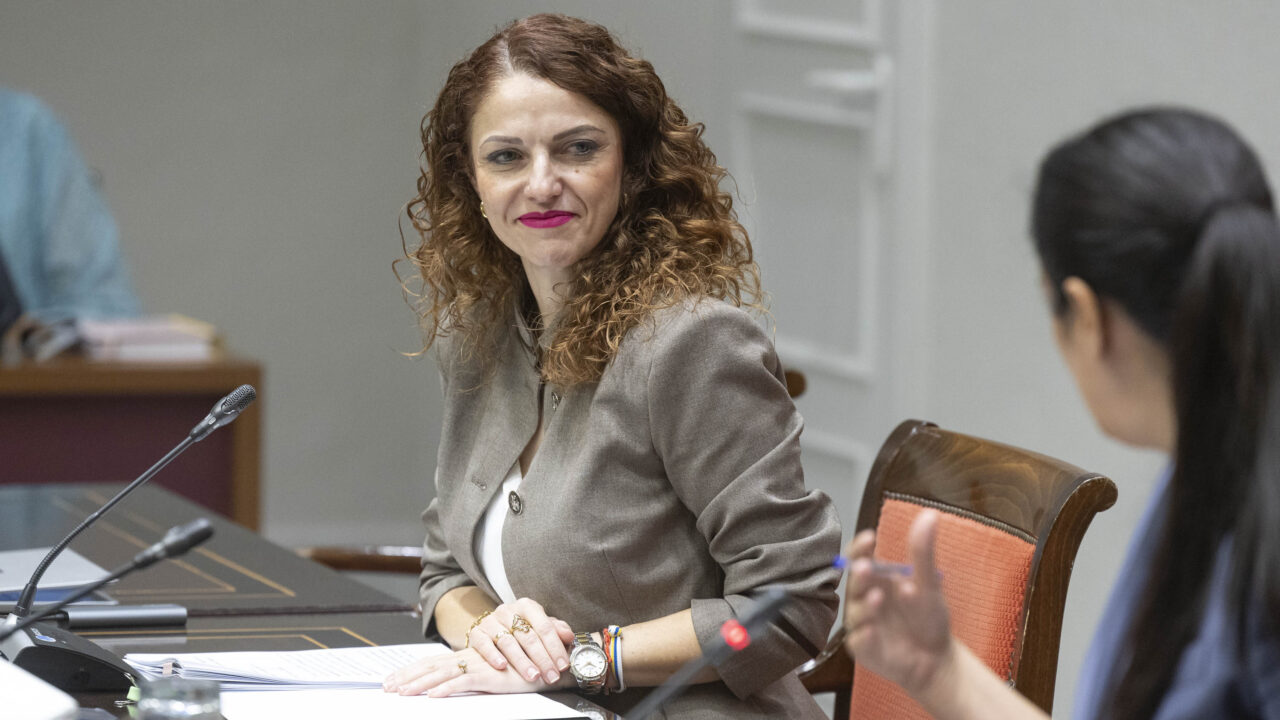
The Director-General of Social Services for the Canary Islands Government, Elisabet Santana, stated on Monday that some 82,000 people are no longer at risk of poverty or social exclusion during this parliamentary term, adding that without social benefits, poverty would affect half the population, according to figures she cited from a report by EAPN Canarias.
The AROPE indicator for the Canary Islands puts the poverty rate at 31.2 per cent, whereas at the start of the parliamentary term it stood at 38 per cent, whilst the ISTAC Survey on Income and Living Conditions, which measures monetary indicators, puts the proportion of the population below the at-risk-of-poverty threshold at 17.6 per cent, compared with 20.5 per cent in 2022, as Santana pointed out to the Canary Islands Parliament committee examining child poverty.
The Director-General has pointed out that this positive trend in poverty indicators cannot be attributed to a single measure, but rather to a combination of «employment, pensions, benefits and public transfers», which help to sustain household incomes.
Canary Islands: Social security benefits protect almost one in two people
In fact, the European Anti-Poverty Network in the Canary Islands (EAPN Canarias) believes that without pensions, benefits and other social transfers, «poverty would affect almost half the population of the Canary Islands», the director-general emphasised.
«Benefits matter; financial protection is not a mere afterthought, but a safeguard that prevents thousands of people from falling into far more serious situations,» she said.
Child poverty calls for coordinated social policy at several levels
Elisabet Santana has emphasised that child poverty cannot be viewed in isolation from families‘ economic and social circumstances and must be tackled in a coordinated manner through social services, employment, education, housing, health, taxation, and equality and care policies.
She explained that her overall approach is based on income support, the Canary Islands Citizens‘ Income, pathways to inclusion, strengthening municipal social services, coordination with local councils, ensuring the stability of organisations in this sector, developing the social partnership framework, and improving information systems.
In this regard, she explained that the National Association of Social Services Directors and Managers has confirmed that the Canary Islands have undergone «a structural transformation of the social services system», to the point where they have become «the fourth autonomous community with the best-developed social services».
«Per capita spending on social services rose from 619 euros in 2023 to 724 euros in 2024,» said Santana, whilst the national average stands at 575.06 euros per capita.
Furthermore, the minimum integration benefits in the Canary Islands amount to 17 per cent of the average income, compared with 14 per cent in the rest of Spain.
Canary Islands Basic Income reaches 11,341 families
The Director-General explained that the Canary Islands Citizenship Income, which is received by 11,341 families and is expected to reach an annual budget of 126 million euros, is the region’s main tool for guaranteeing income and social inclusion, and she pointed out that the approval process takes around four months once the application has been properly documented.
Since this benefit came into force, 37,841 cases have been processed and 30,747 have been resolved, of which 19,445 are new applications for recognition.
34.46 per cent were rejected because they did not meet the eligibility criteria, including, amongst other reasons, because they had sufficient other income or benefits.
In addition to this protection, there is the regional supplement of 400 euros for recipients of non-contributory pensions, and together these two benefits «form part of the social safety net that underpins household income and reduces the impact of economic vulnerability on children», she said.
Santana emphasised, however, that it is not only benefits but also pathways to inclusion that are essential; this has contributed to the fact that, as of March 2026, 577 cases had been closed due to recipients taking up employment and exceeding the income thresholds, whilst a further 550 recipients had requested a review of their benefits after also taking up employment.
«Our approach is not one of charity, but of inclusion; we provide protection whilst there is a need and support people as they regain their independence,» she said.
Local authorities to receive 97 million euros for social services
As regards the calls for the Canary Islands Government to implement the housing and education allowances provided for in the Canary Islands Citizenship Income Act, the Director-General stated that «they are still undergoing technical and budgetary analysis».
With regard to strengthening municipal social services, she highlighted that the plan agreed with local councils amounts to 97 million euros this year, enabling support to be provided to some 450,000 people and allowing local authorities to recruit around 2,500 professionals.
Elisabet Santana noted that progress has been made, and work is continuing, on reducing red tape and ensuring the financial stability of social organisations.
«In 2026, we allocated 23 million euros to third-sector organisations, enabling them to fund 236 social inclusion projects and support 261,000 people,» she said.
«Our aim is for every family to receive protection when they need it, support to overcome their difficulties, and real opportunities so that their sons and daughters never inherit poverty,» concluded the director-general.

Comments (0)
No comments on this article yet.