

For decades, astrophysics explained the life cycles of massive stars as if they were solitary entities that were born, evolved and came to the end of their lives following a relatively predictable path.
However, observations have shown that many of them were never alone, and the old ‚instruction manual‘ has begun to become obsolete for this type of object, which has a mass at least eight times that of the Sun and can reach around 200 solar masses.
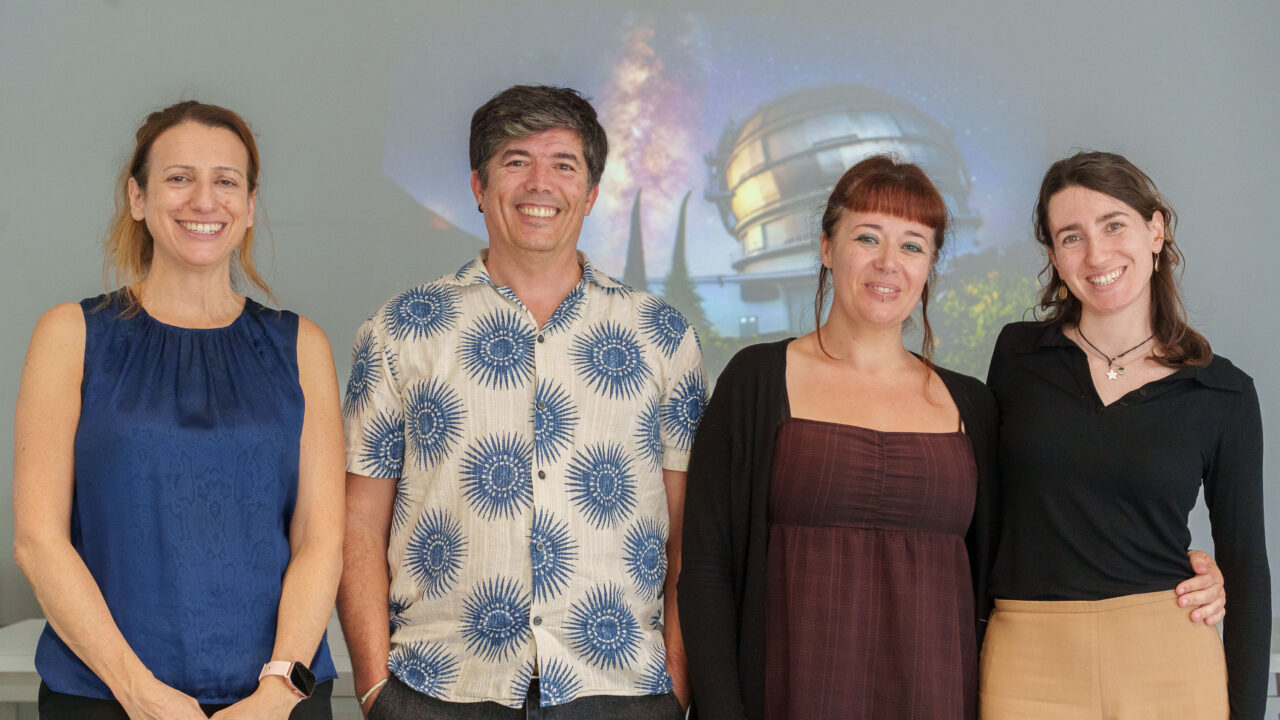
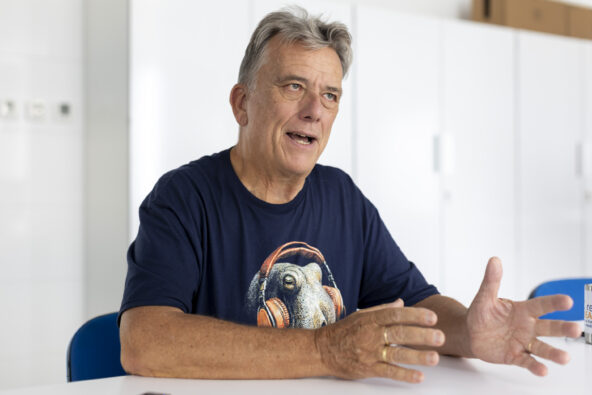
«It’s as if we had a textbook and realised that everything we knew was wrong,» summarises Sergio Simón-Díaz, a researcher at the Canary Islands Institute of Astrophysics (IAC) and coordinator of the 37th edition of the ‚Canary Islands Winter School of Astrophysics‘, which this year is dedicated to these objects, during a meeting with the EFE news agency and the newspaper El Día.
Massive stars: Binary star systems challenge old models
It is not that everything was wrong, he clarifies, but rather that the model based primarily on the evolution of isolated stars proves insufficient when it is found that perhaps between 50 per cent and 70 per cent of the most massive stars may be born in binary systems.
He adds that in such binary systems, the stars exchange matter; one can completely alter the evolution of the other, and a supernova explosion can fling its companion at high speed across the galaxy.
Some stars that appear to be solitary today, therefore, still bear the traces of a relationship with another star that can no longer be observed.
«We are rebuilding that book,» says Simón-Díaz, for whom the discipline is, precisely for that reason, going through «a very exciting period», after years in which it might have seemed that stellar physics was a field that had largely been resolved.
He thus points out that the importance of getting this right extends beyond the stars themselves, for although the most massive stars represent only a small fraction of the stellar population, they have an enormous capacity to transform their surroundings, produce chemical elements and alter the evolution of galaxies.
Sara Rodríguez Berlanas, a Viera y Clavijo researcher at the University of La Laguna (ULL), points out that elements such as oxygen were formed inside these stars.
«We are here because massive stars were here before us,» she explains.
Their research focuses specifically on identifying and characterising the most massive stars in the Milky Way and the regions where they are born, combining spectroscopy, photometry and the astrometry provided by the Gaia satellite.
WEAVE records around a thousand stellar spectra simultaneously
The field is also undergoing a shift in scale: whilst for decades it was common practice to study stars individually, instruments such as WEAVE, installed on the William Herschel Telescope on La Palma, are capable of obtaining around a thousand spectra simultaneously, whilst its counterpart, 4MOST, in Chile, can obtain around 2,400.
This will enable us to move from individual cases to entire populations and statistically determine which are the typical patterns of progression and which are the exceptions.
Among the latter are the so-called runaway stars, the subject of study by Mar Carretero-Castrillo, a researcher at the European Southern Observatory (ESO), who, whilst working on her PhD, identified some 175 massive stars of this type alongside other researchers, thanks to Gaia and ground-based observations.
She points out that these are stars which were born in one place and, following some event, such as a dynamic interaction or a supernova explosion, were ejected at high speed.
Tracking them, she explains, enables us to link stellar evolution to supernovae, black holes, clusters and the interaction of stars with the interstellar medium.
Space telescopes penetrate the dust surrounding massive stars
But there are still areas that remain virtually hidden, warns the researcher, who points out that massive stars tend to form in regions with large amounts of dust that block some of their light; consequently, one of the next steps is to observe at wavelengths capable of penetrating the dust.
This includes the new infrared instrumentation for the Gran Telescopio Canarias, future space projects and telescopes such as the Extremely Large Telescope (ELT), on whose instrumentation Miriam García, a researcher at the Centre for Astrobiology (CSIC-INTA), is working.
García focuses on how these stars enable us to tackle some of the most pressing questions in astrophysics, from the reionisation of the Universe to the explosions detected by the new telescopes designed to observe transient phenomena; questions for which the sensitivity of current telescopes is beginning to fall short.
The James Webb Space Telescope also enables us to study stars and galaxies that are increasingly distant and, as a result, to gain insights into earlier periods in the history of the Universe.
The Canary Islands, the scientists add, play a key role in this new landscape, both through WEAVE and through ground-based support for space missions.
«Gaia without the Canary Islands would not be the same», they summarise, stressing the need to complement satellite observations with ground-based spectroscopy.
Astrophysics: The flood of data calls for automation and artificial intelligence
The new problem will be precisely this abundance, as millions of data points that can no longer be analysed individually will require automated methods, large teams and a new generation of researchers.
Artificial intelligence, too, although Simón-Díaz warns that it must remain a tool and not replace scientific inquiry, as this is intrinsic to the human race, not to AI.
Simón-Díaz believes that artificial intelligence will be an indispensable tool given such a vast volume of information, but warns that it must be used without compromising our critical thinking or the fundamental principle that science must be understood, verified and reproducible.
The paradox, he concludes, is that astrophysics now has more data and better instruments than ever before, but these have also served to highlight just how much remains to be understood.
With new observations, large-scale surveys and a generation of researchers who will have to learn how to use them, the challenge will be to determine which parts of the old ‚instruction manual‘ are still valid and which will need to be rewritten.

Comments (0)
No comments on this article yet.