

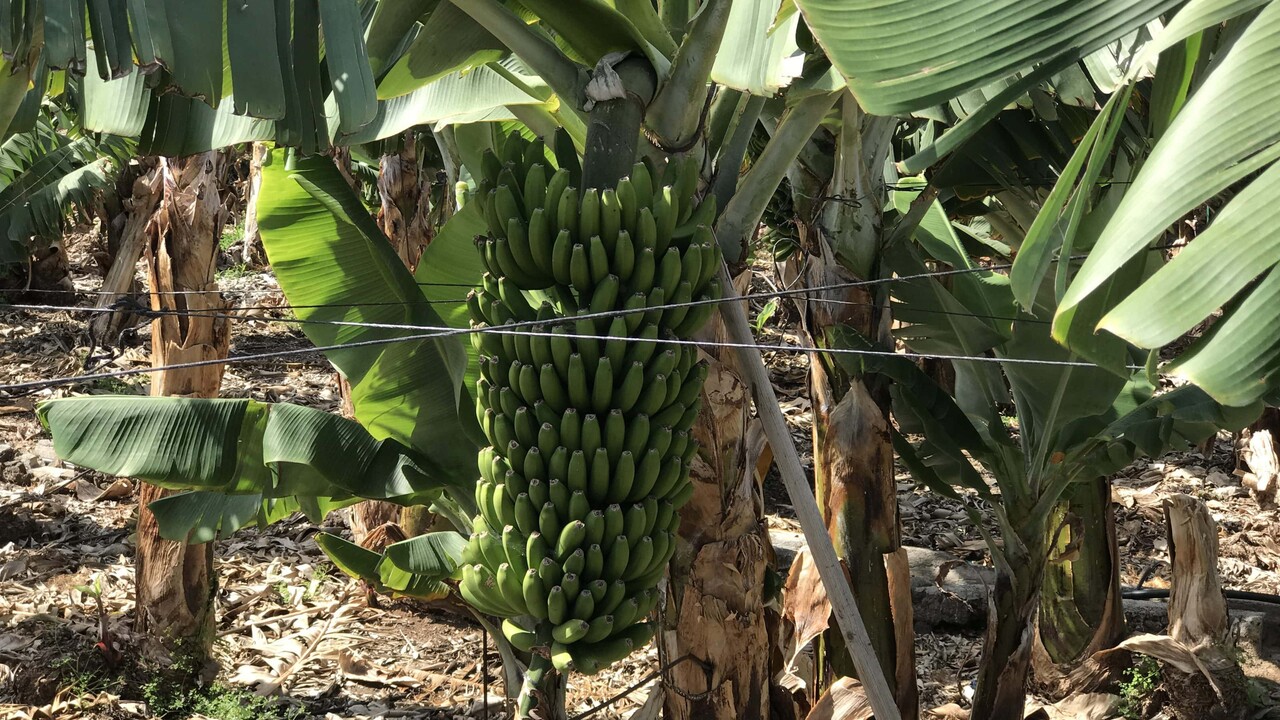
In June, 24,013 tonnes of bananas were exported from the Canary Islands. This was almost twice as much as a year earlier. The increase compared with the same month last year was 94.3 per cent. This is shown by data from the Canary Islands Statistical Office (ISTAC). Almost the entire volume was destined for a single market.
23,909 tonnes of bananas were shipped to mainland Spain. Only 104 tonnes left Spain. This means that less than one per cent of the Canary Islands‘ June production ended up abroad. Bananas therefore remain primarily a product for the domestic market. Otherwise, the archipelago’s export statistics were dominated by industrial and petroleum products.
La Gomera reported the largest percentage increase. Exports there rose by a good 120 per cent. This means that the small Canary Island clearly outperforms its neighbours. In absolute terms, however, another island saw a remarkable increase.
Canary Islands: Banana exports rise significantly
La Palma exported 11,350 tonnes of bananas in June. This represented an increase of more than 112 per cent compared with the same month last year. Tenerife contributed a further 7,970 tonnes, which was just under double the figure for the same period last year. Whilst the relative increase is therefore slightly lower than on La Gomera, in absolute terms La Palma claims the largest increase for itself.
Overall, the Canary Islands saw their exports rise by 372 million euros in June. This represented an increase of 15.3 per cent compared with the same month last year. The banana sector therefore grew six times faster than the rest of the foreign trade sector.
On La Palma, banana cultivation was long affected by the aftermath of the volcanic eruption. Ash and lava had buried the island’s plantations, and cultivation lay dormant for a long time. Last year, however, a gradual recovery in banana cultivation on La Palma began to take shape. The fruits of this recovery are once again clearly measurable and marketable this year.






«Canary Islands double banana exports as one island reports a rise»
No comments on this article yet.