

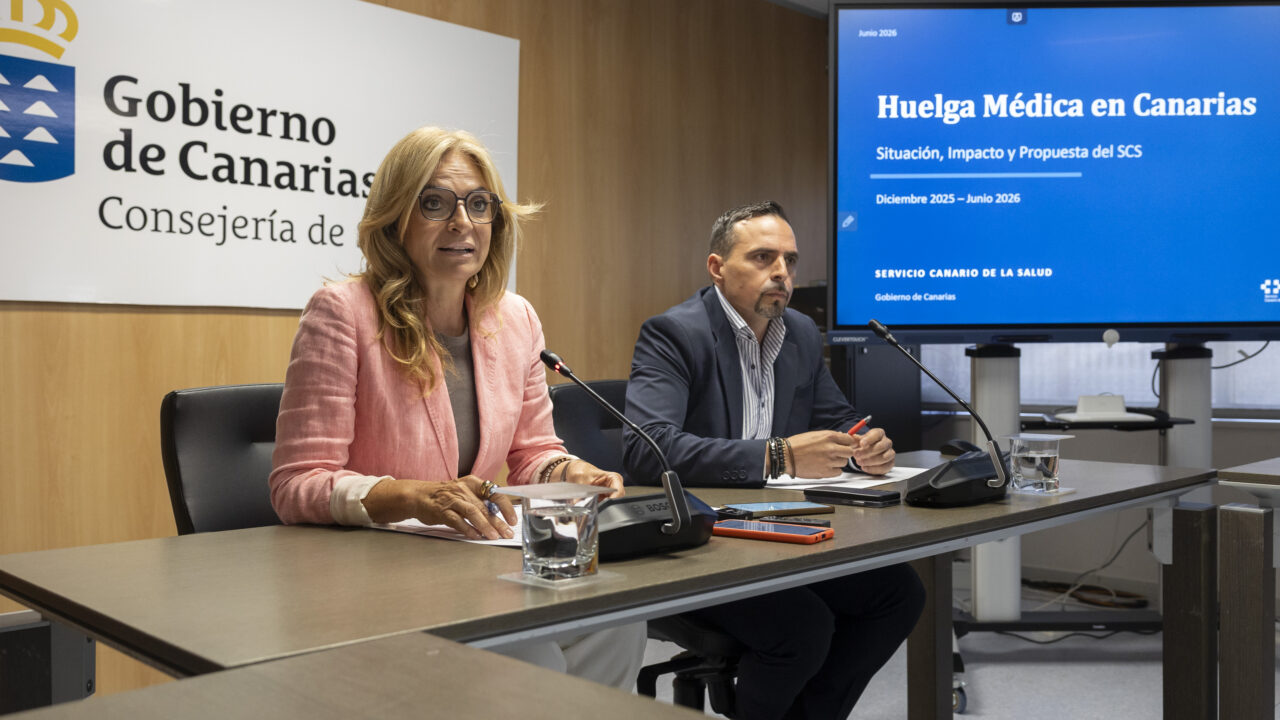
The Canary Islands Health Service (SCS) «cannot understand» why the main trade unions representing doctors in the public health service are set to begin an indefinite strike on the islands tomorrow, when «negotiations are still ongoing, covering 14 measures aimed at improving both working conditions and pay» for this professional group.
In a statement issued just a few hours before the labour protest was due to begin, the SCS points out that the call for this strike «was issued on the very same day» that the trade union representatives refused to attend a meeting with public health service managers.
It reveals that, on Wednesday, «a further meeting was held with both trade unions, but no agreement has yet been reached».
Doctors' strike in the Canary Islands: SCS hopes for a settlement
«The SCS management is confident that the trade union representatives will give these proposals careful consideration and explore the position that would allow the strike to be called off whilst negotiations continue,» it says.
The SCS explains that it has offered doctors the option of «reducing their working hours when on call, so that they do not have to work 24 hours continuously»; specifically, it proposes that these shifts be 17 hours long when they fall between Monday and Friday.
«This means they would continue to be paid the same; in other words, the reduction of 7 hours‘ on-call duty would not result in a pay cut, and their day off would be maintained. The reduction in on-call hours is proposed as an optional measure, provided that services can be organised in this way,» it explains.
SCS offers higher pay for on-call duties
It also proposes to the doctors‘ unions a pay rise for on-call hours, so that the pay for a 17-hour on-call shift will increase by 41 per cent.
For weekend and public holiday shifts, the SCS proposes replacing the 24-hour shift with two 12-hour shifts on an optional basis, for services where this is feasible.
«Similarly, the hourly rate for on-call duty is being increased by 15.4 per cent, reaching 1,026 euros for each on-call shift at weekends and on public holidays,» it adds.
It goes on to explain that «the hourly rate for night-time on-call duty increases by 70 per cent, whilst the hourly rate for on-call duty at weekends and on public holidays rises by 15 per cent.»
The SCS’s offer to doctors also includes a 30 per cent increase in the fixed allowance for hospital and out-of-hospital A&E staff, and an increase in the professional career allowance of between 19 per cent and 58 per cent, depending on the level recognised for each professional.
For junior doctors, the hourly pay for night-time on-call duty would rise by 70 per cent on weekdays and by 17 per cent at weekends and on public holidays, depending on the year of their residency.
Retaining skilled staff will bring in 800 doctors over three years
The SCS is also committed to maintaining the talent retention programme, which has enabled it to recruit 800 doctors over the past three years, «a programme few autonomous communities can boast», whilst increasing the allocation of days off for training to ten.
It also provides for improved rest periods following on-call shifts, with an extra day off.



Comments (0)
No comments on this article yet.