

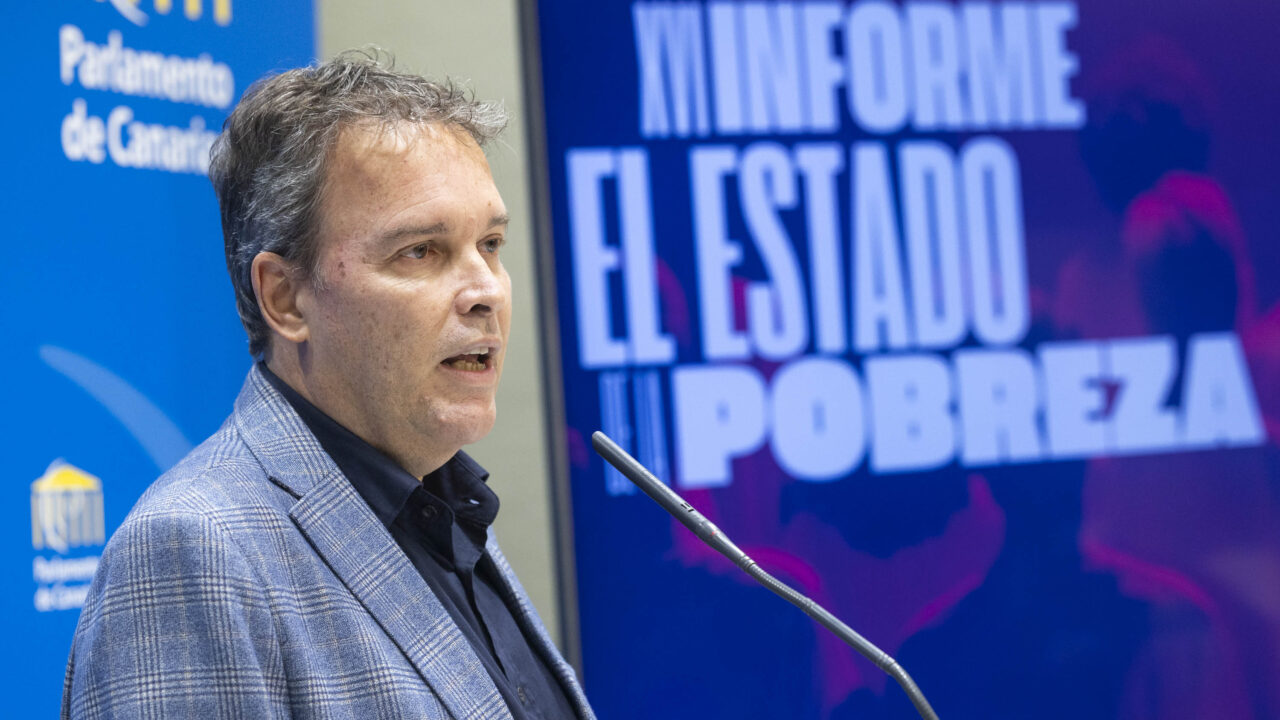
Poverty and the risk of social exclusion in the Canary Islands have levelled off at 31.2 per cent of the population, the same figure as in 2025, following four consecutive years of improvement.
«We might think that the measures have hit rock bottom, that efforts to reduce poverty have gone as far as they can,» remarked Fernando Rodríguez, vice-president of the European Network for Combating Poverty and Social Exclusion in the Canary Islands, at the presentation of the sixteenth AROPE report.
Rodríguez has expressed surprise at this «stagnation» in the figures, as they had been improving over the last four years at a rate of 2 percentage points per financial year, although he pointed out that this has been the trend across almost the whole country in 2026. The national average stands at 25.7 per cent.
Canary Islands: 182,000 people live on less than 679 euros
One of the figures that causes the European Network the greatest concern is the 182,000 Canarians who are getting by on less than 679 euros a month.
Its vice-president in the Canary Islands has stated that «enormous efforts» will be required to meet the challenge of halving poverty by 2030.
As Fernando Rodríguez has analysed, poverty disproportionately affects people who face one or more structural inequalities: single-parent households, predominantly mothers with dependent children (20.1 per cent), non-EU nationals (21.7 per cent), people with a disability (37 per cent) and the unemployed (63 per cent).
Another section of the population giving cause for concern is children and young people: 91,000 children and adolescents are living in poverty, representing 41.1 per cent of the total, according to data from the living conditions survey; however, if ISTAC’s statistics are taken into account, this figure could rise to 141,000, «a figure that is alarming and worrying», said Rodríguez.
Furthermore, the AROPE report shows that 671,000 Canarians aged over 65 are living in poverty or social exclusion, a figure that has risen since 2025.
AROPE report: Isolated improvements do not reduce the exclusion rate
The authors of the report emphasise that, despite some isolated improvements, these do not translate into a reduction in the AROPE rate: people are not escaping social exclusion, which points to more complex and persistent processes of impoverishment, influenced by job insecurity, access to housing and the vulnerability of households.
Consequently, the proportion of Canarians who cannot afford to go on holiday for at least one week a year has fallen by six percentage points (39.3 per cent), as has the proportion of those who cannot afford to eat meat, chicken or fish (or the equivalent) at least every two days (9 per cent).
However, the proportion of people who are unable to keep their homes at a suitable temperature during the winter months has risen to 18.8 per cent, and the percentage of those unable to meet unexpected expenses has also increased, standing at 49.8 per cent following a rise of 0.9 percentage points.
These figures show that the forms of deprivation most closely linked to housing and basic economic security continue to worsen, exacerbating situations of structural vulnerability.
Housing costs and precarious work increase the risk of poverty
In the Canary Islands, the average amount spent on rent exceeds 45 per cent of household income, although in areas where the housing market is under pressure this figure rises to 80-90 per cent, whereas, according to the concept of affordable housing, it should not exceed 30 per cent.
Furthermore, 293,000 Canarians are in arrears with their rent or mortgage payments, according to the vice-president of the European Network for Combating Poverty and Social Exclusion in the Canary Islands.
Another of the most worrying factors for AROPE analysts is the worsening of low employment intensity, which has risen by 1.2 percentage points compared with the previous year and affects 11.6 per cent of the Canary Islands‘ working-age population, compared with the national average of 8 per cent.
This, in turn, is an indicator of the fragility of the Canary Islands‘ labour market, which is characterised by temporary employment, involuntary part-time work and income instability. Around 400,000 people in the Canary Islands are living in in-work poverty.
At the same time, the wage gap has continued to widen on the islands, with the average income of the richest 10 per cent of the population now 8.6 times that of the poorest, who are «becoming increasingly poorer».
Tackling poverty: Rodríguez calls for a pact and better coordination
Fernando Rodríguez has called for partisanship and ideologies to be set aside «so that we can all come together in the belief that the fight against poverty and inequality must be everyone’s responsibility, through a major pact to tackle poverty, which is now long overdue in the Canary Islands».
He has also called for «genuine coordination between public authorities at all levels», as discussions about who has the powers «are tiresome» and «in the end, nothing gets done».
He has acknowledged that the impact of transfers from public authorities (basic income, the Canary Islands income scheme, non-contributory pensions, care allowances and support for people with disabilities, and grants) «is proving positive» but at the same time «clearly insufficient».
Without that ’social safety net‘, the poverty rate in the Canary Islands would rise to 52.2 per cent of the population.
The Canary Islands are the fifth-highest spending autonomous community on social policies: 3,456 euros per inhabitant; yet, even so, «why do we remain the fourth autonomous community with the highest poverty rate? What is happening with public transfers?», he asked.
And the answer is that these «are not reaching everyone» who is entitled to them, due to a lack of information, the digital divide or the inadequate roll-out of the minimum living income, just like the Canary Islands income support scheme or the social electricity tariff.
«It is not a question of increasing resources, but of ensuring they reach everyone who needs them,» he advised.
Other proposals set out in the 16th AROPE Report include ensuring access to and the maintenance of decent and affordable housing; in this regard, it has emphasised that, as well as increasing the stock of public housing, priority should be given to bringing vacant properties onto the market; and moving towards stable employment, with adequate wages and decent working conditions.






Comments (0)
No comments on this article yet.