

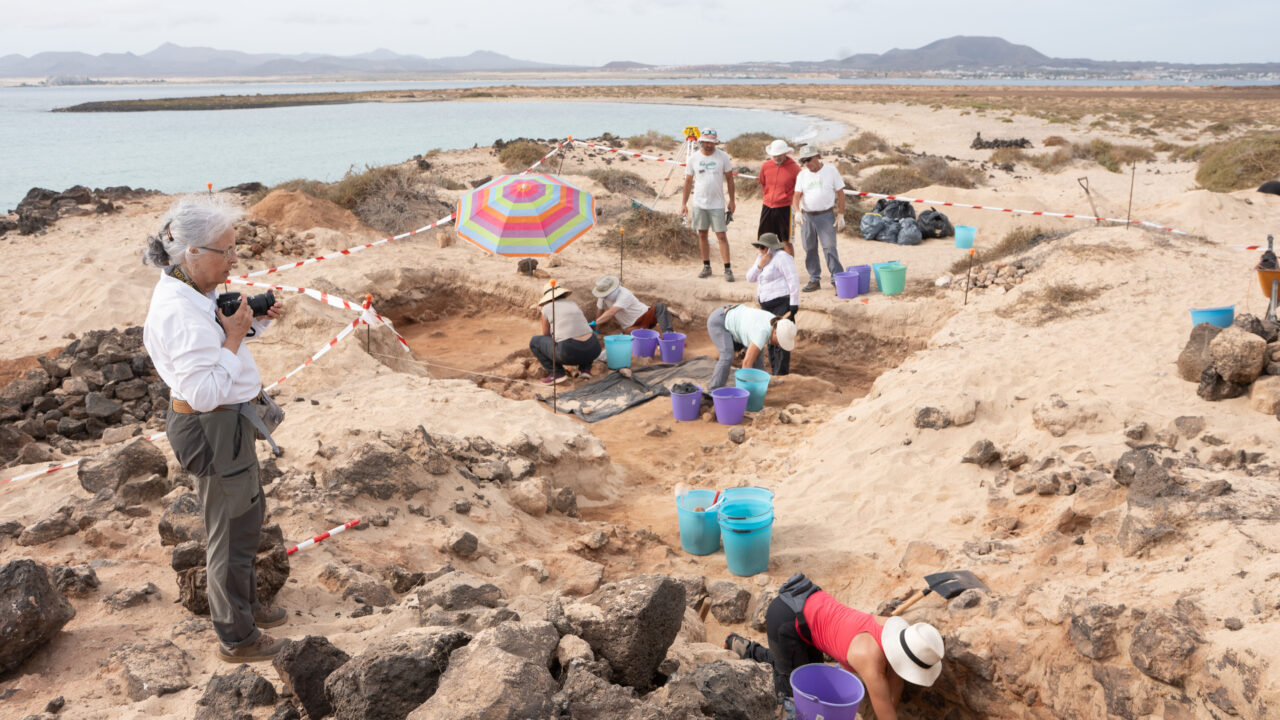
The eleventh season of archaeological excavations on the islet of Lobos has concluded with the identification of a lime kiln at the site on La Calera beach, situated on a small promontory opposite the area where a Roman purple dye workshop is located.
This work began on 25 October and has revealed a workspace linked, in part, to lime, which the project’s researchers believe was used in the dye-making process, according to a statement issued on Thursday by the Fuerteventura Island Council.
The campaign is being run under an agreement between the island councils of Fuerteventura, through the Archaeological Museum of Fuerteventura, and Tenerife, through the Autonomous Body for Museums and Centres and the Archaeological Museum of Tenerife.
Lobos Island: Research project investigates newly discovered lime kiln
It is a multi-year project co-directed by Isidoro Hernández Sánchez, Mercedes del Arco Aguilar and María del Carmen del Arco Aguilar. The team comprises archaeologists and specialists from the University of La Laguna, the Surveying Department of the Fuerteventura Island Council and the Tenerife Museum of Natural Sciences.
For Rayco León, the Minister for Historical Heritage, this work confirms that «Lobos continues to show that the islet holds much more than meets the eye».
«This campaign adds a new area of research linked to lime and raises new questions that will only be answered through further work and excavations», a process, he said, that will enable us to «gradually piece together the history of the islet».
Excavations have uncovered a furnace and other structures
The archaeologists first examined what was thought to be a lime kiln, which had collapsed due to the failure of its structure and was covered in sand.
The excavation covered an area of around 98 square metres, both outside and inside the structure, which could not be fully excavated. This has made it possible to identify a kiln without external buttresses, with a central section of circular plan that takes on a horseshoe shape due to the narrowing of its internal walls in the area of the mouth.
The press release states that no archaeological artefacts were found in the landslide deposit or its surroundings that would allow it to be linked to a specific culture.
In a second area, measuring 20 square metres and situated to the south-west of the kiln, near its mouth, a combustion structure was identified, with an extensive layer of lime encrustation beneath it. These may correspond to one of the kiln’s emptying or cleaning operations. No associated materials were found there either.
The third area, measuring 16 square metres and situated to the north-west, revealed a deposit of stones beneath the sand, some of which were aligned in a pattern that could correspond to the base of a wall. This deposit includes a well-defined circular space and a triangular stone element, with a hole in one of its faces, positioned vertically and securely set in place.
The interpretation remains open: the research team points out that the excavated area will need to be expanded in order to gain an overall view of these structures.
Lime for producing purple
The team is certain that the Romans settled in Lobos required lime, both for the mortar used in the walls of the Lobos 1 purple dye workshop and for the dye-making process, although in this case it may have been replaced or supplemented by other alkaline substances.
The kiln displays certain distinctive, perhaps archaic, architectural features which could help to date its construction. Researchers do not, however, rule out the possibility that it dates from a more recent historical period.
Dating of the lime crust and the combustion residues will make it possible to pinpoint one of the periods during which it was used, probably the last one.
Even without these results, the team considers the heritage value of the kiln and the surrounding areas to be ‚unquestionable‘. Remains of human activity, such as malacological material, pottery and what appear to be wall structures, have also been identified in nearby areas; these will be studied in future excavations.






Comments (0)
No comments on this article yet.