

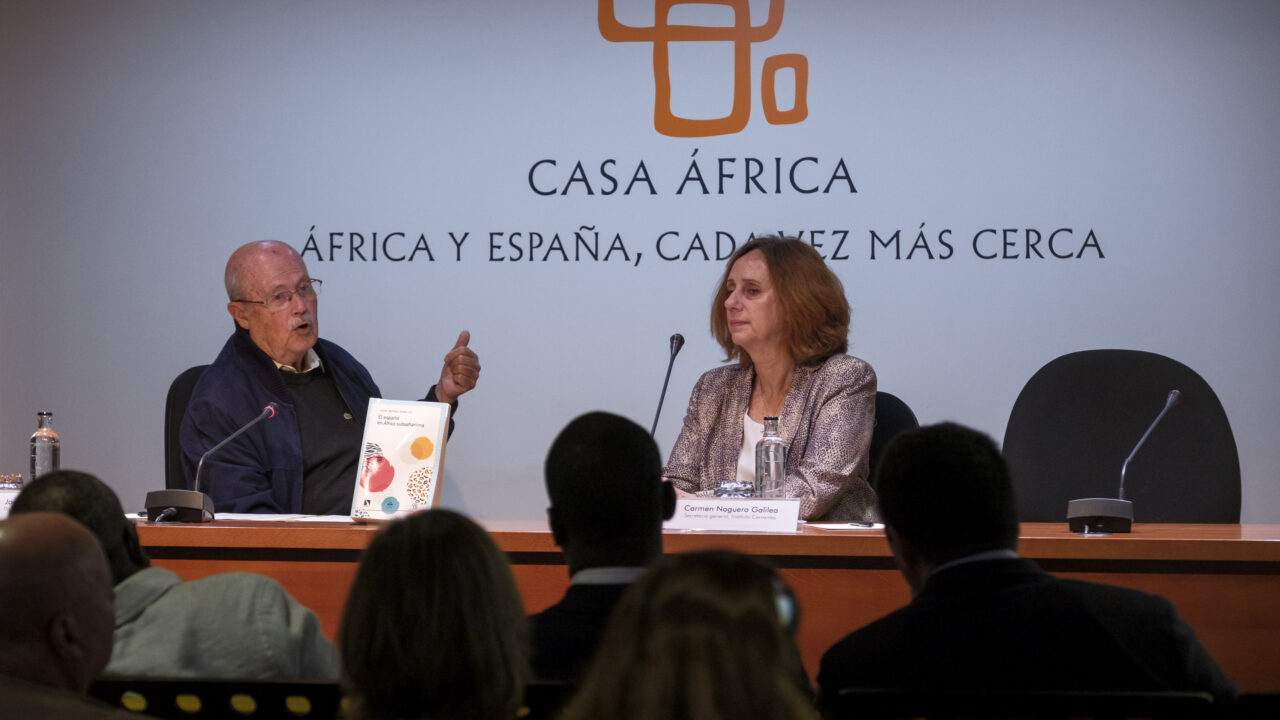
There are 3,556,675 students learning Spanish in sub-Saharan Africa, almost three times as many as twelve years ago, according to data contained in a report presented on Thursday by the Instituto Cervantes at Casa África.
The publication ‚Spanish in Sub-Saharan Africa‘, edited by the researcher Javier Serrano Avilés, analyses the status of Spanish in 24 countries in the region and identifies Sub-Saharan Africa as one of the main areas of international growth for the language.
As Serrano Avilés explained to the press, the previous edition of the study, published in 2014, had documented around 1.3 million students of Spanish, whilst the new research puts the figure at over 3.5 million, equivalent to 14.75 per cent of Spanish learners worldwide (24 million).
Sub-Saharan Africa: Education systems are driving the learning of Spanish
The book’s editor has pointed out that sub-Saharan Africa now ranks ahead of the Maghreb, Brazil and Asia in terms of the number of students learning Spanish, and has highlighted the educational structures that enable the language to be studied as the primary factor behind this progress.
The Secretary-General of the Instituto Cervantes, Carmen Noguero, has emphasised that this increase is due both to the international spread of Spanish and to the development of African education systems themselves, as is the case in Côte d’Ivoire, Cameroon, Gabon and Senegal.
«To a large extent, these have been spontaneous initiatives undertaken by the education systems of Sub-Saharan Africa themselves,» said the head of the Cervantes Institute, highlighting the «impressive» work of professional associations in the region, which serves not only to «further the promotion of Spanish» but «above all to foster greater dialogue between our cultures».
Noguero recalled the opening in 2021 of the new Cervantes Institute centre in Dakar, which runs teacher training programmes, provides support for researchers and fosters collaborative networks with African and Spanish institutions.
Senegal: Spanish opens up career and academic opportunities
The Secretary-General also argued that Spanish is perceived in many African countries as a language that is «professionally interesting» and «culturally appealing», a perception bolstered by the links between Africa, Europe and the Americas.
In this regard, the book’s co-author and lecturer at Gaston Berger University in Saint-Louis (Senegal), Gustave Diousse, has attributed the popularity of Spanish amongst students in that country to both cultural and emotional factors, as well as to the academic and professional opportunities linked to Spain.
He recalled that in 2005 he was awarded a scholarship to study at the University of La Laguna (Tenerife), where he obtained his PhD, and that he subsequently returned to Senegal as a Spanish teacher.
He also emphasised the importance of initiatives such as the Canary Islands-Africa Scholarship Programme (PBCÁ) run by the Government of the Canary Islands, the Erasmus programme and partnerships with Spanish universities, including those in Las Palmas de Gran Canaria, La Laguna and Madrid, which, in his view, encourage many young people to choose Spanish as their language of study.
Another reason why students from Senegal are drawn to studying Spanish is the influence of relatives who have emigrated, and he stated that, according to a survey they carried out, «some young people say they chose Spanish because they have a relative living in Spain who speaks it well, and that is what attracted them».
Studies on the Central African Republic and Sudan
The book, which was launched in June at the Cervantes Institute’s headquarters in Madrid, is intended to serve as a reference for understanding the spread of Spanish in a region considered strategic for the language’s international future.
For the first time, the study includes specific chapters on the Central African Republic and Sudan, countries at war where the presence of Spanish had scarcely been documented until now.
In the Central African Republic, Spanish is still part of the secondary school curriculum, although its use is in decline, and there is a university department of Hispanic studies at the University of Bangui, explained Serrano Avilés.
In Sudan, the research examines the teaching of Spanish promoted by Comboni College in Khartoum, run by the Comboni Missionaries, which was interrupted by the war just as the official examinations for the Diploma in Spanish as a Foreign Language were beginning.
African literature written in Spanish
The volume also examines cultural and social aspects linked to the Spanish language, such as Afro-Hispanic literature, journalism, science, decoloniality and linguistic rights.
Landry-Wilfrid Miampika, a lecturer in Modern Philology at the University of Alcalá, who has contributed a chapter on Hispano-African literature to the book, has emphasised the need to raise the profile of African literature written in Spanish and has cited authors such as Donato Ndongo-Bidyogo, María Nsué and Lucía Mbomío Rubio.
«Our key challenge remains the recognition and legitimacy of these literatures,» he said, highlighting the importance of linking them with the literatures of Afro-descendant communities in the Caribbean and Latin America written in Spanish.
«They are very important in the Hispanic world, but the most important thing would really be to recognise the place they occupy and to ensure that many people who are not of African origin have access to these bodies of literature,» he concluded.









Comments (0)
No comments on this article yet.