

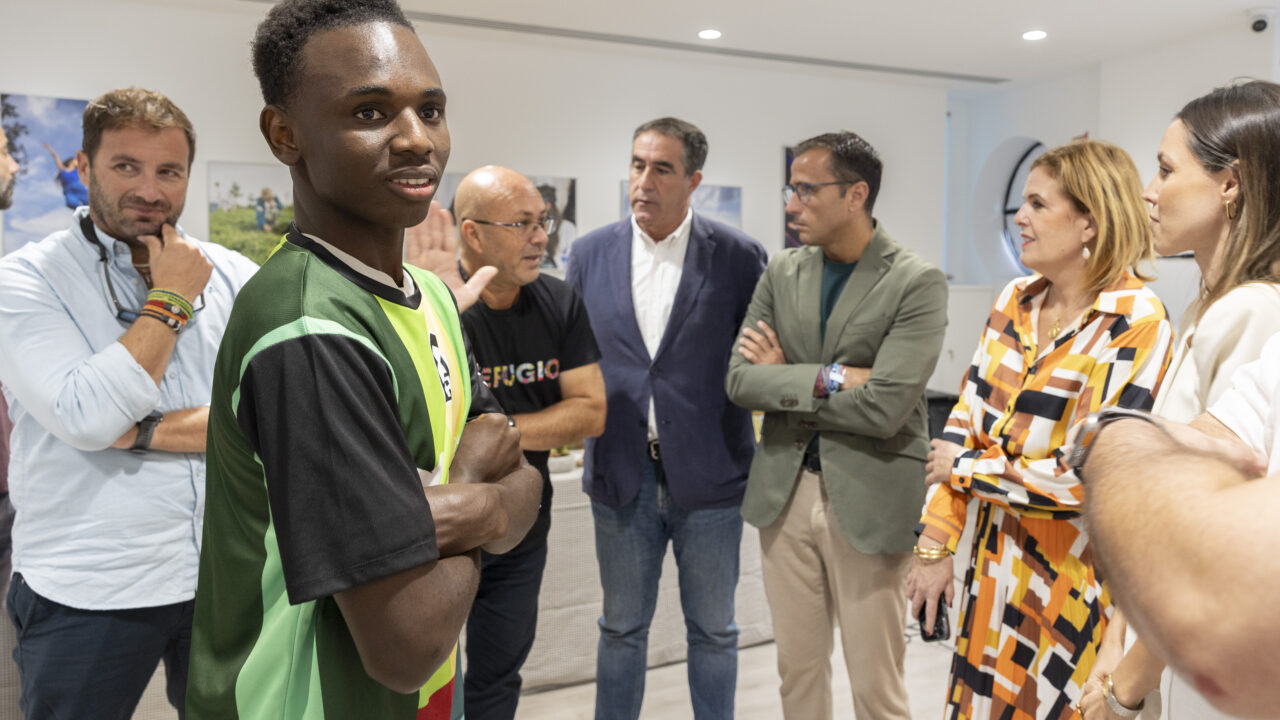
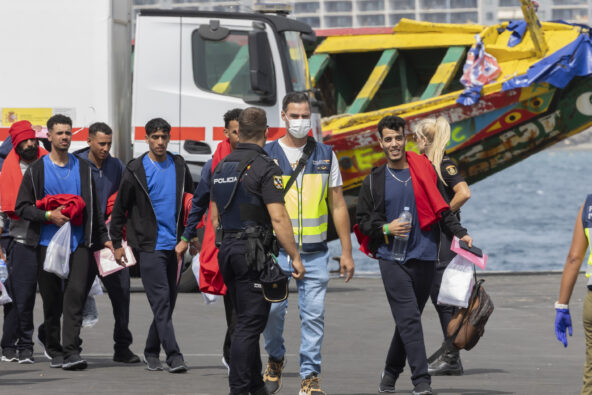
Young African migrants and refugees, most of whom arrived in the Canary Islands on small boats, have found a new family in the amateur football team CEAR Gran Canaria CF, set up by this NGO and the Disa Foundation to promote their social inclusion and their physical and emotional wellbeing.
The club is part of the ‚Goles por Refugio‘ initiative, which already supports around a hundred young people across the country and through which the Spanish Commission for Refugee Aid aims to offer them, via this sport, an inclusive space designed for those who often face administrative and social barriers to joining conventional federated leagues.
The team captain, Mamadou Sissoko, a 19-year-old Malian who arrived on the islands as a minor and was placed in the care of the Canary Islands Government, told journalists on Thursday in fluent Spanish that, in the three years he has been in Spain, football has enabled him to «keep going» with the help of his «teammates, manager and chairman», who are «wonderful».
Gran Canaria: Sissoko finds a new lease of life in football
«At the end of the day, we’re a family both on and off the pitch,» said the young man, who admits that football «has really helped him to keep going and to learn a lot».
Sissoko, who has worked as a carpenter, a trade he learnt on the island, explained that being captain of his team requires «being responsible and having a lot of patience, being a great person and having the character to learn from the experience».
UD Las Palmas: Bassinga advises young CEAR captain
He also pointed out that his club has benefited in Gran Canaria from the help and advice of Aboubacar Bassinga, a young Ivorian midfielder at UD Las Palmas, who arrived on the island in February 2020 on a small boat as an unaccompanied minor.
«My coach has told me to speak to him so that he can come and watch us in training or at a match,» said Mamadou.
The captain of CEAR Gran Canaria CF emphasised that «being a footballer isn’t easy; you have to be patient, train every day, fight hard and keep going», whilst also expressing his appreciation for the opportunity to learn from Bassinga, as he is a professional footballer.
Sissoko arrived in Gran Canaria on 10 December 2023. He is currently looking for a new job «to get on with his life and support his family» without giving up playing football, because this sport, which he used to play with his friends in Mali before coming to Gran Canaria, «improves his character, his patience and his experience».
The young man left his parents and siblings behind in Mali. Although he has a cousin in Madrid, he has admitted that he prefers to continue living in Gran Canaria.
Amayra Peñate, project coordinator at the Disa Foundation, explained that the organisation is collaborating with CEAR on this initiative «because it believes in sport as a transformative tool, capable of forging bonds, pooling resources and transforming lives».
Most of them are from Mali and Senegal
Sara Hernández, CEAR’s marketing and corporate partnerships specialist, has explained that this men’s football club is made up of lads aged between 18 and 30, mostly from Mali and Senegal, although it also has players from Mauritania, Algeria and Guinea-Bissau «who are looking for a sporting opportunity that suits their particular circumstances at this stage in their lives, characterised by uncertainty regarding their residence and employment».
This enables them to «balance their administrative situation and their job search with the opportunity to take part in sport on a regular basis. «We set up this team as a way of promoting healthy leisure activities, helping them establish sporting routines they can stick to, and creating a safe space where they can feel part of something, have a support network and, in some way, have a safe space where they can continue to be young people during such a difficult time as the migration process,» she said.
CEAR Gran Canaria CF, founded in the 2024-2025 season, competes «at a recreational level»; it is not affiliated with any football association, nor is there any intention to do so «because of the bureaucratic red tape» its players have to deal with «and because of the particular circumstances of these lads, who may be transferred to the mainland at any time», explained Hernández.
Most of its members are young people who have left care, young people who, after leaving the youth care centre where they were looked after, «are facing a period of great uncertainty in their lives, and are looking for work, training and a better future».
Almost all the players are working
At present, «almost all of them are in work» after training as carpenters, bricklayers or in the hospitality sector; «many have undergone training, most speak Spanish fluently, which is a great advantage when it comes to communicating with the coach, and they have become very close friends with one another. Their backgrounds are very diverse, but they are united by that very particular migration experience,» she emphasised.
Hernández referred to a «very specific case of a boy whose mother is Mauritanian, who was born in Gran Canaria and returned» to that country, from where he was able to fly back to the island. The rest of his teammates reached Europe’s southernmost shore, that of the Canary Islands, aboard small boats and canoes.
To support the development of this initiative, the Sports Department of Las Palmas de Gran Canaria City Council is making the Antonio Rojas football pitches and the multi-purpose ground available to these young people, as explained by the department’s head, Carla Campoamor.
«This is a wonderful project; it’s an opportunity for these young people to do what they love most, which is football. Sport is a right that we, as institutions, must support,» said the councillor.


Comments (0)
No comments on this article yet.