

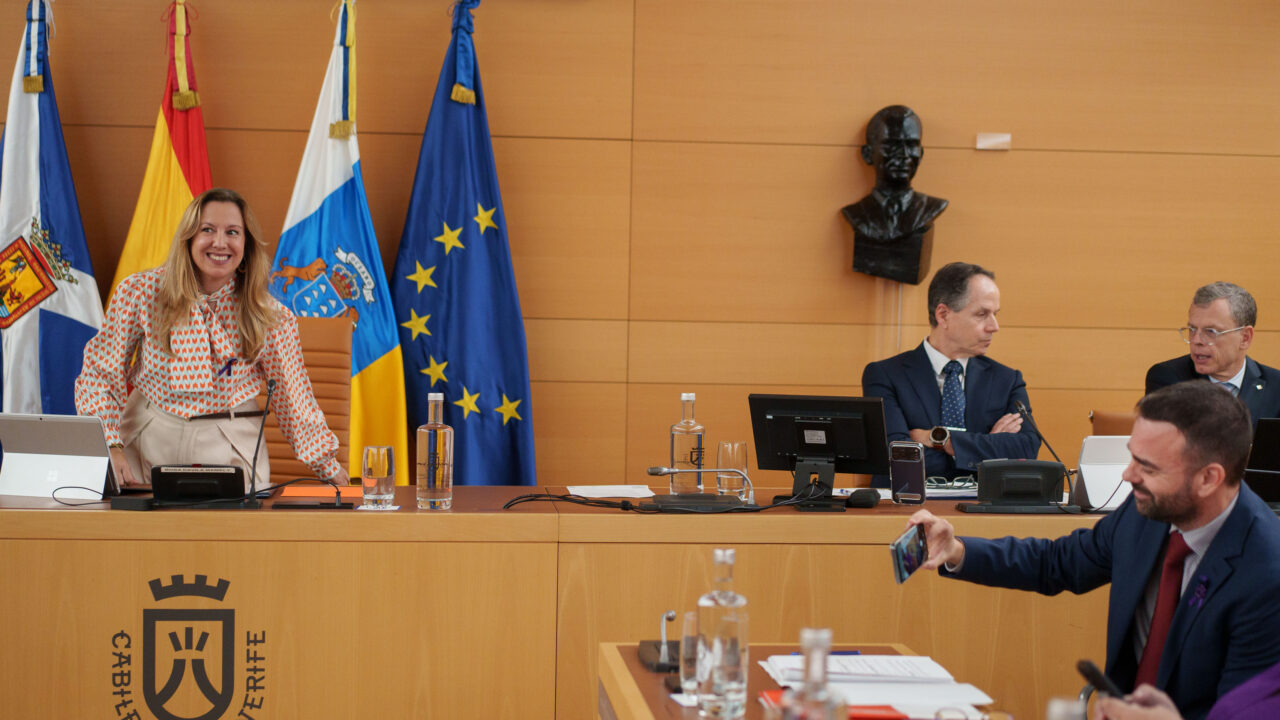
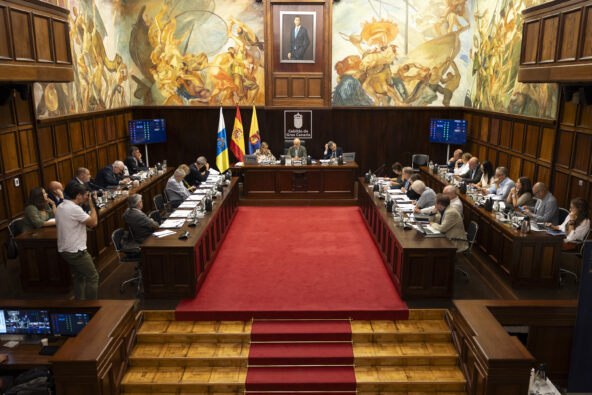
The plenary session of the Cabildo of Tenerife on Wednesday rejected the amendments to the whole budget tabled by the PSOE and Vox opposition against the island’s 2027 budget, which is backed by CC and PP and totals 1.377 billion euros, an increase of 7.7%.
A further 35 million euros from a loan operation currently being processed will be added to the budget, raising planned investment for the coming financial year from 274 million to 309 million euros, according to the island’s director of finance, Juan Carlos Pérez Frías.
Social action accounts for 30% of the island corporation’s budget, followed by mobility with 17% and the natural environment with 14.6%, while one of the areas seeing the biggest increase is housing, with an allocation of 36.2 million euros, 137.6% more than in 2026.
Tenerife: 2027 budget of 1.377 billion euros approved
The president of the Cabildo, Rosa Dávila, did not speak in the plenary session, although in statements released by the Cabildo she highlighted the expansionary nature of the budget and said that it devotes more than 736 million euros to social policies, community welfare and the protection of citizens, and more than 388 million to employment, training and personal development.
She also stressed the commitment to housing and the importance of keeping public transport free of charge in 2027.
Dávila listed the conservation of the territory among the island government’s priorities, with more than 93 million euros earmarked for policies on the environment, sustainability and the protection of natural areas.
The PSOE spokesman, Aarón Afonso, justified the amendment to the whole by pointing to the failure to honour the commitments made by CC and PP at the start of the term, despite having 300 million euros more than in 2023, and called for the accounts to be redirected towards housing, dependency care, mobility, environmental protection and the primary sector.
PSOE criticises promises made by governing parties CC and PP
Afonso complained that the term will end without «a single metre of road, a single metre of tram line or a single metre of railway» having been brought into service, and without any new public social and healthcare centre having been opened, despite the pledge to create 2,700 residential places.
He said that of the 15.5 million euros budgeted for housing in 2026, barely 900,000 euros had been spent as of 31 October.
The Socialist councillor also criticised the fact that the advertising and publicity budget lines of the President’s Office have risen from 900,000 euros in 2023 to more than four million in 2027, called for the abolition of the forestry cent, and reproached the island government for its lack of assertiveness towards the Canarian Executive on healthcare, dependency care and roads.
The Vox spokeswoman, Ana Salazar, questioned the island government’s priorities, its investment planning and the increase in political spending, warning that «economic volume on its own does not guarantee good management».
Vox questions the Island Council's priorities and spending
Salazar defended the 50 partial amendments tabled by Vox, worth 10.2 million euros, to make it easier to access housing, support motherhood and families, improve rural tracks and municipal water supply networks, and fund a fire station in the south-east of the island.
The Cabildo’s second vice-president, José Miguel Ruano, of CC, argued that during this term Tenerife has regained its economic leadership in the Canary Islands, highlighting the creation of more than 54,000 jobs, a fall in the unemployment rate to 8.17 % and the delivery of 1,000 million euros of spending over three years, against a backdrop of political stability and low borrowing by the corporation.
Cabildo deputy president Ruano defends economic record and transport policy
Ruano acknowledged that mobility problems persist and blamed the failure to deliver some of the announced measures on a lack of cooperation from the Dirección General de Tráfico, although he defended the strategy pursued by the island government.
He also pointed to the measures taken to guarantee Tenerife’s water security over the coming decade and spoke in favour of limiting indiscriminate access to natural areas, while noting the need to manage the island’s growth.
For the PP, the Cabildo’s first vice-president, Lope Afonso, named housing, the economy and people as the three priorities of the budget, with 450 million earmarked for social policy, housing, employment, education and youth, almost 12 % more than in 2026.
Afonso stressed that the Cabildo now has, for the first time, its own policy of directly promoting subsidised housing, with some 1,300 homes «mobilised» in less than three years and eight new agreements planned for 2027.
He noted that the Instituto de Atención Social y Sociosanitaria will have close to 400 million euros, of which almost 15 million will go towards creating new residential places for people with a high level of dependency.
Comments (0)
No comments on this article yet.